Gritt Unveils AI-Powered Robotics for Solar Installation, Securing $26 Million Series A to Accelerate Global Energy Transition

In a significant stride towards addressing the critical labor challenges facing the burgeoning global solar energy sector, Gritt, a robotics startup spearheaded by Carnegie Mellon-trained roboticists Puneet Puri and Vishal Dugar, has officially emerged from stealth. The company announced a substantial $26 million Series A funding round, led by Obvious Ventures, with additional participation from Union Square Ventures and Active Impact Investment. This latest injection of capital brings Gritt’s total funding to $34 million, following an earlier seed round backed by First Round Capital, Climactic, Congruent Ventures, and VSC Ventures. Gritt’s mission is ambitious: to deploy intelligent systems that can dramatically accelerate infrastructure construction, beginning with the highly demanding and labor-intensive task of installing solar panels.
The Imperative of Solar Expansion and the Looming Labor Gap
The global push for renewable energy, particularly solar power, stands as one of humanity’s most urgent undertakings. Driven by climate change mitigation goals, the pursuit of energy independence, and the decreasing cost of solar technology, countries and corporations worldwide are engaged in an unprecedented race to deploy solar panels and associated battery storage solutions. According to the International Energy Agency (IEA), solar PV alone is expected to account for over half of the new renewable electricity capacity added globally by 2028, with annual additions reaching over 500 gigawatts (GW) by that time. In the United States, the Inflation Reduction Act (IRA) of 2022 has further supercharged this expansion, offering significant tax credits and incentives designed to bolster domestic manufacturing and deployment of clean energy technologies. The U.S. solar industry, as projected by the Solar Energy Industries Association (SEIA), is expected to quadruple its installed capacity by 2030, reaching over 700 GW.
However, this rapid build-out encounters a formidable obstacle: a persistent and widening labor market deficit. The installation of utility-scale solar farms, in particular, requires a vast workforce capable of performing repetitive, physically demanding, and often hazardous tasks in challenging outdoor environments. Workers must lift and position thousands of heavy, fragile glass panels, often weighing upwards of 60 to 100 pounds, at various heights and angles, day after day. The U.S. Bureau of Labor Statistics (BLS) consistently highlights shortages in skilled trades, and the construction industry, in general, struggles to attract and retain workers for these "dirty, dull, and dangerous" jobs. This labor scarcity not only inflates project costs but also extends timelines, threatening to slow down the very energy transition it seeks to facilitate.
Historically, industrial robots, while adept in controlled factory settings, have largely struggled to adapt to the unstructured, dynamic, and often unpredictable nature of outdoor construction sites. The variability in terrain, lighting, weather conditions, and the precise manipulation of large, unwieldy objects has posed significant programming and operational hurdles. This is precisely where Gritt’s innovative approach, leveraging the latest advancements in artificial intelligence, aims to rewrite the equation.
Gritt’s AI-Driven Solution: Generalizable Intelligence for Unstructured Environments
At its core, Gritt’s strategy revolves around building an "intelligent system" rather than bespoke hardware. Founders Puri and Dugar, both alumni of Carnegie Mellon University, a renowned hub for robotics research, recognized that the true bottleneck wasn’t necessarily the physical machinery, but the intelligence to operate it effectively in chaotic real-world scenarios. Their thesis posits that for construction to truly accelerate, an adaptable intelligence is required—one that can operate across varied and unpredictable outdoor settings with sufficient generalizability.
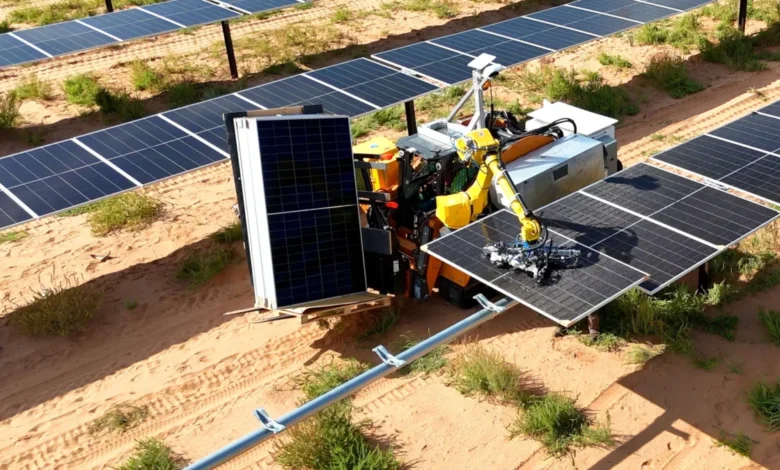
Instead of developing proprietary robots from scratch, a capital-intensive and time-consuming endeavor, Gritt strategically utilizes off-the-shelf industrial hardware. This includes readily available equipment such as rented skidders (heavy machinery commonly used in logging and construction) and robust robotic arms manufactured by established companies like Kawasaki. Gritt then integrates its sophisticated AI models onto these existing platforms, transforming standard machinery into highly capable, autonomous construction assistants. This approach offers several advantages: it significantly reduces development costs, accelerates deployment timelines, and leverages the reliability and maintenance infrastructure of existing industrial equipment.
The initial application of Gritt’s technology targets one of the most labor-intensive phases of solar farm construction: the unloading, transport, and precise positioning of large solar panels. Gritt’s systems are designed to meticulously pick up panels, carry them across challenging terrain to the designated metal frames, and then position them with sub-millimeter accuracy. This precision is crucial for ensuring proper alignment and fit, allowing human workers to then efficiently and safely fasten the panels into place. By automating the most strenuous and repetitive aspects of panel handling, Gritt aims to mitigate physical strain on workers, reduce injury risks, and dramatically enhance overall installation speed.
Chronology of Funding and Investor Confidence
Gritt’s journey to this significant Series A announcement reflects a growing investor appetite for solutions addressing climate change and industrial automation. The company’s initial seed round, backed by First Round Capital, Climactic, Congruent Ventures, and VSC Ventures, provided the foundational capital necessary to develop its core AI technology and demonstrate its viability. While the exact timeline for the seed round wasn’t specified, such early-stage investments typically occur when a startup is in its nascent phases, proving concept and building its initial team.
The recent $26 million Series A round marks a pivotal moment, signifying strong investor confidence in Gritt’s technology, market strategy, and potential for large-scale impact. Obvious Ventures, the lead investor, is known for its focus on companies that combine financial success with positive environmental and social impact, making Gritt a natural fit. Andrew Beebe, the partner at Obvious Ventures who led the round, lauded Gritt’s founders, stating, "These guys are in the second camp [of entrepreneurs who know how to scale dirty, dull, and dangerous jobs], and that’s a special kind of entrepreneur that has the technical chops, the AI, and the machine vision skills to make it work.” This statement underscores the critical combination of deep technical expertise and a pragmatic, scalable business model that attracted Obvious Ventures.
The participation of Union Square Ventures, a prominent venture capital firm known for investing in disruptive technology companies, and Active Impact Investment, further solidifies the perceived potential of Gritt. Their involvement signals a belief that Gritt’s AI-driven approach to construction automation is not merely an incremental improvement but a fundamental shift that could reshape how large-scale infrastructure projects are executed. The total funding of $34 million provides Gritt with substantial resources to scale its operations, expand its team, and accelerate the deployment of its systems across the globe.
Transformative Impact on Efficiency and Safety
The real-world performance of Gritt’s systems has been demonstrably impressive. Puri noted that a typical eight-person crew, without robotic assistance, can install approximately 800 solar panels in a day. However, when the same crew is augmented by Gritt’s intelligent systems, their daily installation capacity skyrockets to between 3,000 and 4,000 panels. This represents a staggering 300% to 400% increase in productivity, translating directly into faster project completion times and significant cost reductions for solar developers.
The benefits extend beyond mere speed. One Gritt customer, who chose to remain anonymous for competitive reasons, expressed enthusiastic support for the system. This customer highlighted two critical advantages: the ability to more easily undertake projects in remote locations where attracting human labor is particularly challenging, and a substantial reduction in workplace injuries. The repetitive lifting of 100-pound panels overhead is a major source of musculoskeletal injuries in construction. By offloading this strenuous task to robots, Gritt’s systems not only enhance worker safety but also allow human crews to focus on more skilled tasks that require human judgment and dexterity, such as final electrical connections and quality checks. This shift could help address the industry’s high injury rates, which according to OSHA, remain a significant concern in construction.
Gritt is already demonstrating significant market traction. The company has secured contracts to assist in the installation of an impressive 2.8 gigawatts of solar panels over the next 18 months. To put this in perspective, 2.8 GW is enough to power approximately 2 million average American homes annually. Furthermore, Gritt counts three of the top ten U.S. power construction companies among its clientele, indicating strong adoption by industry leaders. With two systems currently deployed in the field and continuously collecting data to refine their AI models, Gritt aims to scale rapidly, projecting the operation of 48 systems within the next six months. This aggressive deployment schedule underscores the urgent demand for such solutions and Gritt’s confidence in its scalable technology.
Competitive Landscape and Strategic Differentiation
The nascent field of robotic solar panel installation is attracting other innovators. Companies like Luminous Robotics, Cosmic, and China’s Trinabot are also developing robotic solutions for this sector. However, a key differentiator lies in their approach to hardware. Many competitors opt to build their own proprietary robots from the ground up, designing specialized machinery tailored for the task.
Gritt, by contrast, has strategically chosen to focus on its AI software and integration capabilities, utilizing readily available, off-the-shelf industrial hardware. This approach could offer several strategic advantages. By avoiding the complexities and capital expenditure associated with manufacturing bespoke robotics, Gritt can potentially achieve a leaner cost structure, iterate its software faster, and scale its deployments more rapidly. Its flexibility to integrate with various existing machines could also make its solutions more adaptable to different project requirements and site conditions. This software-centric model positions Gritt more as an "intelligence provider" for industrial machinery rather than a hardware manufacturer, a distinction that could prove crucial in a competitive and rapidly evolving market.
The Future Vision: Beyond Solar and Towards a "Physical AI" Layer
Gritt’s ambitions extend far beyond solar panel installation. The founders envision their intelligent systems tackling a much broader array of common, labor-intensive construction tasks. The immediate roadmap includes expanding the system’s capabilities to include fastening the solar panels themselves, drilling posts for foundations, and even constructing the metal racks upon which the panels sit. Longer term, Gritt aims to enter other physically demanding segments of general construction, citing tasks like tying rebar before concrete is poured—a highly repetitive and ergonomically challenging job—as a prime candidate for automation.
This expansive vision is fundamentally enabled by the advancements in AI models, as highlighted by Puri. He explains that while building a system for a single, specific solution might have been feasible five years ago, today’s AI allows for generalizability. The same underlying software pipeline can be reused and continuously improved across diverse tasks. As an illustrative example, Puri noted that training their system to stack cinder blocks took several weeks, but a similar demonstration involving rebar tying required only a single day, leveraging the same foundational software. This acceleration in task learning underscores the power of modern, generalizable AI, moving robotics from highly specialized, brittle solutions to adaptable, intelligent systems.
Furthermore, Gritt’s founders foresee their systems evolving into more than just physical laborers. Equipped with a suite of sensors and advanced intelligence, these robots can become a "layer of physical AI" that enhances overall site management and decision-making. Imagine a Gritt system autonomously identifying an open trench as a storm approaches and automatically alerting human workers to cover it before rain damages components or creates a safety hazard. Or envision the system autonomously flagging missing inventory, preventing costly delays. This capability transforms the robots from mere tools into intelligent observers and proactive managers, capable of providing real-time data and insights to optimize workflows, improve safety, and enhance overall project efficiency.
Challenges and the Road Ahead
While Gritt’s technology holds immense promise, its journey will not be without challenges. The broader adoption of robotics in construction faces inherent hurdles, including initial capital investment, potential resistance from a workforce concerned about job displacement, and the need for new training programs to facilitate human-robot collaboration. Regulatory frameworks and safety standards for autonomous robots operating in dynamic construction environments will also need to evolve. Scaling the production and deployment of 48 systems, and then many more, will require robust operational capabilities and a strong supply chain.
Despite these challenges, Gritt’s emergence signifies a pivotal moment in the convergence of AI, robotics, and the global energy transition. By intelligently automating the "dirty, dull, and dangerous" tasks of infrastructure construction, Gritt aims to not only accelerate the deployment of vital renewable energy projects but also to create safer, more efficient, and ultimately more sustainable worksites for the future. The company’s innovative blend of advanced AI with off-the-shelf hardware positions it as a key player in reimagining how the world builds its future infrastructure, laying the groundwork for a more automated and efficient construction industry driven by intelligent machines.