I watched a humanoid robot clean my apartment it felt like a taste of the future

The domestic robotics landscape is undergoing a significant transition as San Francisco-based startup Tau Robotics begins deploying humanoid units to perform residential cleaning tasks. While the technology currently relies heavily on remote human oversight, the venture represents a critical step in the ongoing effort to integrate general-purpose humanoid robots into private living spaces. This development marks a shift from specialized, single-task machines—such as automated vacuum cleaners—toward versatile, anthropomorphic platforms capable of navigating complex, unstructured human environments.
The Current State of Domestic Robotics
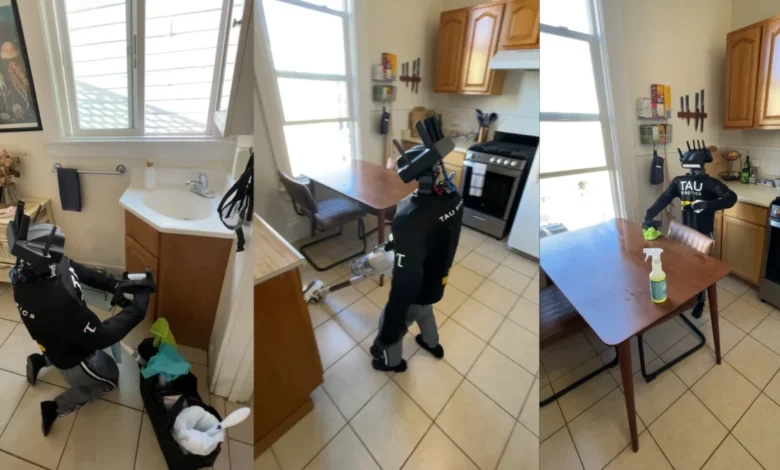
Tau Robotics is currently operating in a beta-testing phase, offering residential cleaning services that utilize four-and-a-half-foot-tall humanoid units. These robots are equipped with 3D-printed heads featuring specialized antennae for real-time communication with remote operators, and dual-claw grippers designed for high-dexterity tasks. To protect the integrity of residential surfaces, the robots are outfitted with protective apparel and non-abrasive, grippy footwear.
The operational model is fundamentally different from autonomous systems like self-driving cars. Instead of relying solely on onboard artificial intelligence for decision-making, the units function primarily as high-tech telepresence platforms. Human pilots, situated at the company’s headquarters, monitor live feeds from cameras mounted on the robot’s head and wrists. When the robot encounters a task—such as folding laundry or scrubbing a bathroom fixture—the pilot performs the action, and the robot’s kinematic sensors mirror the movement. This "kinematic guidance" serves a dual purpose: it ensures the task is completed and generates high-fidelity data used to train future autonomous machine-learning models.
Chronology of Development and Deployment
The emergence of Tau Robotics follows a broader industry trend of accelerating humanoid development, driven by advancements in generative AI and improved motor control. The company’s trajectory has been marked by iterative testing cycles:
- Initial Beta Launch: Tau Robotics opened its waitlist in mid-2024, targeting tech-forward demographics in the San Francisco Bay Area.
- Early Operational Hurdles: During initial deployments in late 2024, the robots faced significant challenges with physical navigation, specifically in residential structures containing stairs and uneven flooring.
- Optimization Phase: Late 2024 and early 2025 saw the company focusing on latency reduction. Because the robots are piloted remotely, signal delay between the headquarters and the home can cause erratic movement, which the company has described as a primary engineering bottleneck.
- Expansion of Capability: By early 2025, the company reported that its units could perform basic, non-guided tasks such as mopping and vacuuming, with more complex tasks like bathroom sanitization still requiring varying levels of human intervention.
Data Acquisition and Economic Models
The economic feasibility of Tau Robotics relies on a feedback loop. By charging a lower price point for these services—ranging from $60 for a weekly two-robot visit to $100 for a single, one-time cleaning—the company effectively subsidizes the cost of data collection. In the field of robotics, the "real-world data" gap is considered the greatest barrier to autonomy. Unlike simulations, real-world data accounts for the unpredictable nature of residential clutter, varying lighting conditions, and the idiosyncratic layouts of private homes.
Every movement performed by a remote pilot acts as a training data point. As the company continues to log hundreds of cleaning hours, it is building a massive repository of human-robot interaction data. This data is expected to eventually allow the company to move from a teleoperation model to a fully autonomous one, mirroring the path taken by autonomous vehicle companies over the last decade.
Operational Challenges and Technical Constraints
Despite the novelty of the technology, the reality of deploying humanoid robots in residential settings involves substantial technical obstacles. During recent field observations, units displayed sensitivity to environmental factors such as ambient temperature. Overheating in residential buildings, or even the overheating of the remote pilot’s equipment, can result in immediate service cessation.
Furthermore, navigation remains a significant hurdle. Stairs, which are common in many San Francisco residences, pose a profound risk to robot stability. The "drunken" gait observed in early units is an artifact of remote operation, where the lag between visual input and motor command creates a stuttering movement pattern. These hardware and software synchronization issues remain the primary focus of the company’s current engineering efforts.
The Socioeconomic Implications of Domestic Automation
The prospect of affordable, autonomous domestic labor brings with it significant socio-ethical questions. Proponents, including Tau Robotics co-founder Cornelia Weinzierl, argue that the cleaning industry is plagued by high turnover, physical injury risks, and a persistent labor shortage. By automating tasks that are physically taxing or considered undesirable, the company posits that it is filling a gap in the service market.
"Cleaning is not a job that a lot of people really actively want to be doing," Weinzierl noted in recent discussions regarding the company’s long-term vision. Beyond residential cleaning, the company is evaluating the utility of its robots for hazardous environments, such as mold remediation and home health care support, where human exposure to biological or chemical threats is a concern.
However, labor economists warn that the widespread adoption of humanoid service robots could displace a vulnerable segment of the workforce. While the technology is currently in its infancy, the potential for a "robotic replacement" in the service sector necessitates a broader public conversation regarding workforce retraining and the social safety net. If a single robot can replace a human cleaning professional, the economic impact on the domestic service industry—which employs millions globally—could be profound.
Future Outlook and Market Integration
Tau Robotics currently occupies a space similar to that of early-stage autonomous vehicle companies, where the spectacle of the technology currently outweighs its pure utility. For the average consumer, the robots are not yet a time-saving replacement for traditional cleaning services, but rather an experience in "living with the future."
The success of these robots will likely depend on the company’s ability to cross the "autonomy threshold." To move beyond the current teleoperation model, the robots must demonstrate the ability to perform complex, multi-step tasks without human intervention. This requires not only better AI but also more robust hardware that can withstand the rigors of home environments without constant maintenance or fear of mechanical failure.
As the industry matures, these robots may move from novelty items to standard household appliances. The integration of humanoid platforms into homes could redefine the relationship between humans and their living spaces, much as the internet and smartphones redefined communication. Whether or not these machines will eventually replace human cleaners, the precedent being set in San Francisco suggests that the era of the humanoid domestic assistant has officially arrived, even if it currently requires a human at the controls to manage the broom.
Ultimately, the trajectory of Tau Robotics and its competitors will be defined by their capacity to handle the "edge cases"—the spilled liquids, the fragile heirlooms, and the unique floor plans that define individual homes. For now, the sight of a robot cautiously navigating a set of stairs or carefully reattaching a toilet wand head is a testament to the rapid pace of modern robotics, signaling that the vision of a "Jetsons-style" future is moving from the realm of science fiction into the reality of everyday life.