AWS Announces Major Update to Amazon EventBridge With Enhanced Custom Event Buses for Multi-Account Architectures

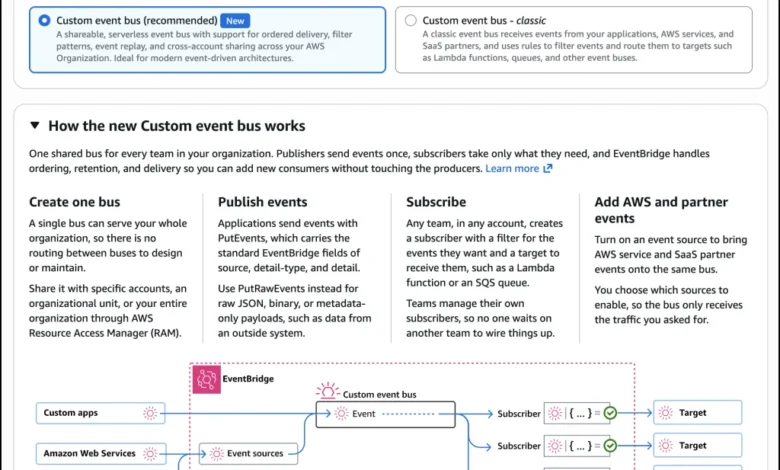
As modern software development shifts increasingly toward distributed, event-driven architectures, organizations frequently find themselves grappling with the operational complexity of scaling across numerous cloud accounts. To address these growing pains, Amazon Web Services (AWS) has officially announced a major architectural enhancement to Amazon EventBridge: the launch of the enhanced custom event bus. Purpose-built for enterprise-scale environments, this new offering aims to streamline event routing, eliminate cumbersome workarounds, and introduce robust ordering and security capabilities across complex, multi-account AWS ecosystems.
The Evolution of Event-Driven Architectures on AWS
When organizations first adopt event-driven design patterns utilizing Amazon EventBridge, the foundational implementation is typically straightforward. Teams generally begin with a single, custom event bus housed within a solitary AWS account, an approach that operates efficiently when a unified team oversees the entire architecture. However, as cloud adoption accelerates and organizational growth prompts decentralization, industry best practices dictate a transition toward a multi-account structure. Under this model, distinct product and engineering teams operate within their own isolated accounts to maintain autonomy, security, and blast-radius containment.
To bridge the communication gap between these disparate accounts, development teams historically had to deploy multiple event buses connected via intricate cross-account rules or complex bus-to-bus configurations. This infrastructural workaround inadvertently reintroduces the very operational friction that serverless paradigms are designed to eradicate. Platform engineering teams quickly lose comprehensive visibility into which downstream consumers are subscribing to specific event streams. Furthermore, compounding routing charges across multiple buses escalate operational expenditures rapidly, while technical teams requiring features like strict event ordering are forced to architect bespoke, highly complex mechanisms or migrate entirely to alternative messaging technologies.

Core Features of the Enhanced Custom Event Bus
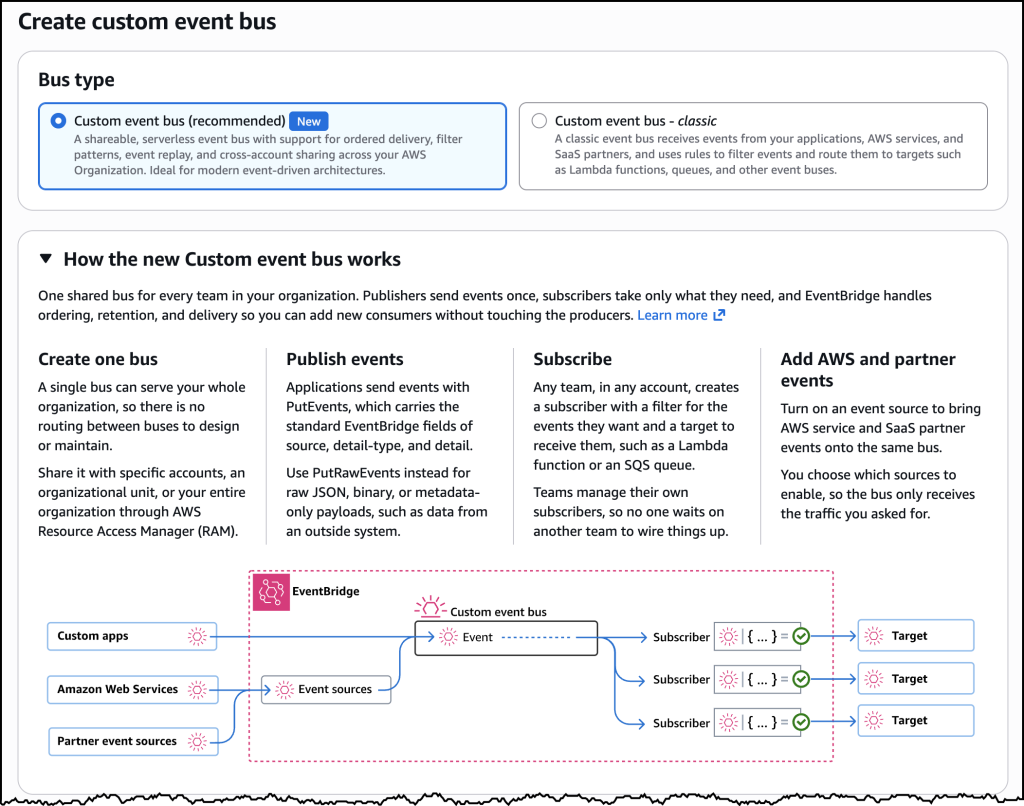
The newly introduced enhanced custom event bus fundamentally rethinks how enterprises handle event routing by allowing organizations to deploy a single, centralized event bus that spans all AWS accounts under a unified AWS Organization. By leveraging AWS Resource Access Manager (AWS RAM), platform administrators can configure resource sharing seamlessly without manually stitching together cross-account permissions or complex routing topologies.
One of the standout capabilities of this release is native event ordering. While standard event-driven architectures thrive on asynchronous patterns where chronological sequence is immaterial, specific verticals—such as supply chain logistics, financial transaction processing, and IoT telemetry—demand strict adherence to sequencing. For instance, in a real-time fleet management application, vehicle location updates must arrive in exact chronological order to prevent routing algorithms from acting upon stale telemetry.
The enhanced event bus solves this by allowing publishers to attach an EventGroupId payload attribute. EventBridge ensures that events sharing the same identifier are delivered sequentially to subscribers that have opted into ordered delivery, while simultaneously permitting other consumers on the same bus to process events fully asynchronously. To support this reliable, ordered flow, the architecture now accommodates synchronous invocation for targets such as AWS Lambda. This synchronous execution model confirms successful downstream processing before acknowledging the event, effectively removing the historical necessity of interposing an Amazon Simple Queue Service (SQS) queue between the event bus and the compute layer solely to guarantee reliability.
Streamlining Subscriptions and Event Evaluation

Managing large-scale event architectures often involves maintaining a sprawling web of disparate rules, targets, and retry policies. The enhanced custom event bus addresses this administrative overhead by introducing the unified Subscriber resource. This construct consolidates event filtering, target configuration, retry policies, and dead-letter queue destinations into a single, cohesive management unit. Additionally, variable start time parameters empower engineering teams to seamlessly onboard new consumers or replay historical event streams to recover from application anomalies or initialize new environments.
Data hygiene and transformation have also received significant upgrades. Publishers can now activate content-based deduplication, enabling EventBridge to autonomously identify and discard duplicate event retries originating from transient network timeouts or partial transmission failures. By analyzing structural payload hashes for matches arriving within a five-minute window, EventBridge delivers exactly-once delivery semantics for sources that lack native idempotency tokens.
For downstream consumers requiring specialized data structures, the integration of JSONata expressions allows subscribers to dynamically reshape incoming events before they hit target endpoints—extracting fields, renaming keys, or computing derived values on the fly. Moreover, native deserialization support for Apache Avro and Protocol Buffers enables EventBridge to parse complex binary or serialized formats into standard JSON, granting subscribers granular filtering capabilities without requiring custom parsing infrastructure.
A New Economic Model for Enterprise Scaling
Alongside architectural enhancements, AWS has overhauled the pricing structure for the enhanced custom event bus. Departing from traditional per-event cost models that penalize multi-bus configurations with compounding cross-account fees, the new architecture implements an ingress and egress throughput pricing paradigm. Publishers incur costs exclusively for events ingested into the bus, while subscribers pay for events successfully delivered to their designated endpoints. This decoupled economic structure aligns expenditures directly with actual resource consumption, providing improved cost allocation visibility for both publishing and subscribing business units.
Official Rollout and Regional Availability
Enterprise customers evaluating the new architecture can adopt the enhanced custom event bus at their own pace. Legacy workloads will continue to function uninterrupted on existing infrastructure, which will now be designated and visible within the management console as classic custom event buses. The new enhanced iteration is immediately accessible as the default recommendation for new deployments.
As of its launch date, the enhanced custom event bus is available across a broad spectrum of global AWS Regions, including US East (N. Virginia, Ohio), US West (Oregon), Europe (Ireland, Frankfurt, Stockholm, Spain), and Asia Pacific (Hong Kong, Malaysia, Mumbai, Singapore, Sydney, Thailand, Tokyo). Organizations can provision and manage their enhanced event buses through the AWS Management Console, the AWS Command Line Interface (AWS CLI), or via programmatic EventBridge APIs.
Broader Industry Implications and Analysis
The introduction of the enhanced custom event bus marks a notable maturation in serverless messaging infrastructure. By dismantling traditional boundaries between AWS accounts without sacrificing governance, AWS has directly targeted one of the most persistent operational hurdles in enterprise cloud architecture. Platform engineering teams are positioned to regain centralized oversight over organizational data flows, while application developers benefit from reduced latency, simplified resource management, and out-of-the-box sequencing capabilities. As enterprises continue to scale their serverless footprints, tools that reconcile developer autonomy with centralized operational control will likely become foundational standards for modern cloud-native enterprises.