How AI Skills Are Solving the Coding Agent Aesthetic Problem by Teaching Taste to Machines

The rapid evolution of generative artificial intelligence has fundamentally transformed software development, empowering developers and non-technical founders alike to build functional, production-ready codebases with simple natural language prompts. Yet, as the volume of AI-generated software expands exponentially, a distinct aesthetic uniformity has emerged across the digital landscape. Applications built entirely by autonomous coding agents frequently default to an uninspired visual template characterized by predictable purple gradients, overly aggressive rounded corners, ubiquitous use of the Inter typeface, and layouts that fulfill technical requirements while entirely lacking design conviction.
Industry observers note that this homogenization is not a malfunction of the underlying language models, but rather a fundamental limitation of their training. AI agents lack subjective taste, cultural context, and an inherent understanding of visual hierarchy. While they excel at processing algorithms and writing syntactically correct code, they traditionally approach interface design as a purely mathematical layout problem rather than an act of visual communication.
This architectural limitation has triggered a new frontier in software engineering: the rise of executable design skills. Rather than relying on rigid, hardcoded templates or ad-hoc prompt engineering, developers are increasingly turning to modular markdown-based instructions—known as AI skills—that can be seamlessly integrated into popular coding environments such as Claude Code, Cursor, Codex, and Windsurf. These installable files supply agents with rigorous design systems, color science formulas, and typographical rules, effectively bridging the gap between raw functionality and professional-grade aesthetic execution.
The Architectural Shift: From Static Design Systems to Executable Rules
Historically, product design has relied on static guidelines, comprehensive brand books, and design tokens housed in Figma or PDF documents that human developers interpret and implement manually. However, the integration of autonomous coding agents has upended this workflow. In the current development paradigm, design knowledge is rapidly transitioning from static reference materials meant for human consumption into dynamic, executable rules that machines can parse, interpret, and apply in real time.
This transition addresses a critical bottleneck in AI-assisted development. Without structural design constraints, prompting an agent to build a dashboard or a landing page often yields a generic interface that requires hours of manual CSS remediation by human designers. By equipping agents with specialized markdown configurations, developers can pre-program aesthetic parameters—ranging from Swiss grid systems to advanced color mathematics—ensuring that every line of generated code adheres to strict, professional design languages from inception.
Market adoption of these agent enhancements has accelerated alongside the maturation of developer toolchains. Platforms supporting modular skill integration have lowered the barrier to entry, allowing developers to upgrade their autonomous workflows via simple command-line interfaces or straightforward file placements within project repositories.
Comprehensive Catalog of Essential Design-Focused AI Skills
To combat the prevailing uniformity of agent-generated interfaces, the developer community has introduced a diverse ecosystem of specialized skills and directories. Each tool targets a specific dimension of UI/UX design, equipping coding agents with precise vocabularies and methodologies.
1. Advanced Color Science: The OKLCH Color Skill
Color management has historically been a weak point for generative AI, which often relies on guessing standard hexadecimal values or producing muddy combinations in the traditional HSL color space that fail to scale across light and dark modes.
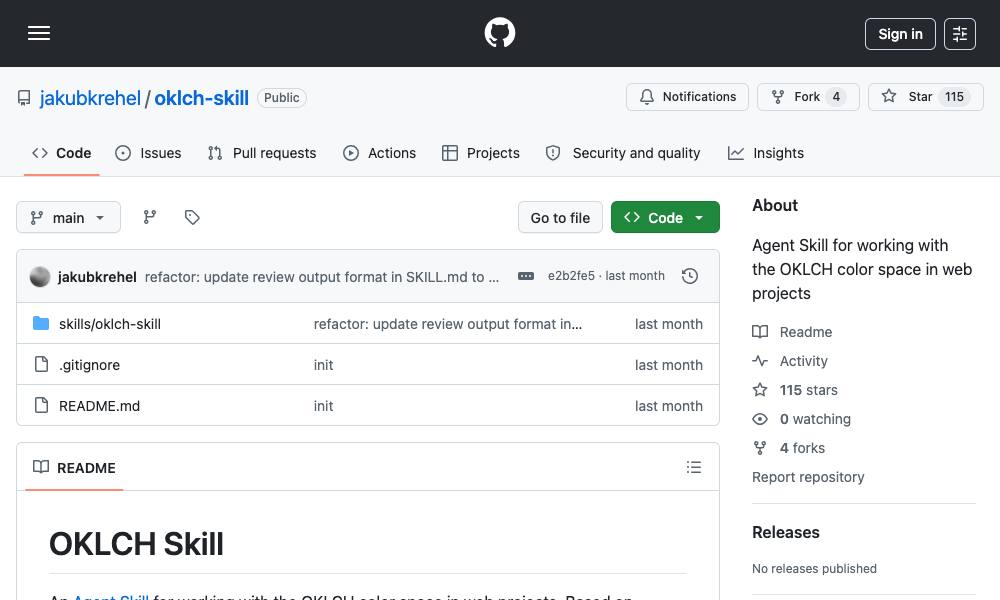
The OKLCH Color Skill, developed by Jakub Krehel, addresses this by training agents to utilize the OKLCH color space—a perceptually uniform alternative that eliminates hue drift and ensures predictable palette generation. Once installed via npx skills add jakubkrehel/oklch-skill, the agent gains the ability to convert between color formats, construct uniform scale steps from 50 to 950, derive accessible dark mode palettes through controlled lightness manipulation, and verify contrast ratios against both WCAG 2 and APCA standards. Furthermore, the skill enables agents to natively construct Tailwind CSS v4 themes utilizing proper OKLCH tokens, ensuring visual consistency across complex applications.
2. Rigorous Typography and Layout: Swiss Design System Skill
For projects prioritizing structural clarity and uncompromising visual hierarchy over decorative flourish, the Swiss Design System skill brings the principles of the Swiss International Style directly to AI agents.
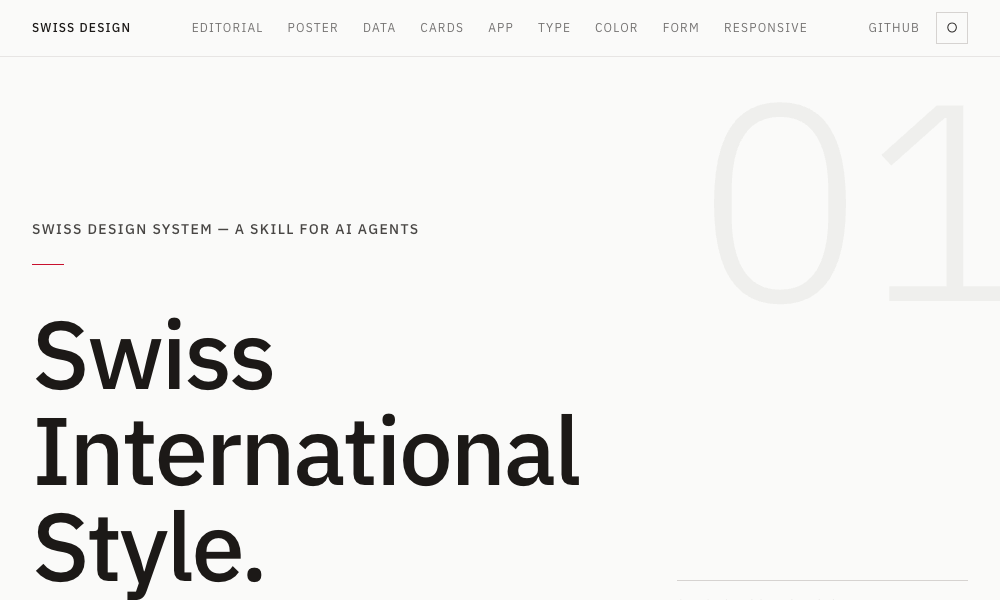
Inspired by the teachings of Josef Müller-Brockmann and the historical foundations of the Zurich and Basel schools of typography, this skill directs agents to deploy grotesque sans-serif typefaces—such as Helvetica, Univers, and Neue Haas Grotesk—alongside strict grid systems and generous whitespace. Distributed via npx skills add zeke/swiss-design-skill, the configuration translates these classic modernist principles into Tailwind CSS utility classes. When activated, the agent automatically enforces grid discipline, selects appropriate font pairings, and maintains intentional breathing room around layout elements, making it an ideal asset for editorial platforms and high-conversion landing pages.
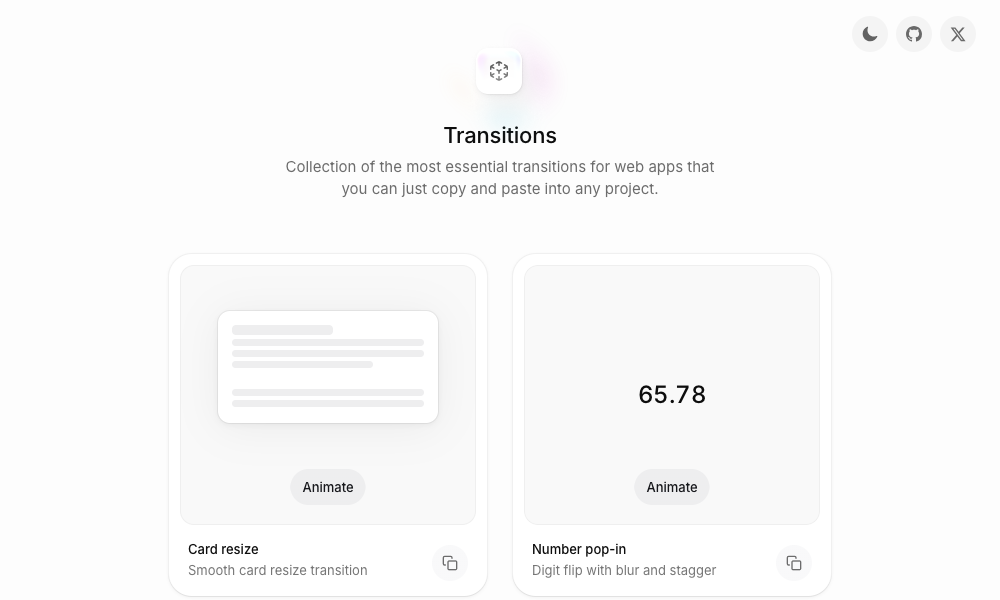
3. Fluid Micro-Interactions: Transitions.dev
Static interfaces often suffer from abrupt state changes, such as modals appearing instantaneously without spatial context or notification badges snapping into position. Transitions.dev offers a curated collection of nine essential UI transitions packaged as both a visual showcase and an installable agent skill.
Derived from production-ready code found in its open-source repository, the skill equips agents with pre-optimized CSS patterns for complex interactions, including card resizing, animated number pop-ins with digit-flip and blur effects, and diagonal slide animations for notification badges. By referencing these patterns, developers can eliminate jarring layout shifts and ensure that agent-generated components feature fluid, professional-grade motion design.
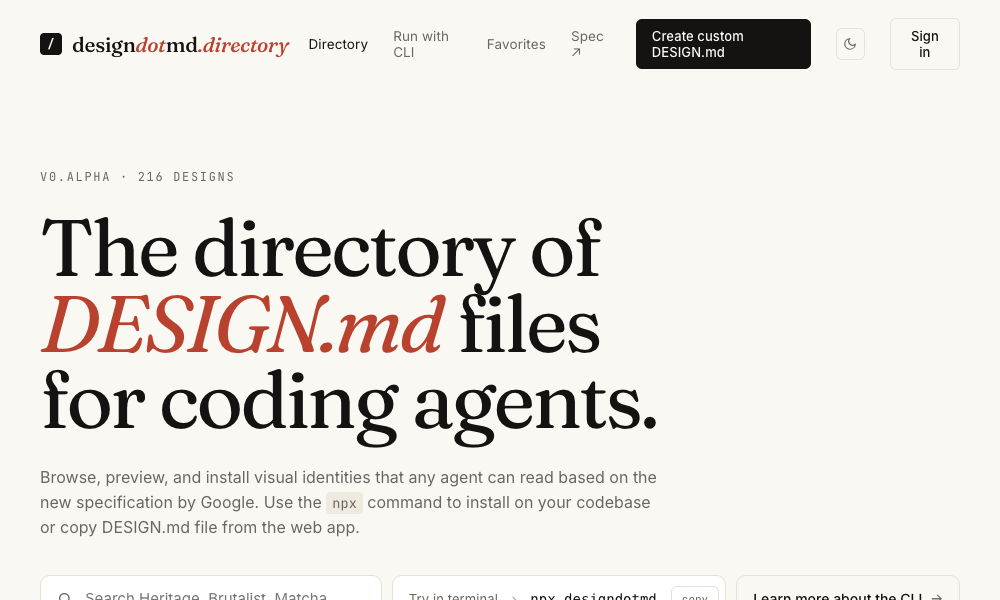
4. Zero-Friction Integration: The DESIGN.md Directory
For teams seeking immediate aesthetic improvement without the overhead of command-line tools or package managers, the DESIGN.md directory provides a lightweight alternative. The repository contains a comprehensive collection of markdown files, each detailing a complete design system encompassing color palettes, typography hierarchies, spacing scales, and component specifications.
Implementation requires minimal friction: developers simply select a desired aesthetic from the directory, copy the corresponding DESIGN.md file, and place it into the root directory of their project. Autonomous agents automatically parse the file upon initialization, adopting the specified design language for all subsequent code generation tasks ranging from individual button components to comprehensive multi-page application layouts.
5. Production-Grade Animation Engineering: Agents with Taste
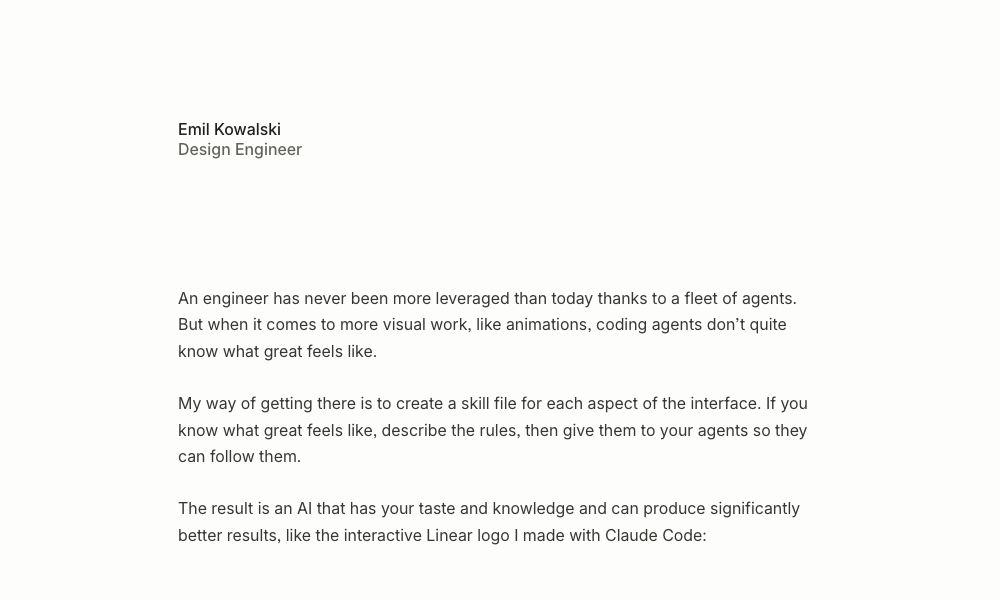
Developed by design engineer Emil Kowalski, Agents with Taste codifies real-world production insights into an installable skill via npx skills add emilkowalski/skill. The package focuses heavily on motion design, component architecture, and readability constraints.
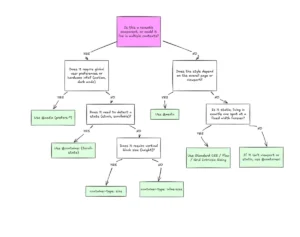
The skill provides agents with a structured easing decision flowchart, precise duration guidelines ranging from 100–150ms for micro-interactions to 200–300ms for modal transitions, and strict typographical rules—such as capping body text at 65 characters per line to optimize legibility. By integrating this philosophy, developers ensure that their AI-generated interfaces reflect the nuanced timing and polish characteristic of top-tier human-designed software.
6. Automated Brand Extraction: Hue
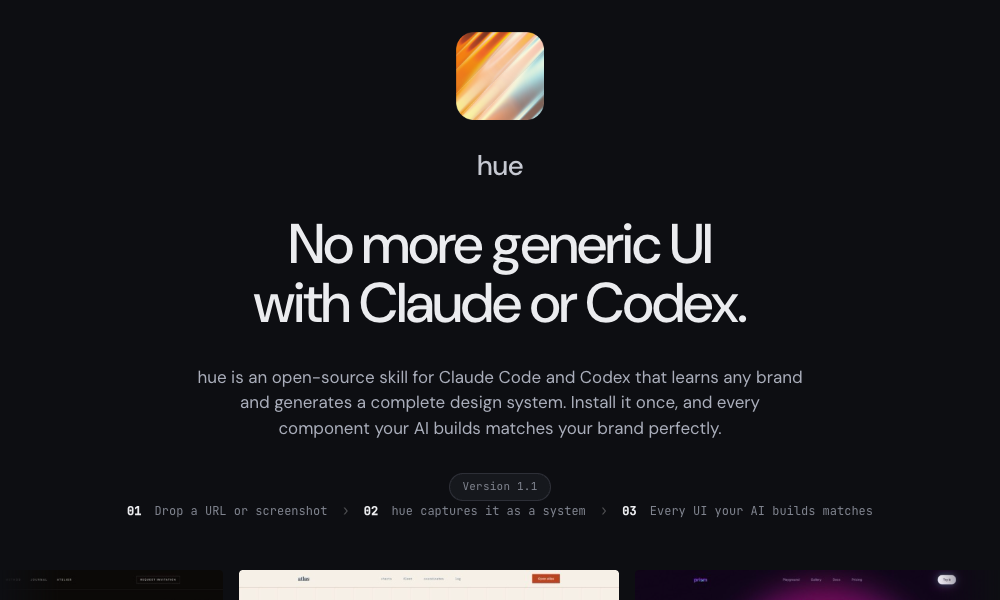
Matching an existing corporate identity has traditionally required manual configuration of design tokens. The Hue app, created by Dominik Martin, automates this process by analyzing a specified URL, brand name, or visual screenshot to generate a comprehensive, bespoke design system.
Available via Git clone into local agent directories, Hue analyzes target properties—such as Cursor or Raycast—and outputs a complete design architecture including color tokens, typography rules, spacing matrices, component guidelines, dark mode configurations, and icon recommendations. Accompanied by pre-built models and rendered landing page examples, Hue enables coding agents to replicate and scale established brand identities accurately.
7. Large-Scale Reference Libraries: Refero Styles
Bridging the gap between empirical design research and automated execution, Refero Styles connects coding agents to a visual search engine indexing over 150,000 real application screens and 6,000 user flows from industry leaders like Stripe, Linear, Notion, and Figma.
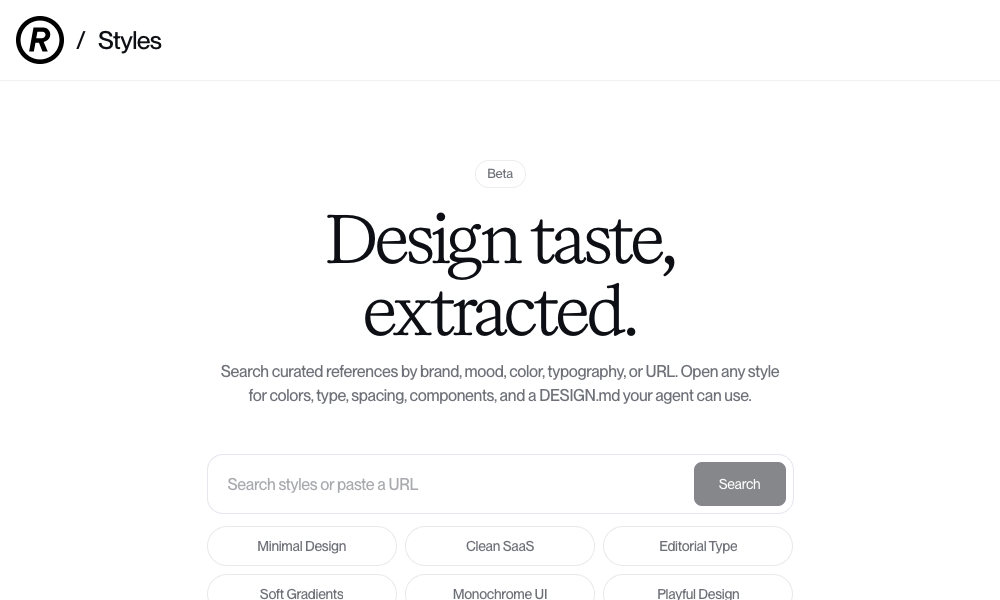
Through its associated Model Context Protocol (MCP) server or downloadable DESIGN.md files, the skill grants agents on-demand access to established interface patterns. Developers can search for specific moods, color schemes, or functional layouts, allowing their coding assistants to query and implement validated design paradigms directly during the development lifecycle.
8. Multi-Platform Adaptability: TypeUI Design Skills
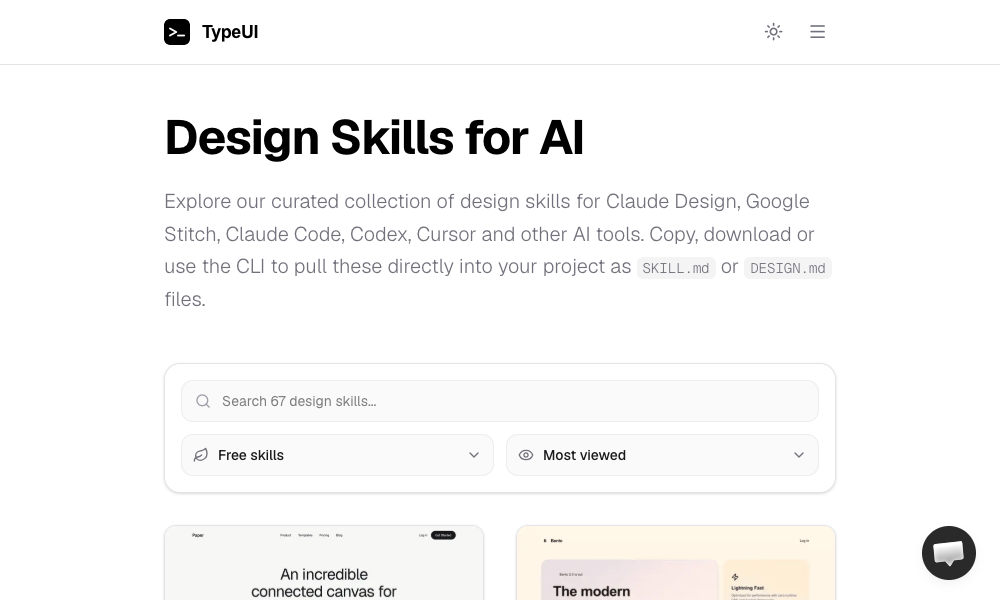
Designed to support a wide array of agentic environments—including Claude Code, Codex, Cursor, and OpenClaw instances—TypeUI Design Skills offers a modular library of optimized SKILL.md and DESIGN.md files. Accessible via a dedicated CLI (npx typeui.sh pull [name]), the collection allows teams to seamlessly inject distinct aesthetic frameworks into their local development workflows, ensuring consistent output across diverse AI tooling.
9. Comprehensive System Generation: UI/UX Pro Max Skill
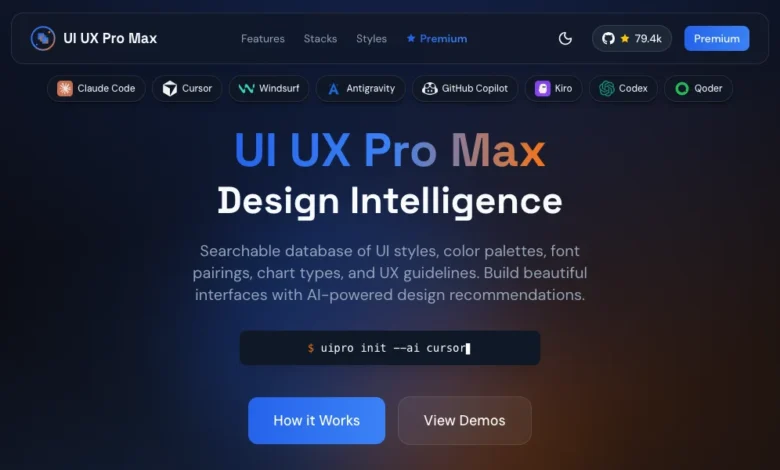
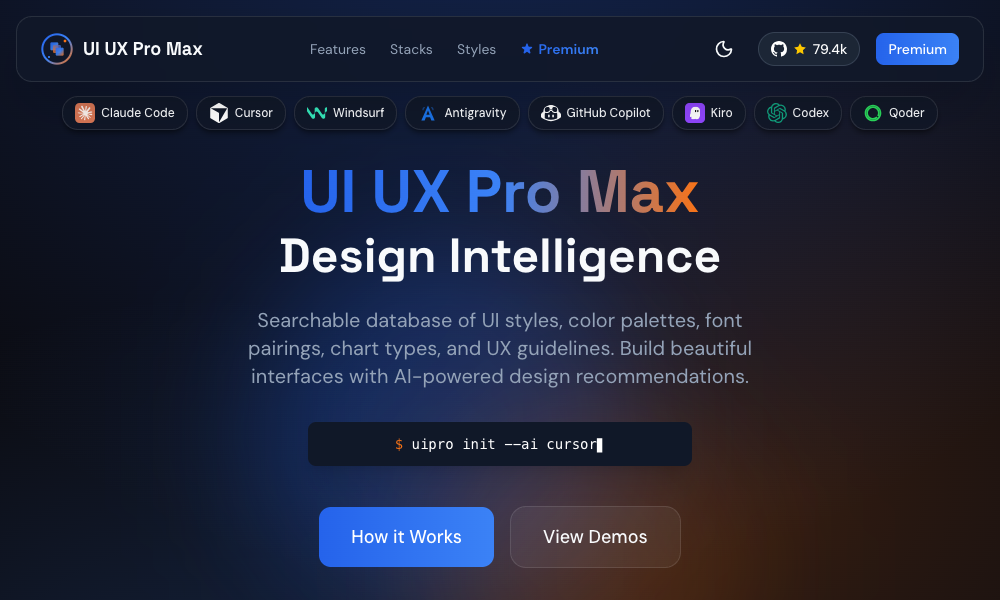
As one of the most exhaustive options available, the UI/UX Pro Max skill incorporates 161 reasoning rules and 67 distinct UI styles. Initiated via npx ui-pro init, the framework features an advanced Design System Generator that analyzes natural language project descriptions—such as a premium tour booking platform—and prescribes a complete structural architecture covering layout patterns, color palettes, typography, visual effects, and explicit anti-patterns to avoid. Compatible with major IDE extensions and local agents, the tool manages the entire design workflow from initial requirements analysis to final component generation.
10. Specialized Agent UX: AI UX Playground
Moving beyond visual skinning, the AI UX Playground addresses the unique interaction paradigms required for applications powered by conversational models and autonomous systems. Documenting specific patterns for interfaces integrated with ChatGPT, Claude, Perplexity, and Gemini, the library provides actionable implementation guidelines for designing effective human-AI interaction loops.
Economic Implications and Future Outlook
The proliferation of executable design skills marks a significant maturation phase in the generative AI economy. As coding agents transition from experimental novelties to core infrastructure within enterprise software development, the demand for visual differentiation has intensified. Companies can no longer rely on generic agent outputs without risking brand dilution in an increasingly saturated digital marketplace.
Industry analysts suggest that the integration of structured design skills will permanently alter the division of labor between human designers and software engineers. Rather than spending valuable time drafting repetitive CSS utility classes or enforcing standard spacing rules, human designers are increasingly evolving into system architects—crafting the markdown rules, design tokens, and behavioral constraints that govern autonomous agents.
This shift empowers smaller teams and solo founders to ship software that rivals the visual polish of large engineering organizations, effectively democratizing access to high-end design engineering. However, it also places a premium on aesthetic literacy; developers who understand how to curate and combine these agent skills will successfully produce distinctive, high-performing applications, while those relying on default settings risk perpetuating the era of homogenized machine-generated design.
As the underlying models continue to advance, the boundary between human intent and machine execution will continue to blur. For now, adopting installable design skills represents an immediate, practical methodology for restoring human taste and intentionality to the automated software development lifecycle.