Building a Rigorous AI Data Analyst: Transitioning from Blind Chatbot Prompts to Structured Analytical Python Toolkits

The rapid evolution of generative artificial intelligence has fundamentally transformed how business organizations interact with their operational databases. Historically, executives seeking commercial insights turned to human data teams who exercised deliberate caution: they methodically restated business problems, formulated concrete hypotheses, constructed optimized database queries, and rigorously validated underlying sample sizes before delivering executive summaries. However, contemporary adoption of vanilla conversational chatbots has inadvertently fostered a dangerous corporate culture of immediate, unverified answers. When queried about business performance metrics—such as determining which promotional campaigns warrant increased investment—standard conversational models frequently evaluate superficial numbers with misplaced statistical confidence. A campaign demonstrating stellar performance across a meager ten transactions is analytically equivalent to one backed by a thousand transactions in the eyes of an unchecked model, introducing profound strategic risks to modern enterprise decision-making.
To reconcile the speed of automated language generation with the rigorous discipline of professional data science, modern engineering methodologies now embed procedural checks directly into application code. Recent technical advancements championed by data experts and educators have introduced programmatic Python architectures that force large language models through a multi-stage analytical pipeline. Rather than relying on a single prompt to instantly divine business strategy, these modular toolkits divide analytical workflows into distinct, auditable milestones: initial business contextualization, targeted hypothesis generation, structured query language (SQL) planning, empirical validation, executive summarization, and evidence-based recommendation. By decoupling provider-specific application programming interfaces through unified client wrappers, these toolkits enable seamless transitions between leading model ecosystems, such as Anthropic’s Claude and OpenAI’s GPT models, while ensuring that automated data evaluations consistently respect fundamental statistical boundaries.
The Anatomy of Data Vulnerability in Unchecked Analytics
The primary hazard of utilizing conversational models for data analysis stems from their inherent inability to autonomously gauge statistical significance. In standard corporate environments, analysts encounter datasets characterized by skewed distributions, sparse segments, and highly variable sample sizes. Consider an operational online ordering dataset containing transactional records across multiple months, numerous promotional categories, and diverse product lines. When analyzed through simplistic aggregations—such as calculating average units sold per order grouped by promotion identifiers—naive computational approaches routinely misidentify top-performing initiatives.
For instance, a promotional category yielding the highest average units per order upon initial inspection may mathematically rely upon a solitary transaction. A traditional chatbot receiving this query processes the numerical output, ignores the underlying sample size, and issues an authoritative recommendation to scale the campaign. Conversely, a senior human data analyst deliberately operates at a slower cognitive pace. They inspect data schematics, identify missing values, verify data types—such as ensuring chronological fields are properly indexed rather than treated as unstructured text—and mandate minimum support thresholds before elevating any metric to executive leadership. Translating this cautious professional behavior into deterministic code requires shifting from conversational prompting to programmatic pipeline enforcement.
Engineering a Multi-Stage Analytical Python Toolkit
Implementing a production-grade automated analytics pipeline necessitates a modular architecture capable of handling diverse database structures and language model providers without code duplication. The foundation of such a system relies on a unified client wrapper designed to normalize interactions across different artificial intelligence vendors. Because downstream functions require predictable outputs, this wrapper encapsulates API-specific response mechanics—such as navigating multiple content blocks in Anthropic responses or parsing standard chat completion payloads in OpenAI frameworks—while introducing robust error handling to intercept unsupported providers or missing text blocks.
Furthermore, because these analytical stages require structured data exchange, the toolkit incorporates advanced response parsing mechanisms. Large language models frequently embed valid JavaScript Object Notation (JSON) structures within conversational prose or wrap outputs in markdown code fences. A resilient parsing utility must systematically strip markdown formatting, attempt direct deserialization, and fall back to regular expression searches to extract the earliest valid JSON object or array. This defensive programming approach prevents pipeline disruptions caused by minor stylistic variations in model outputs while strictly enforcing structural integrity for subsequent computational steps.

Stage-by-Stage Implementation of the Analytical Pipeline
The structured pipeline executes across six distinct, sequential phases that mirror the cognitive workflow of an experienced data professional.
Stage 1: Business Understanding and Contextualization
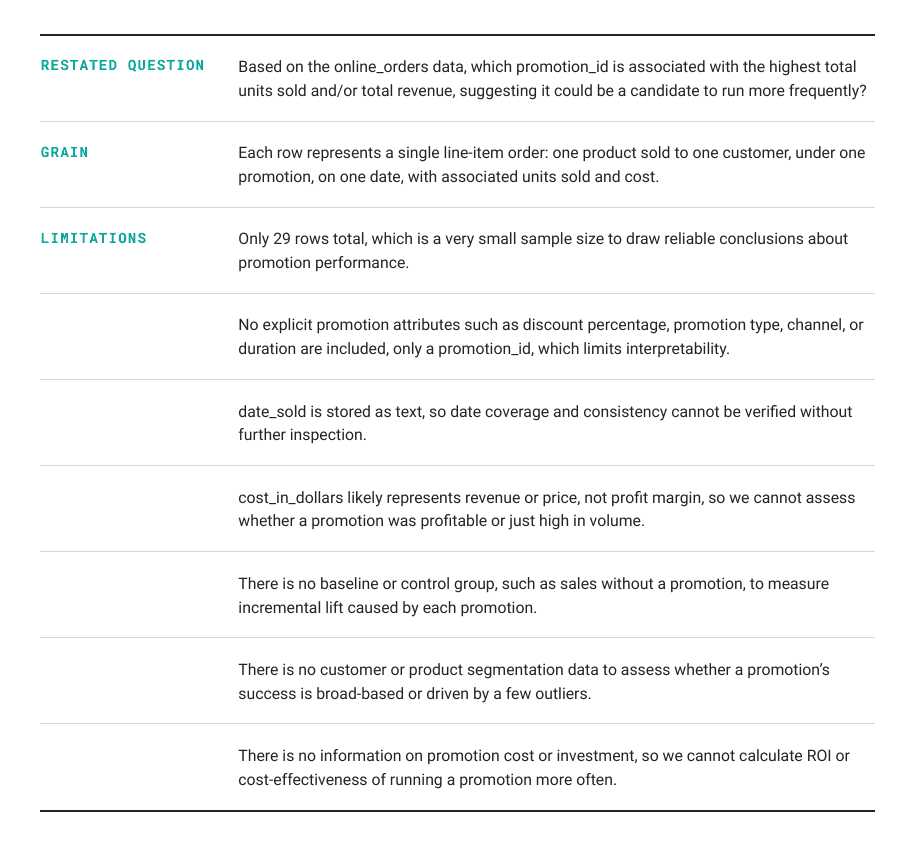
The initial phase programmatically evaluates table schematics, row counts, and column data types using embedded database engines like DuckDB, which permit high-performance SQL execution directly against local dataframes without requiring external database server infrastructure. The language model is provided with the table schema and row count to restate the stakeholder’s core question, define the exact grain of the data—specifying precisely what an individual row represents—and explicitly catalog potential analytical limitations, including sample size constraints and temporal coverage gaps.
Stage 2: Hypothesis Generation
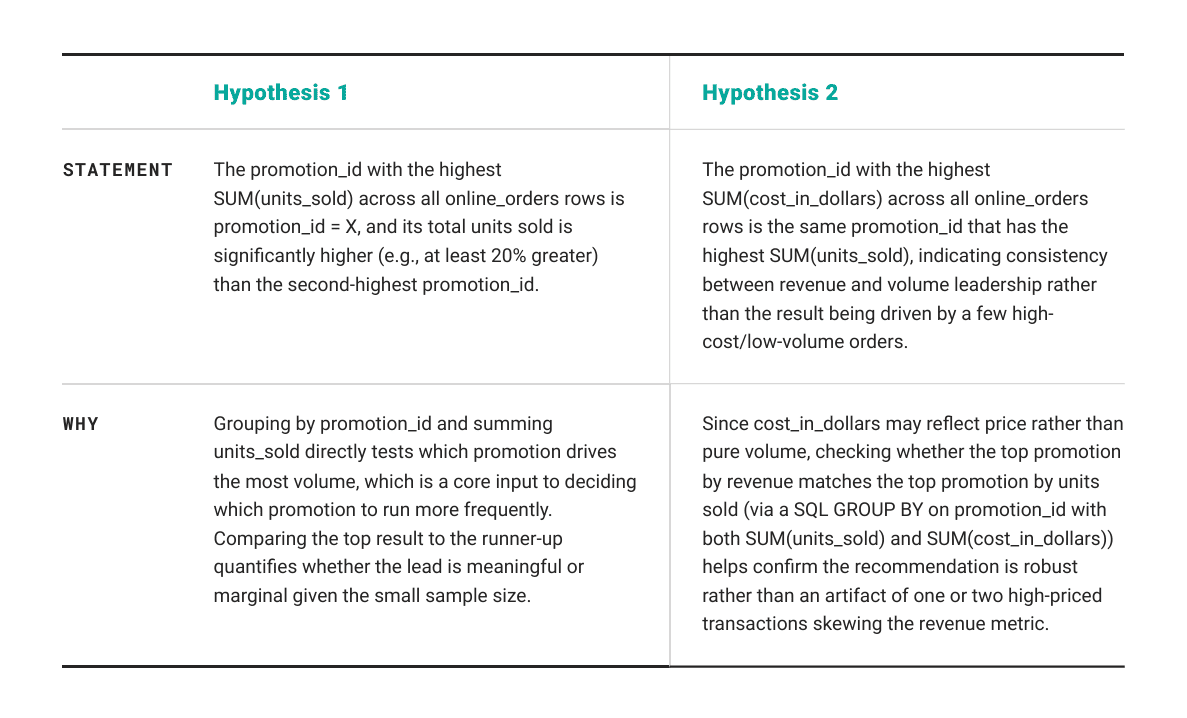
Once the business context is established, the pipeline prompts the model to propose specific, testable hypotheses derived exclusively from the available table columns. This phase ensures that subsequent data queries remain grounded in measurable phenomena rather than speculative assumptions.
Stage 3: SQL Planning and Query Construction
The third stage translates the prioritized hypothesis into an executable database query. Crucially, the system mandates that any query grouping categorical data must simultaneously incorporate row count aggregations. This structural requirement ensures that the resulting dataset retains the necessary metadata for subsequent sample size validation. Rather than relying on basic aggregations, advanced models naturally construct sophisticated queries utilizing common table expressions and window functions to rank performance metrics and compare leading categories against runners-up.
Stage 4: Programmatic Validation and Threshold Enforcement
Unlike preceding generative steps, the validation phase operates entirely through deterministic code rather than probabilistic model inference. The execution engine runs the generated SQL query and evaluates the resulting row counts against a predefined minimum support threshold. Groups failing to meet the minimum transaction count are programmatically flagged as low-confidence data points. This programmatic enforcement ensures that human-defined statistical guardrails cannot be bypassed by the language model.
Stage 5 and Stage 6: Executive Summarization and Actionable Recommendations
The final two stages synthesize the validated data into concise executive summaries and strategic business recommendations. Crucially, system instructions explicitly forbid the model from anchoring headline conclusions or strategic initiatives on low-confidence data rows. If underlying sample sizes are insufficient, the toolkit redirects the organization toward acquiring further data rather than fabricating certainty where none exists.
Broader Implications for Enterprise Data Operations
The integration of structured, multi-stage analytical toolkits into enterprise data workflows marks a significant maturation in how organizations leverage artificial intelligence for business intelligence. By moving away from unverified conversational prompts and toward programmatic, test-driven analytical pipelines, businesses can harness the speed of large language models without sacrificing statistical rigor. As data architectures continue to evolve, the implementation of automated guardrails—such as mandatory sample size validation and deterministic code checks—will become an essential standard for maintaining data integrity and executive trust in automated decision-making systems.