The AI Era Demands More Than Just Permission; It Requires Ownership of Your Journey


The advent of artificial intelligence has fundamentally reshaped the landscape of possibility, dismantling traditional barriers and presenting a new paradigm for personal and professional growth. What was once a distant aspiration or a carefully guarded secret is now accessible, yet this unprecedented democratization of capability has also introduced a new challenge: the overwhelming abundance of readily available tools and information. The author’s poignant reflection on leaving home at 17 to pursue college, a terrifying yet exhilarating step into the unknown, serves as a powerful metaphor for the current moment. Just as that first departure opened a larger world, AI has collectively opened a door for humanity, a threshold into an era where the excuses for inaction have evaporated, leaving only the stark reality of permission.
This profound shift, however, is not being widely discussed in terms of its ultimate implications. The true nature of this AI-driven transformation lies not just in the tools themselves, but in the inherent opportunities and the subsequent responsibilities they bestow.
AI’s Four Gifts: A Catalyst for Transformation

Artificial intelligence is not a fleeting trend or a deceptive illusion; its gifts are tangible, measurable, and transformative. Yet, these advancements also usher in a period of profound uncertainty, a great unknown that demands careful navigation. The core of AI’s current impact can be distilled into four primary advantages:
-
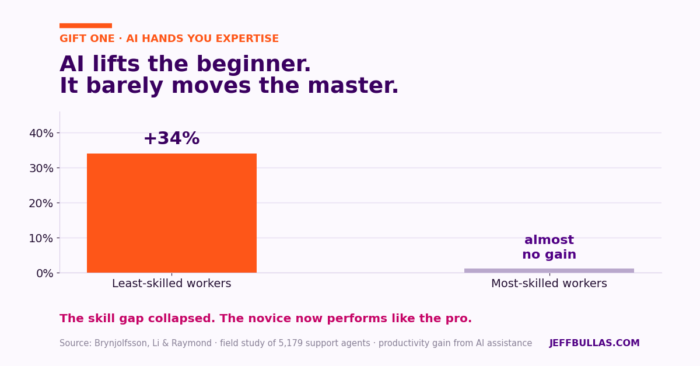
Unearned Expertise: AI significantly enhances the capabilities of individuals, particularly those at the early stages of their professional journeys. A landmark study conducted by researchers at Stanford and MIT, analyzing the work of over 5,000 customer support professionals utilizing AI assistants, revealed a remarkable 14% average increase in productivity. Crucially, the least skilled workers experienced the most dramatic improvement, with a 34% surge in output. In stark contrast, the most experienced professionals saw only marginal gains. This data, published by the National Bureau of Economic Research (NBER), underscores a critical point: AI acts as a powerful equalizer, bridging skill gaps and democratizing proficiency. The novice gains the patterns and insights of the expert, effectively collapsing the learning curve.
-
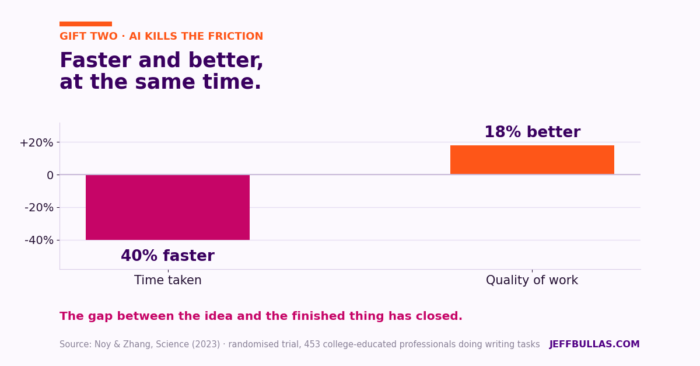
The Demise of Friction: The distance between conception and execution has been dramatically shortened by AI. A controlled trial, documented in the journal Science, involved 453 professionals tasked with writing assignments. Those equipped with ChatGPT experienced a 40% reduction in time spent on their tasks, coupled with an 18% improvement in the quality of their work. This dual enhancement—speed and quality—signifies a fundamental alteration in how creative and knowledge-based work is performed. The impediment between having an idea and bringing it to fruition has been all but eliminated, allowing for more rapid iteration and innovation.
-
The Collapse of Complexity: Tasks that previously required extensive teams, substantial budgets, and years of specialized training can now be accomplished with unprecedented ease. A complex problem that once necessitated a decade of dedicated practice and a significant financial investment can now be addressed within an afternoon, often with a well-formulated query to an AI system. This simplification of complex processes democratizes access to sophisticated capabilities, lowering the barrier to entry for individuals and organizations alike. What was once an insurmountable challenge has become an accessible endeavor.
-
The Unnamed Gift: Unfettered Freedom: Perhaps the most significant, yet often overlooked, gift of AI is the profound freedom it grants individuals to embark on their own ventures. Historically, common impediments to pursuing ambitious projects included a lack of capital, insufficient skills, the absence of a team, limited time, or simply not knowing where to begin. AI tools have systematically dismantled these obstacles. The current challenge is no longer a deficit of skills or resources, but rather a deficit of permission—the internal authorization to pursue one’s ambitions.
The Gatekeeper Within: The Problem of Permission
The core realization is that the ultimate barrier to progress in this AI-augmented era resides not in external limitations, but within the individual’s own mindset. The author’s powerful assertion, "Everything standing in your way is behind your own eyes," encapsulates this truth. The path forward involves two crucial steps: granting oneself permission and then taking decisive action. Inaction, even with a brilliant idea, leads to its demise in obscurity. This internal gate, the decision to move forward, is something no machine can open for you.
The Unforeseen Consequence: A Crowded Room
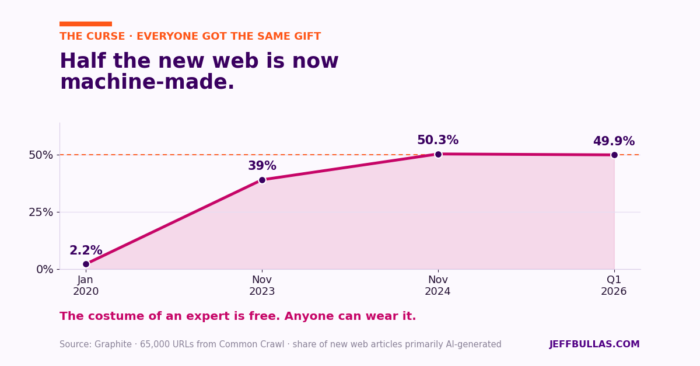
While the gifts of AI are undeniable, there is a critical caveat that is frequently omitted from the narrative of technological progress. These four transformative advantages were bestowed simultaneously upon nearly everyone, at minimal cost. In 2022, approximately half of all new web articles were generated by machines, a figure that has steadily climbed since early 2020. This exponential increase in content creation, driven by the ease of AI tools, has led to a dramatic surge in the number of individuals entering fields previously constrained by technical difficulty. The "room" of opportunity, once sparsely populated, is now becoming increasingly crowded. This phenomenon is not an anomaly; it is the predictable outcome of arithmetic and the widespread availability of powerful tools. The once-exclusive domain of the expert is now accessible to anyone, democratizing the outward appearance of mastery.
The True Villain: Not the Machine, but Past Difficulty
It is crucial to identify the real antagonist in this evolving narrative, and it is not artificial intelligence. For years, the primary protection for original work and expertise was not necessarily inherent talent, but the sheer difficulty of creation. When the author began their blog in 2009, the technical hurdles were immense, a "technical nightmare" that served as a formidable barrier to entry. This difficulty, the "moat" surrounding specialized knowledge and creative output, effectively kept the masses at bay. AI has now effectively drained this moat, leveling the playing field for millions. This is the unadvertised trade-off: access to powerful tools has also brought with it an unprecedented influx of competition.
The Price of Passage: Embracing the Unknown
The author’s personal journey offers a profound perspective on the cost of venturing beyond established confines. Leaving home at 17 for college was the first significant price paid. At 27, a more profound departure occurred: leaving the religious faith of their upbringing. This decision carried a heavier burden, involving the difficult task of articulating a broader worldview to loved ones and confronting the fear of rejection and ostracization. Despite these fears, the author found acceptance, but the necessity of moving beyond a confining belief system was paramount. Later, at 52, the decision to become a self-employed entrepreneur, dedicating five years to early mornings with no guarantee of success, represented another significant investment of time, resources, and emotional fortitude.
These personal accounts highlight a crucial, often unmentioned aspect of pursuing ambitious goals: the real price involves fear, anxiety, and years of dedication with no assured outcome. However, this price yields invaluable rewards: the freedom to grow, the opportunity to learn from inevitable failures, and a deep-seated intrinsic motivation that transcends mere discipline. This drive, this genuine desire to engage, is not a product of external systems but a consequence of stepping through the door of personal challenge. AI can furnish the skills, accelerate the process, and deliver the final product, but it cannot provide the fundamental "why" that fuels human endeavor.
AI’s Limitations: Collapsing Doing, Not Deciding
While AI excels at automating and streamlining routine tasks, its limitations become apparent when confronted with complex decision-making that requires nuanced judgment, context, and taste. Studies consistently demonstrate AI’s effectiveness in closing the gap between beginners and experts in straightforward tasks. However, in situations demanding critical thinking, ethical considerations, and sophisticated contextual understanding, AI acts as an amplifier of existing human expertise rather than an equalizer. It magnifies the abilities of those who already possess a strong foundation of knowledge and judgment.
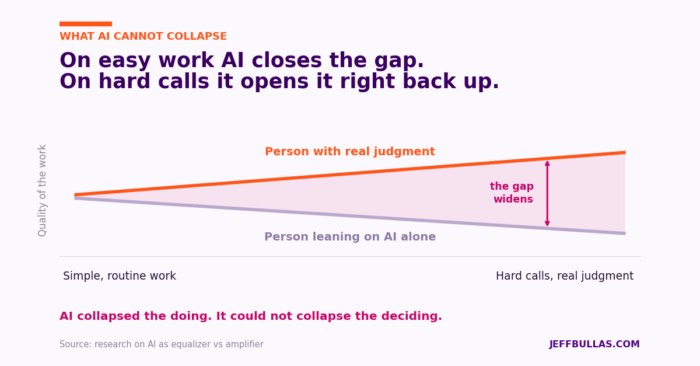
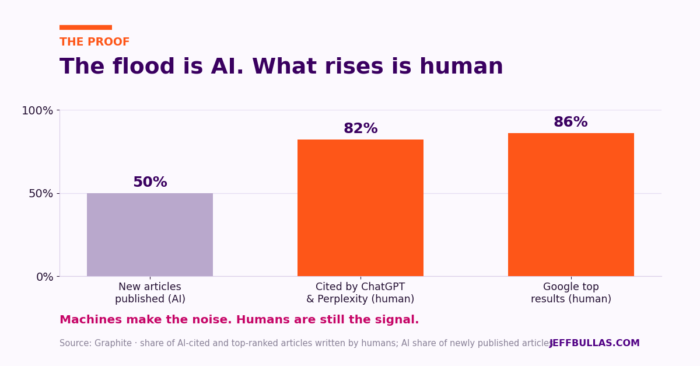
In essence, AI has collapsed the "doing"—the execution of tasks—but it has not collapsed the "deciding"—the strategic and judgmental aspects of work. The market’s response to this distinction is already evident. While approximately half of all online content is now machine-generated, human-authored content continues to dominate search engine rankings and academic citations. Graphite’s analysis of web data reveals that 86% of articles ranking on Google Search were written by humans, and 82% of articles cited by leading AI models like ChatGPT were also human-generated. This indicates that while AI can produce volume, human-crafted content remains the signal amidst the machine-generated noise.
Building True Authority: The Future of Value Creation
If the act of mere production is no longer the primary differentiator, what then becomes the ultimate prize? The answer lies in the creation of a public record of judgment that cultivates trust. In an era where traditional institutions are experiencing declining public confidence—with 69% of people globally worrying about deliberate deception from officials and leaders, according to the Edelman Trust Barometer 2025—earned, personal authority is becoming increasingly vital. This authority is not borrowed, which is precarious and transient, nor is it rented, subject to the whims of algorithmic changes. True authority is owned, built on principles that cannot be easily replicated or revoked.
Owned authority is constructed upon five foundational pillars:
- Authenticity: A genuine commitment to truth and transparency.
- Consistency: A reliable and predictable presence over time.
- Value: Providing demonstrable benefit and insight to others.
- Engagement: Actively interacting with and responding to an audience.
- Originality: Offering unique perspectives and contributions that cannot be mimicked.
The construction and maintenance of this authority follow an ongoing loop: create, share, listen, refine, and repeat. The critical, yet often neglected, step is the iterative refinement based on feedback and observation. This meticulous process, undertaken consistently, offers the most cost-effective path to establishing an unassailable position of trust.
The Enduring Power of Thinking, Not Just Answering
The author’s reflective approach to writing—focusing on understanding rather than simply asserting certainty—resonates deeply with readers who can discern genuine thought processes from mere performance. The machine can provide an answer instantaneously, but it cannot replicate a lifetime of accumulated wisdom, nuanced judgment, and the hard-won lessons derived from navigating complex challenges.
We stand at a pivotal juncture. The tools are abundant, the barriers to entry have dissolved, and the common spaces are becoming densely populated. In this landscape, the sole enduring differentiator is the observable trajectory of an individual who consistently learns, takes calculated risks, and speaks truthfully in the public sphere, thereby building an irrefutable foundation of trust. Artificial intelligence has undeniably opened the door to unprecedented opportunity. However, the courage and conviction required to step through it and forge one’s own path remain an exclusively human endeavor. The question that lingers, therefore, is not what AI can do for us, but rather, what room are we still hesitant to leave behind?