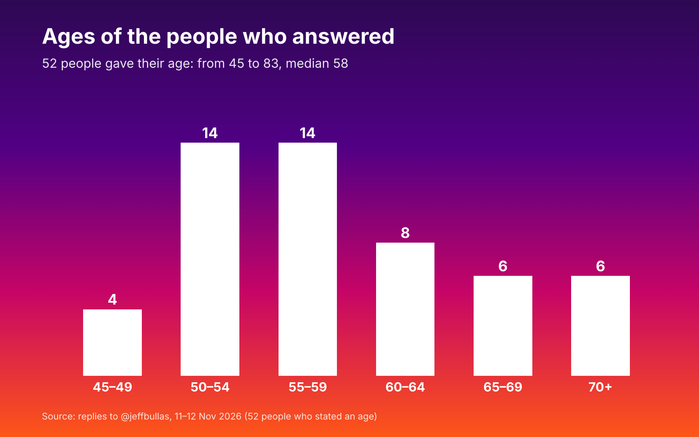
Last Wednesday evening, a digital experiment conducted on the social media platform X yielded results that challenge conventional wisdom regarding aging and career transitions. The inquiry, which asked, “Anyone over 50 starting something new right now? A business, a course, a craft, a second career. What is it?” acted as a catalyst for a massive influx of anecdotal data. Within less than 24 hours, the post reached 27,000 impressions, generating nearly 100 substantive responses from individuals ranging in age from 45 to 83. The prompt, initiated by Jeff Bullas, an online writer and founder of the AI startup Zyrro, sought to determine whether the aging workforce is embracing the rapid technological shifts of the mid-2020s or succumbing to the narrative of professional obsolescence.
The data gathered from this social media interaction, while not a peer-reviewed scientific study, aligns with larger, longitudinal trends in the labor market. The consensus among the respondents—many of whom are navigating their fifth or sixth decade—is that they are not in a period of professional decline, but rather a phase of active, strategic development.
Chronology of a Demographic Shift
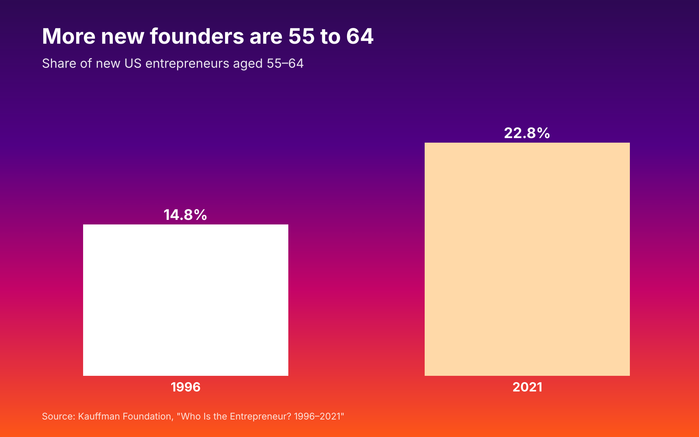
The perception of the “founder” has long been tethered to a Silicon Valley-centric archetype: the individual in their twenties, typically male, working from a dorm room or a startup incubator. However, the data reveals a different reality. The Kauffman Foundation, which has tracked entrepreneurship in the United States since the 1990s, provides historical context for this trend. In 1996, individuals aged 55 to 64 accounted for approximately 14.8% of new business starts. By 2021, that figure had climbed to 22.8%.
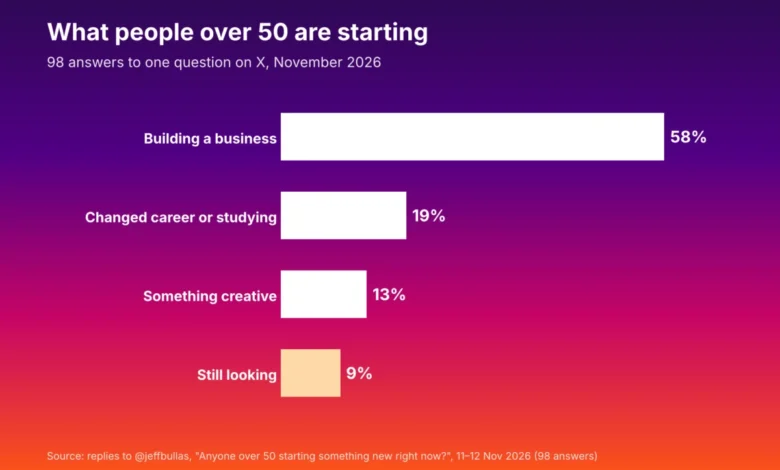
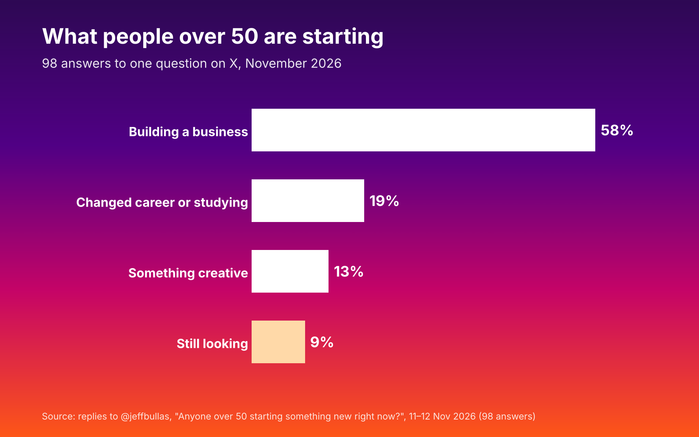
The recent social media inquiry reinforces this upward trajectory. Of the 98 actionable responses analyzed, over 50% indicated they were in the process of establishing a new business venture. Another 20% reported having successfully transitioned careers or returned to higher education, while 12% had initiated new creative pursuits. Only 10% of the respondents reported being in a state of search, indicating a high degree of intent and activity among the demographic.
The Myth of Age-Related Technological Obsolescence
A prevalent narrative in modern workforce discourse suggests that the rapid advancement of Artificial Intelligence (AI) poses an existential threat to older workers, rendering their skills redundant and their experience irrelevant. Yet, the empirical evidence gathered from the 2,000 individuals who engaged with the study’s broader discourse over a four-month period contradicts this fear-based narrative.
Only 1% of respondents over the age of 50 expressed a belief that AI had left them behind. Instead, a significant portion—nearly 40%—spontaneously cited the integration of AI or sophisticated software into their new ventures. These professionals are leveraging AI to automate administrative workflows, develop new applications, and synthesize complex data, effectively using their decades of industry-specific knowledge to provide the "judgment" that remains a significant limitation of current generative AI models.
While a Pew Research Center survey from February 2026 noted that 58% of Americans aged 50 to 64, and 77% of those 65 and older, do not currently use AI chatbots, this statistic appears to reflect a lack of adoption rather than an inability to learn. AARP’s 2026 data indicates that 54% of adults over 50 feel confident in their ability to adapt to new technologies. The barrier, therefore, is not cognitive, but cultural and systemic.
Systemic Challenges and the "Overqualified" Stigma
The reluctance to hire older workers remains a documented structural issue. In 2009, during a period of economic instability, many professionals in their fifties faced a labor market that viewed their extensive experience as a liability, often citing the term “overqualified” as a euphemism for age-based discrimination.
Current data suggests this phenomenon persists. An AARP report from 2026 revealed that 64% of U.S. workers aged 50 and older have either witnessed or personally experienced age-based discrimination in the workplace. Furthermore, research from Boston College indicates that since the widespread adoption of generative AI, workers aged 55 and older in roles most susceptible to automation have seen an accelerated exit from the workforce. However, these individuals are not necessarily transitioning into permanent retirement; many are shifting into independent consultancy, solo-entrepreneurship, or freelance work—sectors where age-related barriers are more easily bypassed.
Why Experience Functions as a Competitive Edge
In the context of the AI revolution, there is an emerging consensus that "experience" is not a static set of historical skills, but a framework for high-level decision-making. AI models excel at generating information, but they lack the contextual nuance required to determine the validity, ethics, or long-term viability of that information.
Professionals with 30 or 40 years of experience possess what could be termed “domain intuition.” Whether it is managing complex budgets, navigating personnel crises, or understanding the idiosyncrasies of specific market sectors, this experience provides a baseline for evaluating the output of AI tools. Consequently, the most successful ventures launched by the 50-plus demographic are those that synthesize deep industry expertise with modern technical agility. A 72-year-old developer creating bilingual agricultural training materials or a filmmaker using AI-assisted workflows for stop-motion production are examples of this hybrid approach to modern labor.
Addressing the “What Next?” Gap
The most significant challenge identified among the 10% of respondents who are still searching for their next professional step is not a lack of technical capability, but a lack of clarity. In an era where the barriers to entry for starting a business—such as creating a newsletter, building a website, or launching a software prototype—have been reduced to near-zero cost, the paradox of choice becomes overwhelming.
When an individual is no longer constrained by the traditional "ladder" of a 40-year career, the question of what to do next requires a high degree of self-awareness. This is the gap that modern startups, such as the aforementioned Zyrro, aim to fill. By providing structured introspection—moving beyond standard personality tests and toward patterns of energy, strength, and past performance—these tools assist individuals in identifying professional paths that align with their accumulated experience.
Broader Implications for the Workforce
The shift away from the traditional "work-retire-fade" script is accelerating. As life expectancy increases and the nature of employment becomes more fragmented and project-based, the definition of a "career" is undergoing a fundamental transformation. The 83-year-old individual starting a new life chapter is an outlier, but one that points toward a future where professional contribution is no longer synonymous with chronological age.
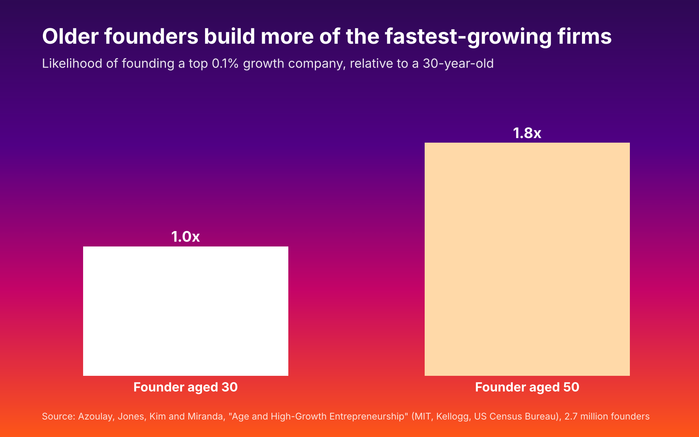
The data suggests that the workforce of the future will be defined by continuous learning and iterative career pivots. Organizations and policy makers who fail to recognize this demographic’s capacity for innovation will likely lose out on a significant pool of talent and leadership.
As the barriers to entry continue to fall, the focus must shift from technical training to strategic mentorship and the identification of new, meaningful professional niches. The individuals who are successfully "starting over" are not those who abandoned their past experiences to keep pace with the youth-centric startup culture; they are those who recognized that their past is the foundation upon which their future, assisted by modern tools, must be built.
The question that remains for the broader labor market is whether it will continue to enforce the outdated script of retirement at 65, or whether it will adapt to accommodate a workforce that is, as many of the respondents noted, not winding down, but "winding up."