Cloudflare Containers Vulnerability Exposed Sensitive Customer Data Through Residual Disk Blocks

A critical security vulnerability within Cloudflare’s infrastructure recently allowed paying customers to access sensitive data belonging to other tenants, stemming from an oversight in how the platform managed shared disk space. The flaw, which was identified by researchers at the security firm Accomplish and reported via Cloudflare’s bug bounty program, highlights the inherent complexities and risks associated with multi-tenant cloud environments. While the company has confirmed that the issue has been fully remediated and that there is no evidence of malicious exploitation by third parties, the incident serves as a significant case study in the challenges of maintaining strict isolation in containerized cloud services.
The Mechanism of the Flaw
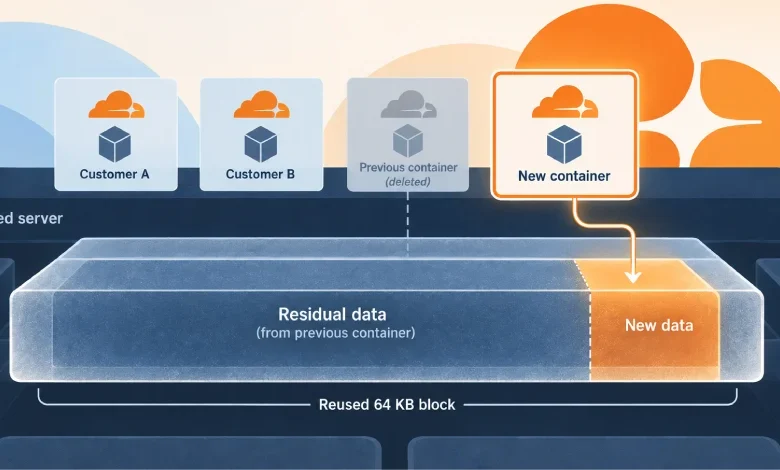
The vulnerability originated in the configuration of thin-provisioned storage within Cloudflare’s container architecture. Cloudflare Containers—a service designed to allow users to execute code in isolated environments—relies on shared physical servers where multiple customer accounts operate concurrently. To optimize storage, the system utilizes a Linux kernel feature known as "thin provisioning," which allocates storage in 64-kilobyte blocks.
Under standard operating procedures, when a container is decommissioned, the storage blocks it occupied should be wiped clean before being returned to the global pool for reallocation. However, researchers discovered that the specific configuration used by Cloudflare’s infrastructure was set to skip this wiping process. Consequently, when a new container was allocated a previously used block, it inherited the raw data left behind by the previous occupant.
The proof-of-concept demonstrated by Oren Yomtov of Accomplish was remarkably straightforward: by writing a small four-kilobyte file into an unallocated disk space and then reading the full 64-kilobyte block at the raw disk level, researchers were able to retrieve the "ghost" data—the 60 kilobytes of residual information that had not been overwritten.

Chronology of Discovery and Remediation
The timeline of the vulnerability’s discovery and resolution underscores the rapid response required in modern cloud security.
- September 4: Researchers at Accomplish formally reported the vulnerability to Cloudflare through the company’s bug bounty program.
- Early September: Cloudflare’s security engineering team conducted an internal investigation, validating the findings and identifying that the flaw affected both Cloudflare Containers and the associated Cloudflare Sandboxes service.
- September 14: Cloudflare implemented the first phase of the fix, re-enabling the wiping mechanism for all newly provisioned blocks. Researchers confirmed that the original proof-of-concept exploit was no longer functional.
- September 19: Recognizing that the initial fix did not address blocks already residing in active container disks or server-side caches, Cloudflare initiated a comprehensive infrastructure cleanup. This involved retiring all running container disks and clearing cached image layers. To minimize customer impact, these operations were conducted during off-peak hours.
- September 24: Cloudflare officially disclosed the vulnerability to the public, confirming that a full audit of their logs had been conducted to identify any unauthorized access.
Technical Implications and Data Exposure
The recovered data was not trivial. According to the disclosure, the residual blocks contained a wealth of sensitive information, including directory structures, database pages, and complete SQLite databases. Further analysis by the researchers identified Chromium browser profiles, configuration files (specifically .env files containing environment variables), and various credential files.
It is important to note that the vulnerability did not provide an attacker with the ability to target a specific victim. Because the server selection process is handled by Cloudflare’s load-balancing algorithms, an attacker could not choose whose data they might recover; the process was essentially a "data lottery." Despite this limitation, the sensitivity of the exposed files—which could potentially include API keys, session tokens, or private user data—posed a substantial risk to any organization using the service.
The researchers were quick to emphasize their professional ethics during the discovery process. They confirmed that their analysis scripts were designed only to verify the format of the data to prove the vulnerability, not to harvest or decrypt the contents. They maintained that no third-party names, credentials, or personally identifiable information (PII) were transmitted during their testing, and that all recovered material was securely deleted immediately following their report to Cloudflare.
Analysis: The Challenge of Shared Environments
The incident at Cloudflare is emblematic of the "shared responsibility" model in cloud computing. While cloud providers implement robust isolation layers, the reliance on low-level system features—such as Linux device-mapper thin provisioning—introduces a surface area for vulnerabilities that are often invisible to the end user.

From an architectural standpoint, the decision to disable block wiping is typically a performance optimization. By skipping the zero-fill process, the system can allocate storage more rapidly, reducing latency for container startup times. However, this optimization created a "security debt" that materialized when the hardware abstraction failed to ensure cryptographic or logical erasure.
Security experts note that this is not an isolated event in the industry. As companies increasingly rely on "sandboxed" environments to execute untrusted code—including code generated by AI agents—the stakes for container isolation have never been higher. The researchers from Accomplish have been particularly active in this space, having documented similar escapes from sandboxes managed by major tech firms, including Anthropic, OpenAI, and Docker, in recent months. This trend suggests that the industry is in a transitional phase where the speed of deploying containerized AI workloads is currently outpacing the maturity of the security protocols protecting them.
Official Response and Future Outlook
Cloudflare’s transparency regarding the incident was a critical component of its mitigation strategy. By providing a detailed technical breakdown, the company aimed to restore trust among its enterprise customer base. Their retrospective analysis—which involved creating detection signatures based on the researchers’ exploit and scanning historical logs—concluded that no malicious actors had successfully leveraged the vulnerability prior to the researchers’ report.
However, a key unanswered question remains regarding the duration of the exposure. Cloudflare did not explicitly state how long the misconfiguration had been active on its servers. Without this data, customers may find it difficult to perform a definitive audit of their own potential exposure, leading some to adopt a "worst-case" posture by rotating all secrets and API keys that might have been stored in their containerized environments.
In the aftermath, the incident serves as a stark reminder that even the most sophisticated cloud providers are susceptible to configuration drift and architectural oversights. As the ecosystem continues to embrace serverless computing and AI-driven code execution, the necessity for rigorous, continuous validation of "data at rest" isolation—even within temporary, ephemeral storage—will remain a top priority for cybersecurity teams globally. For now, the successful patching of the Cloudflare environment, coupled with the absence of exploitation, provides a temporary reprieve, but the industry will likely see renewed focus on the security of low-level kernel configurations as a result.
Related posts: