Find out what social media algorithms are and how to navigate the ranking signals of each platform to get your content seen.

The pervasive influence of social media algorithms fundamentally shapes the digital experience for billions worldwide, acting as unseen gatekeepers that determine what content reaches our screens. These sophisticated systems, at their core, are collections of intricate rules, ranking signals, and complex calculations designed to prioritize and order content for each individual user. Far from simple chronological feeds of the past, today’s algorithms are primarily powered by artificial intelligence (AI), utilizing machine learning to constantly adapt, evolve, and personalize the user experience in real-time.
The Evolution of the Digital Feed: From Chronology to Hyper-Personalization
The journey of social media algorithms reflects the rapid maturation of the internet itself. In the nascent days of platforms like MySpace and Facebook in the early 2000s, content delivery was straightforward: users saw posts from those they followed in reverse chronological order, from most recent to oldest. This transparent, albeit often overwhelming, approach meant that every piece of content had an equal chance of being seen, provided the user was online at the right moment.
However, as social media engagement exploded and the volume of daily content surged, this purely chronological model became unsustainable. Users were missing crucial updates from friends and family amidst a deluge of less relevant information. Recognizing this challenge, platforms began to experiment with more intelligent systems. Facebook was an early pioneer, introducing its News Feed algorithm in 2006, a pivotal moment that began to curate content based on perceived relevance. This marked the genesis of a fundamental shift towards personalization. Instagram followed suit in 2016, moving away from a strictly chronological feed, a decision that initially met with user resistance but ultimately cemented the algorithmic paradigm. By 2026, this evolution is complete: every major social platform now predominantly ranks and displays content through its own proprietary algorithms. While some, like X, Facebook, and Instagram, still offer a chronological viewing option, platforms like Bluesky represent a newer trend, defaulting to user-controlled chronological feeds.
These AI-powered algorithms are critical for managing the vast amount of information generated daily. Statistics reveal the scale of this digital consumption: the average global user spends approximately 141 minutes per day on social media, according to Statista data from 2024. Within this timeframe, AI systems are making instantaneous decisions, sifting through millions of posts to present a uniquely tailored feed to each individual. This personalization is achieved through continuous machine learning, where the algorithms analyze user interactions, preferences, and behaviors to refine their recommendations.

Understanding the Mechanics: How Algorithms Process Your Digital Footprint
To grasp how these digital gatekeepers operate, it’s essential to define key terms and illustrate their practical application. A ranking signal is any attribute or factor that a social media algorithm uses to assess content quality and relevance. These signals dictate whether content is included in a user’s feed or search results, and crucially, its display order. Machine learning, a core component of artificial intelligence, enables these systems to make sense of vast datasets, learn from patterns, and react to information without explicit human programming. This allows algorithms to constantly improve their predictive capabilities. Artificial intelligence (AI), the broader technology, empowers computers to solve complex problems, mimic human reasoning, and automate tasks traditionally performed by humans, making it the bedrock of modern content curation.
Consider a practical example on Instagram: If a user watches three cooking-related Reels to completion, the algorithm registers this behavior. It analyzes the watch time, cross-references it with the user’s past engagement with similar food content, and subsequently begins to surface more cooking Reels in their main feed and on the Explore page. Conversely, a friend who consistently skips cooking content and instead engages with travel photographs will receive an entirely different set of recommendations. This illustrates hyper-personalization: the same platform, leveraging the same underlying algorithmic framework, delivers a distinct and unique experience to every user.
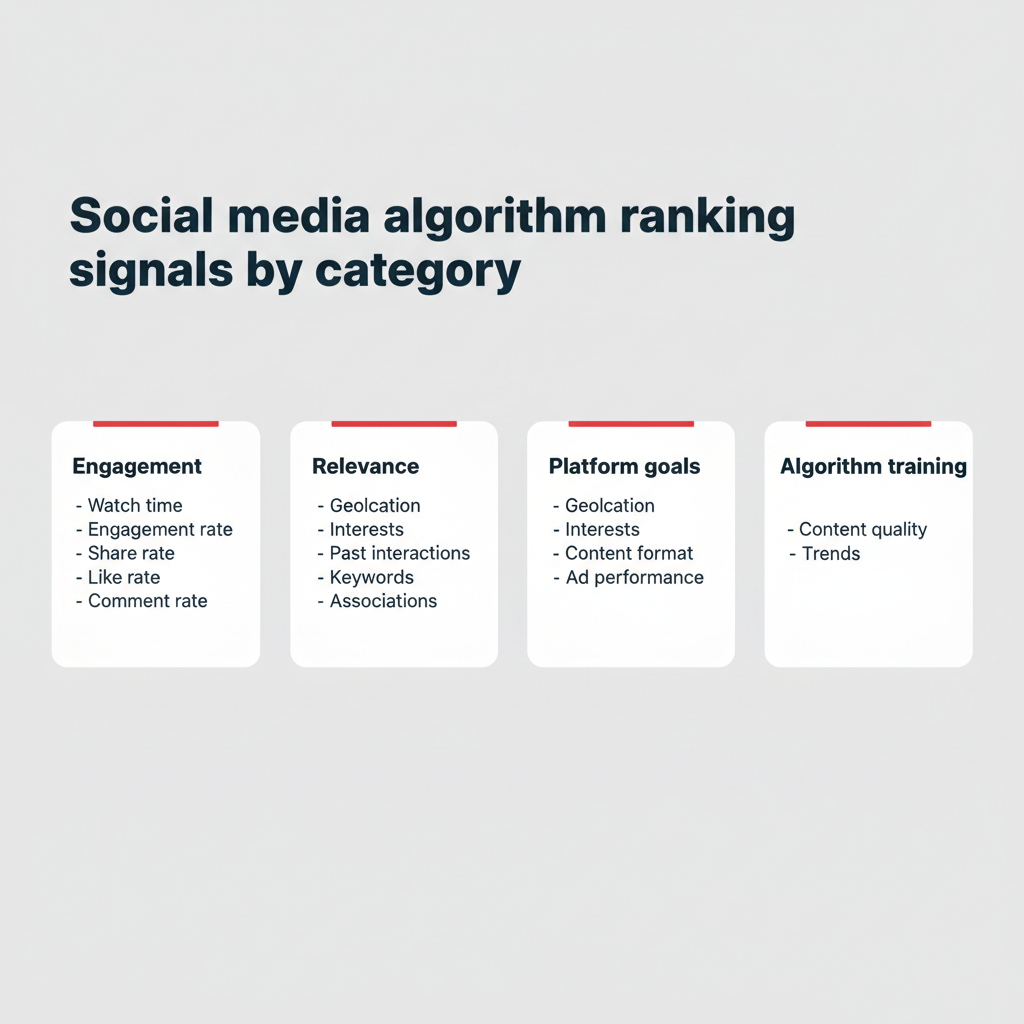
Social media algorithms orchestrate content delivery by weighing a multitude of factors, broadly categorized into engagement metrics, relevance signals, platform-specific priorities, and continuous algorithm training. While the precise weighting and interplay of these signals remain proprietary secrets for competitive advantage, common categories of influence include:
- Engagement-based ranking: Algorithms heavily favor content that generates interaction, such as likes, comments, shares, and saves. High engagement signals to the algorithm that the content is valuable and should be shown to more users. This is often the most potent signal across platforms.
- Relevance and personalization: This category assesses how closely content aligns with a user’s past behavior, stated interests, and connections. Factors include explicit preferences (e.g., following a specific topic) and implicit signals (e.g., spending more time on certain types of posts or interacting with specific accounts).
- Platform goals: Each platform has strategic objectives, and its algorithms are designed to promote these. For instance, a platform pushing a new video format or feature will likely give algorithmic preference to content using that format to drive adoption.
- Algorithm training: Through continuous feedback loops, algorithms learn from user responses. When a user consistently engages with certain content and ignores others, the algorithm refines its understanding of that user’s preferences, making future recommendations more accurate.
Dissecting Platform-Specific Algorithms in 2026
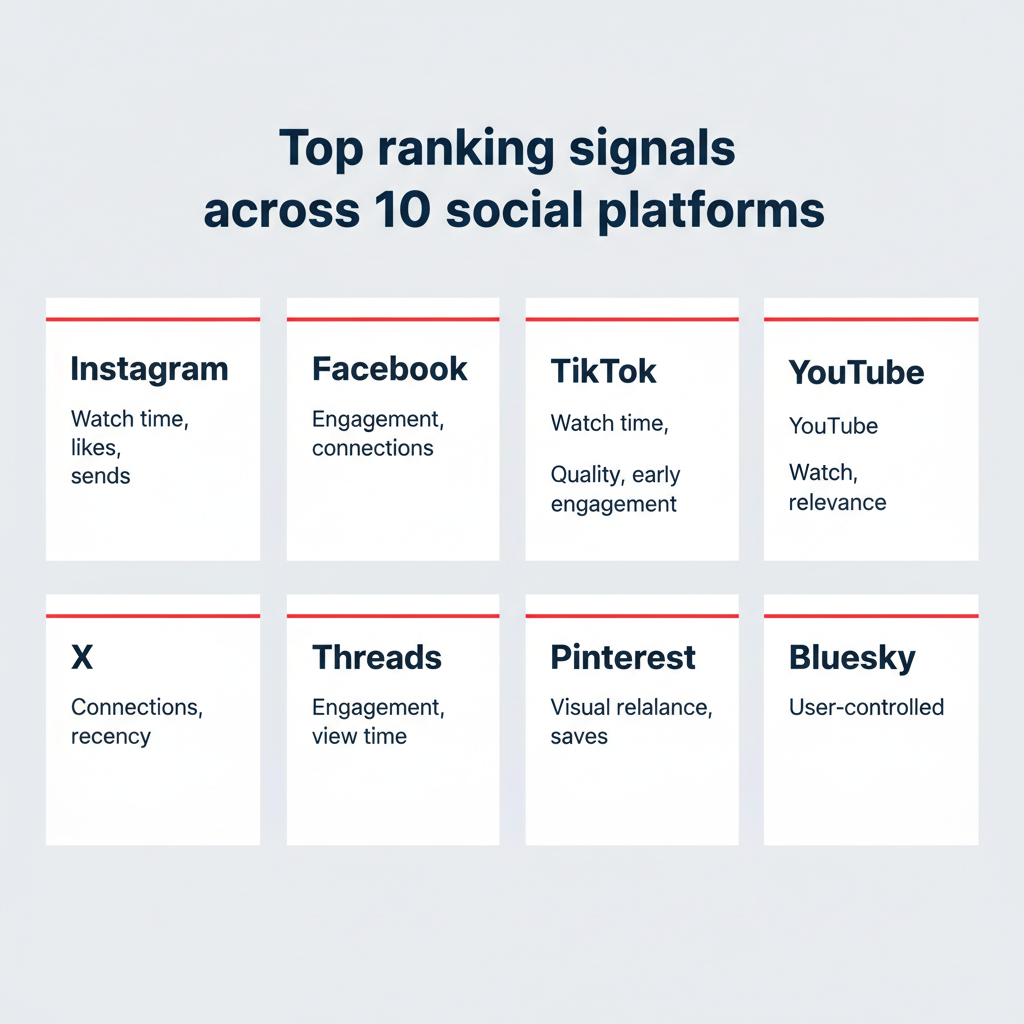
Despite shared principles, each major social network employs distinct algorithms with unique ranking priorities, reflecting their specific user bases and strategic objectives. Understanding these nuances is crucial for content creators and brands aiming to maximize their digital presence.
-
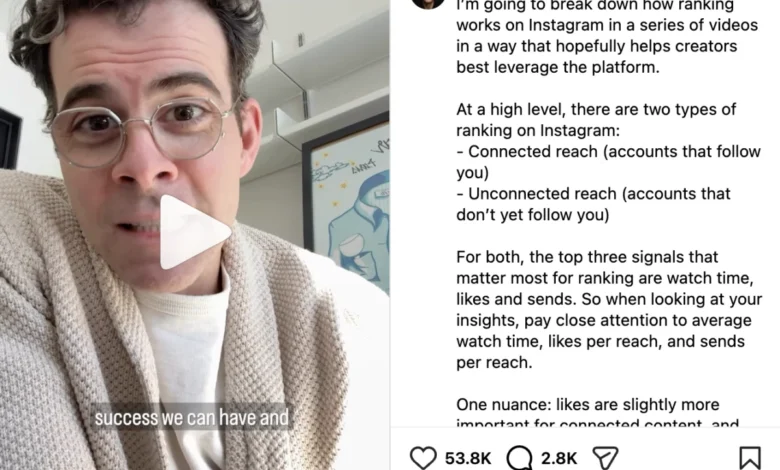
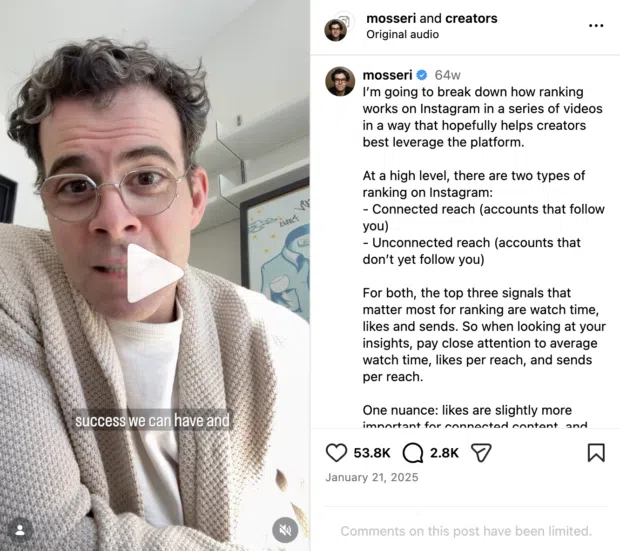
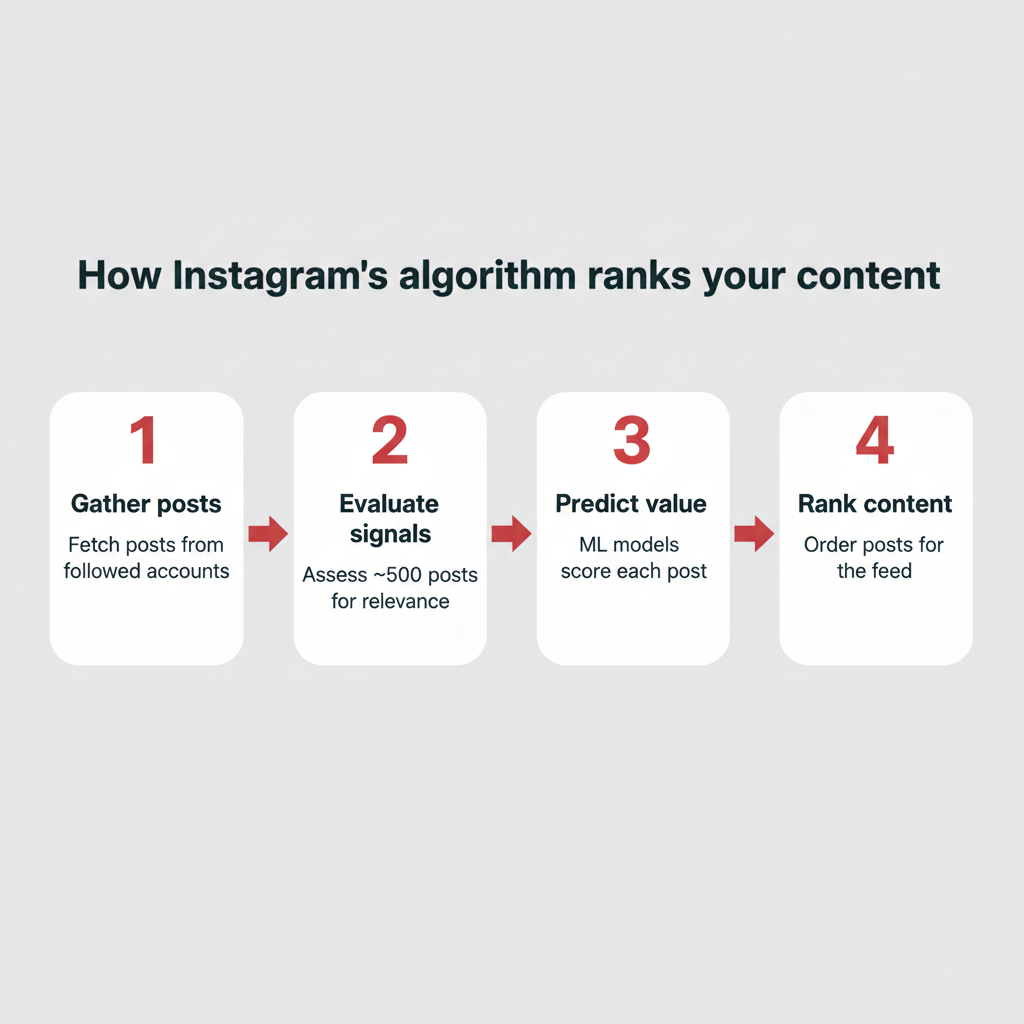
Instagram: In 2026, Instagram’s algorithm prioritizes watch time, likes, and sends across its various content formats, as highlighted by Head of Instagram, Adam Mosseri. The platform employs a multi-stage analysis process for content ranking:
- Inventory: The algorithm first compiles a vast array of potential content to show the user.
- Signals: It then gathers data on the user and the content to inform predictions about potential interactions.
- Predictions: Based on signals, it predicts the likelihood of user actions (e.g., liking, commenting, sharing, saving).
- Ranking: Finally, it ranks content by predicted value, displaying the most relevant and engaging posts while filtering out low-quality or policy-violating content.
- Feed Algorithm: Focuses on predicted engagement, timeliness, and strength of user connections. Content from accounts a user frequently interacts with, and recent posts, receive higher priority.
- Stories Algorithm: Emphasizes closeness of connections, recency, and rewatchability. Stories from close friends and those with high completion rates are favored.
- Reels Algorithm: Heavily weights watch time, rewatches, and shares, aiming to keep users entertained and engaged. It also favors content using trending audio and effects to capitalize on virality.
- Explore Algorithm: Designed for discovery, it prioritizes content from accounts not yet followed, based on broad interest categories and engagement from similar users. Visual relevance and saves are key indicators here.
-
Facebook: Facebook’s content ranking is driven by thousands of signals, but key factors in 2026 include predicted engagement (the likelihood of a user liking, commenting, or sharing) and the strength of connections (content from friends, family, and groups a user frequently interacts with). Video and photos generally receive preferential treatment due to their higher engagement potential.
-
X (formerly Twitter): The "For You" tab on X blends content from followed accounts with recommended posts. Key ranking signals include connections (interactions with people you follow), recency, and topic relevance. Text and images remain the preferred formats, with real-time updates and trending topics being a core value proposition.
-
LinkedIn: As a professional networking platform, LinkedIn’s algorithm prioritizes content quality and early engagement. Posts that spark professional discussions, receive comments from industry peers, and demonstrate authority tend to perform well. Text posts and documents are highly favored, reflecting the platform’s professional ethos and focus on thought leadership.
-
TikTok: The "For You Page" (FYP) is TikTok’s algorithmic centerpiece, delivering highly personalized short-form video content. Top signals include watch time (crucially, video completion rate), user activity (likes, shares, comments), and video information (captions, sounds, hashtags). The algorithm is renowned for its ability to rapidly identify and amplify trending content, with short-form video being the exclusive preferred format.
-
YouTube: As the dominant video platform, YouTube’s algorithm prioritizes watch time (both total watch time and session time) and relevance to a user’s viewing history and search queries. It aims to recommend videos that keep users on the platform longer. Both long-form and short-form video (YouTube Shorts) are important, with distinct algorithmic considerations for each.
-
Pinterest: Pinterest functions more as a visual discovery engine. Key ranking factors in 2026 revolve around visual relevance to a user’s search queries and saved pins, as well as saves (pins being added to user boards). High-quality images and aesthetically pleasing Pins are paramount for discoverability and engagement.
-
Threads: Emerging as a text-first platform, Threads’ algorithm focuses on predicted engagement and view time for its text-based posts. It seeks to foster conversations and connections, similar to its sibling platform, Instagram, in its early algorithmic approach to text content.
-
Bluesky: A notable outlier, Bluesky champions "algorithmic choice," allowing users to curate and create multiple algorithms to match their interests. While chronological is the default, the emphasis is on user-controlled feeds and community-driven content discovery. Brands on Bluesky must focus on building direct communities and fostering genuine discussions rather than solely optimizing for a single, centralized algorithm. This represents a significant shift towards user empowerment in content consumption.
-
Reddit: Reddit’s algorithm is driven by upvotes/downvotes (community consensus), comment quality, and recency. Content that sparks robust, high-quality discussion within specific subreddits tends to gain traction. Text and images are the primary formats, with the "New" sort option offering a chronological view.
Optimizing Your Content for Algorithmic Success in 2026
Navigating this complex algorithmic landscape requires a strategic and adaptive approach. Understanding the underlying mechanisms is only half the battle; the other half involves implementing proven strategies to maximize content reach and engagement across diverse platforms.
- Create for Engagement, Not Just Impressions: Algorithms universally reward content that sparks genuine interaction. Focus on crafting posts that invite comments, encourage shares, and prompt users to save for later, rather than merely aiming for superficial views. This signals higher value to the algorithm.
- Use Keywords and Hashtags Strategically: The rise of "social SEO" is undeniable, with 46% of Gen Z reportedly using social media as their primary search engine. Integrate relevant keywords into captions, alt text for images, and profile bios to enhance discoverability. Hashtags remain vital for categorization and reaching niche audiences.
- Post Consistently at Optimal Times: Algorithms favor active accounts. A consistent content publishing schedule signals reliability and relevance, increasing the likelihood of algorithmic distribution. Utilize platform analytics or third-party tools to identify when your specific audience is most active and schedule posts accordingly.
- Prioritize Each Platform’s Preferred Format: Platforms actively promote content formats they are strategically pushing. In 2026, this translates to prioritizing Reels and carousels on Instagram, short-form video on TikTok, and text posts on LinkedIn and Threads. Adapting content to these preferred formats can yield significant algorithmic boosts.
- Engage Authentically with Your Community: Active participation is a powerful algorithmic signal. Brands that invest in genuine social media engagement – by responding to comments on their own posts and actively commenting on others’ content – are often rewarded with increased algorithmic promotion. This fosters community and demonstrates genuine interest.
- Experiment with Text-First Platforms: Platforms like
Related posts: