The Human-AI Content Connection: Redefining Strategic Marketing for the Modern Enterprise

Marketing communications serve as the circulatory system of the customer lifecycle, carrying the lifeblood of brand trust through every touchpoint. In an era where artificial intelligence has democratized the creation of text, imagery, and data analysis, the challenge for modern enterprises is no longer how to produce content, but how to maintain the authenticity that keeps B2B relationships profitable. While AI offers unprecedented scalability, it lacks the inherent capacity for the person-to-person trust that remains the cornerstone of long-term business success. The Human-AI Content Connection framework provides a structural methodology to rebalance these forces, ensuring that short-term productivity gains do not come at the expense of long-term brand equity.
The current technological landscape is defined by a rapid, often frantic, adoption of generative AI. Since the public emergence of large language models in late 2022, enterprise marketing departments have shifted from experimental adoption to full-scale operational integration. Industry reports from 2023 and 2024 indicate that over 70% of B2B organizations now utilize some form of generative AI for content drafting. However, this shift has created a paradoxical "authenticity gap." As automated output floods the digital ecosystem, the premium on human-verified, emotionally resonant communication has skyrocketed. Recent consumer sentiment surveys suggest that B2B buyers are increasingly wary of robotic, repetitive messaging, noting that they can identify AI-generated holiday notes or outreach emails with startling accuracy, often leading to a subtle erosion of professional respect.
The Anatomy of the Trust Deficit
The value of the human-AI partnership is anchored in a simple, immutable reality: B2B marketing is, and will always be, inherently personal. When an enterprise attempts to scale intimacy, the results are frequently disastrous. Consider the common year-end outreach scenario: a marketing team uses a prompt to generate personalized holiday greetings for top-tier clients. While the AI may efficiently incorporate names and specific accomplishments, the nuance of genuine appreciation is lost in the translation of algorithmic patterns. When a client detects the synthetic nature of the message, the "betrayal" is not merely about the use of technology; it is a perceived lack of effort, signaling to the client that their relationship does not warrant the investment of human attention.
This phenomenon has forced a reassessment of the role of automation. Industry experts now suggest that organizations must categorize their communications based on the degree of trust required. The higher the stake—such as executive correspondence or high-level account strategy—the lower the threshold for AI involvement. Conversely, the more transactional and repeatable the communication, the higher the utility of AI.
Categorizing Marketing Communication Levels
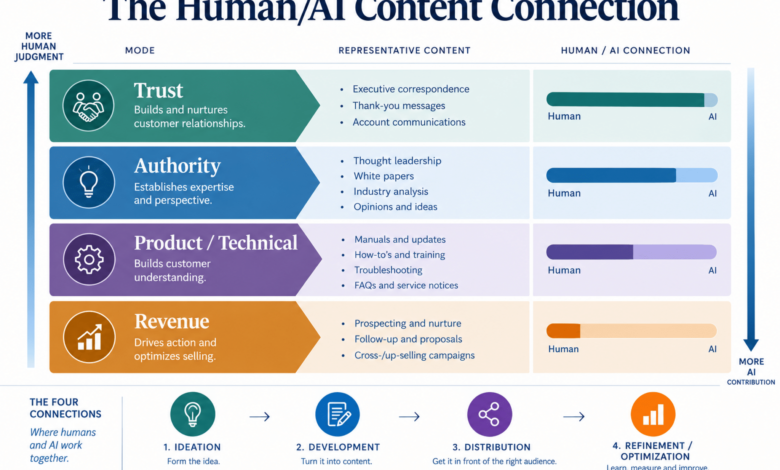
To successfully implement the Human-AI Content Connection, organizations must distinguish between four distinct modes of communication, each requiring a unique ratio of human judgment to machine speed.
1. Building Trust and Nurturing Relationships
This level encompasses executive communications, thank-you messages, and introductory notes regarding strategic shifts. Because these touchpoints are designed to solidify the bedrock of the B2B relationship, they must be owned by human practitioners. AI may serve as a drafting assistant for formatting or grammar, but the creative and emotional core must be distinctly human. Any detectable sign of machine generation at this level risks being interpreted as insincerity, potentially damaging years of account management efforts.
2. Establishing Authority
Thought leadership serves as the primary engine for demonstrating expertise. This includes white papers, opinion pieces, and analytical forecasts. While AI is adept at synthesizing vast amounts of data and creating explanatory visualizations, it cannot possess an original "point of view." Humans must articulate the unique interpretation of market shifts, as AI models are inherently trained on historical data, which inherently prevents them from producing true innovation. The human role here is to lead with perspective, using AI to refine the presentation of that expertise.
3. Technical Understanding and Product Support
Manuals, tutorials, and troubleshooting documentation represent the most effective arena for AI integration. Because these tasks are repeatable and fact-dependent, AI can significantly improve efficiency. However, the risk of "hallucinations"—where the AI presents false information with total confidence—requires a rigorous human oversight process. Every factual claim and technical figure must be audited by a human subject-matter expert before distribution to ensure the brand’s reliability is not compromised.

4. Revenue Generation
Sales communications, including cold outreach, nurture sequences, and proposals, occupy the final category. Here, the goal is optimization. AI excels at analyzing performance metrics, identifying ideal customer profiles, and suggesting pivots in real-time. By leveraging machine learning, sales teams can deliver highly specific communications at scale, provided that a human remains the architect of the underlying strategy.
The Chronology of the Human-AI Lifecycle
Integrating this framework requires a shift in how marketing teams approach the four-stage lifecycle of content production: ideation, development, distribution, and optimization.
The ideation phase is the most critical juncture. Many teams erroneously offload this to AI, asking models to generate campaign concepts based on existing data. This is a fundamental error, as AI only reproduces what already exists. True ideation requires the human capacity for rejection, association, and wonder—qualities that are absent in LLMs. By dedicating human time to the creative process, organizations ensure that their messaging resonates on a level that synthetic models cannot replicate.
Following ideation, the development phase serves as the testing ground for the communication. Here, AI acts as a "pre-mortem" partner, helping identify weak conclusions or unsupported arguments. This collaborative rigor allows the human author to refine the message, injecting the passion and eccentricity that define a brand’s unique voice.
Distribution follows, where the accuracy of the underlying database becomes the primary asset. AI serves as the engine for segmenting audiences and delivering messages at the optimal time, but the quality of the data remains a human responsibility. Finally, the refinement and optimization phase allows AI to take the lead. By monitoring engagement data and iterating on copy, AI can drastically shorten the time it takes to move a prospect through the sales funnel, provided the human team has established the guardrails and key performance indicators.
Broader Implications and Future Outlook
The broader impact of the Human-AI Content Connection is not just operational efficiency; it is a competitive differentiator. As the digital space becomes increasingly saturated with low-effort, AI-generated content, the "human premium" will rise. Companies that effectively utilize AI as a background tool while keeping their core value proposition firmly in human hands will likely see higher customer retention rates and stronger brand loyalty.
Data from recent enterprise software transitions suggest that organizations that fail to integrate a framework like this face a "productivity trap." They achieve a short-term surge in content volume, only to see a long-term decline in conversion rates as their audience disengages from the increasingly generic output. Conversely, those that treat AI as a junior assistant rather than a creative lead maintain the consistency of their brand voice.
Ultimately, the goal of this synthesis is to ensure that technology serves the relationship, rather than replacing it. The higher the stakes of the communication, the more essential the human element becomes. As artificial intelligence continues to evolve, the businesses that succeed will be those that view their human talent as the primary architect of their narrative, using the power of the machine to ensure that the message is delivered with precision, without ever sacrificing the humanity that makes the connection possible. By formalizing this connection, enterprises can navigate the transition into an AI-driven future while maintaining the trust and profitability that are essential to their long-term survival in a competitive global market.