AI-Powered Discovery Leads to Disclosure of Four Critical Linux Kernel Privilege Escalation Vulnerabilities

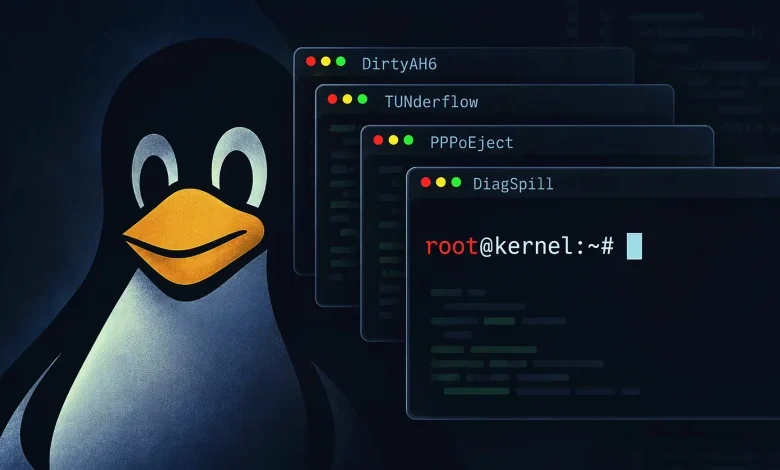
A security researcher has publicly released functional exploit code for a quartet of critical vulnerabilities within the Linux kernel, each capable of granting a local user root-level administrative access. These flaws, collectively identified as DirtyAH6, TUNderflow, PPPoEject, and DiagSpill, represent a significant, albeit now mitigated, risk to enterprise and consumer Linux environments. While the vulnerabilities have been successfully patched by kernel maintainers over the past several weeks, the emergence of proof-of-concept (PoC) code has intensified the urgency for system administrators to audit and update their infrastructure to ensure complete protection.
The vulnerabilities were discovered by security researcher Asim Manizada, who identified the flaws in mid-July. Following a period of coordinated disclosure with various Linux distribution maintainers, Manizada published a comprehensive technical analysis on September 18. This window of time allowed for the development and distribution of security patches before the exploit methodology became public knowledge. Currently, there are no documented instances of these vulnerabilities being exploited in the wild for malicious purposes; however, the availability of the exploit code lowers the barrier for potential attackers seeking to escalate privileges on compromised systems.
Chronology of Discovery and Disclosure
The discovery process for these four vulnerabilities highlights the evolving landscape of automated security research. Manizada utilized a custom-built, AI-assisted framework designed to map kernel memory management and identify logical inconsistencies in how the kernel handles data. This systematic approach allowed for the identification of deep-seated bugs that had, in some instances, existed for over two decades.
The timeline of the disclosure began in mid-July, when Manizada formally submitted his findings to the Linux kernel security team. Recognizing the severity of the potential for local privilege escalation (LPE), the maintainers prioritized the development of patches. Throughout August and early September, upstream fixes were integrated into the mainline kernel. The coordinated embargo period concluded on September 18, when Manizada released his detailed write-up, providing both the technical context of the flaws and the associated exploit scripts. This delay was a strategic choice intended to ensure that the primary Linux distributions—such as Ubuntu, Debian, Red Hat Enterprise Linux (RHEL), and SUSE—had sufficient time to propagate the security updates to their respective user bases.

Technical Breakdown of the Flaws
The four vulnerabilities are classified as memory-safety issues, residing within various segments of the kernel’s networking stack. The complexity of the Linux kernel, which comprises millions of lines of code, often leads to such architectural vulnerabilities where data is processed incorrectly, allowing for memory corruption that can be leveraged to gain unauthorized control.
- DirtyAH6 (CVE-2026-80844): This flaw impacts the IPsec AH6 (IPv6) component. It is reachable primarily through unprivileged user namespaces, a Linux feature that permits non-root users to perform operations within a sandboxed environment. In specific scenarios where a host acts as an IPv6 router and utilizes the Authentication Header in transport mode, the flaw can trigger a system crash.
- TUNderflow (CVE-2026-81000): Situated within the TUN/TAP virtual network device driver, this vulnerability also requires the presence of unprivileged user namespaces. By manipulating the virtual interface, an attacker can trigger memory corruption, leading to potential privilege escalation.
- PPPoEject (CVE-2026-68121): Affecting the Point-to-Point Protocol over Ethernet (PPPoE) implementation, this flaw allows for local privilege escalation when unprivileged user namespaces are active.
- DiagSpill (CVE-2026-74469): Unique among the quartet, DiagSpill does not require unprivileged user namespaces. It involves the SCTP (Stream Control Transmission Protocol) diagnostic module. As long as the SCTP networking module is loaded on the system, an attacker may exploit this vulnerability. While primarily a crash-inducing bug, it represents a significant path for potential escalation under specific configurations.
The Role of User Namespaces and Attack Surface
The reliance of three out of the four vulnerabilities on "unprivileged user namespaces" underscores a recurring debate in the Linux security community. User namespaces were designed to improve container security by allowing processes to run with elevated privileges within a private, restricted environment. However, this feature has also expanded the attack surface of the kernel by allowing unprivileged users to interact with code paths that were previously restricted to root-level users.
While disabling user namespaces can serve as a temporary mitigation strategy for systems that cannot be immediately patched, it may break functionality for containerized applications like Docker or Podman. Consequently, experts, including Manizada, emphasize that patching the kernel is the only reliable long-term solution. Turning off specific features is viewed as an incomplete defense, as other, as-yet-undiscovered vulnerabilities may exist within the same subsystems.
Implications for Multi-User and Cloud Environments
Local privilege escalation remains one of the most critical threats in multi-user environments, including shared hosting servers, cloud infrastructure, and enterprise workstations. In these scenarios, an attacker often begins with limited, low-privileged access. The goal is to move horizontally or vertically to gain "root" or "superuser" status, which would allow them to bypass system security controls, install persistent backdoors, steal sensitive data, or deploy ransomware.
The fact that these exploits can be tuned to specific kernel builds suggests that while they are not "one-size-fits-all" tools, they are highly effective in the hands of a determined actor. Furthermore, the possibility of container escape—where a user within a container breaks out into the host kernel—presents a severe risk to cloud providers. Although Manizada did not construct a container-escape exploit, he noted the theoretical possibility, warning that security teams must treat these vulnerabilities with high priority.

The Rise of AI in Bug Hunting
The discovery of the DirtyAH6, TUNderflow, PPPoEject, and DiagSpill vulnerabilities marks a milestone in the application of artificial intelligence to cybersecurity research. By leveraging LLM-based logic to analyze kernel memory layouts, Manizada was able to uncover flaws that had persisted in the codebase for 10 to 21 years.
This development follows a broader trend seen throughout 2026, where several high-profile kernel vulnerabilities were identified using AI-assisted analysis. The inclusion of an "Assisted-by" line in the official Linux kernel commit for the DirtyAH6 fix acknowledges the shift in how vulnerabilities are being found. As AI tools become more sophisticated, the speed at which both researchers and malicious actors can identify zero-day vulnerabilities is expected to accelerate, placing greater pressure on the open-source community to maintain robust, rapid patch cycles.
Recommendations for System Administrators
To mitigate the risks posed by these four vulnerabilities, organizations must verify that their systems are running the latest security-patched kernels.
- Audit Kernel Versions: Administrators should check their specific Linux distribution’s security bulletins. Because major distributions (e.g., Ubuntu, Debian, RHEL, CentOS, AlmaLinux, SUSE) maintain their own kernel versioning schemes, users should not rely solely on upstream Linux project version numbers.
- Prioritize Patching: Apply kernel security updates as part of a standard maintenance window. Given the public availability of the exploit code, the window of time for attackers to reverse-engineer and weaponize these scripts is limited.
- Evaluate Configuration: For systems that cannot be updated immediately, assess whether unprivileged user namespaces can be restricted via sysctl settings (e.g.,
kernel.unprivileged_userns_clonein some distributions). However, this should only be a secondary measure, as it may cause application instability. - Monitor System Logs: Ensure that kernel crash logs (dmesg) are being monitored. The DiagSpill and DirtyAH6 vulnerabilities, even if they fail to grant root access, may result in noticeable system instability or unexpected kernel panics, which can serve as an indicator of an exploitation attempt.
As the Linux kernel continues to serve as the backbone of the modern internet and cloud computing, the discovery and remediation of these vulnerabilities serve as a reminder of the ongoing necessity of proactive security maintenance. The collaboration between individual researchers and the Linux kernel maintainers remains the primary defense mechanism against such threats, ensuring that the foundational software of the digital age remains resilient in the face of increasingly sophisticated attack methodologies.