AWS Announces General Availability of Continuum for Code Vulnerabilities to Streamline Cloud Security and Automated Remediation

Amazon Web Services (AWS) has officially announced the general availability of AWS Continuum for code vulnerabilities, a security service engineered to detect, validate, and remediate application security flaws. The service operates by evaluating code vulnerabilities, determining their actual exploitability within a specific cloud environment, ranking them based on real-world business impact, and generating targeted patches delivered directly to code repositories as pull requests. By blending automated context gathering with human-in-the-loop oversight, AWS Continuum addresses one of the most persistent bottlenecks in modern software development and cybersecurity operations: the overwhelming volume of false positives and alert fatigue generated by traditional vulnerability scanners.
The launch comes at a critical juncture in the enterprise software lifecycle. In contemporary development environments, the widespread adoption of artificial intelligence and frontier AI models by both developers and malicious threat actors has fundamentally transformed the cybersecurity landscape. Threat actors can now ingest vulnerability disclosures and manufacture functional exploit code within minutes, compressing the window of exposure for organizations worldwide. Simultaneously, automated scanning tools deployed across extensive enterprise application estates routinely generate thousands of findings daily. Many of these alerts represent theoretical risks that are unreachable over a network, mitigated by existing runtime controls, or located in isolated development environments that never interact with production data.
Historically, distinguishing a genuine, exploitable threat from a benign alert required hours of intensive manual investigation by security engineers. Furthermore, deploying a remediation safely required days of cross-functional coordination involving security, infrastructure, and application development teams. Because traditional generic severity scores fail to account for the unique network topology, asset criticality, and data access pathways of an individual cloud deployment, organizations frequently struggled to gauge the true blast radius of a vulnerability or a prospective fix. AWS Continuum was developed to close this operational gap by bridging the divide between static code analysis and dynamic cloud environment context.
Core Architecture and Context Graph Mechanics
At the heart of AWS Continuum lies its ability to construct a comprehensive context graph derived from two primary data streams: application code repositories and live AWS cloud environments. To establish this context within an AWS account, organizations deploy a specialized collector in the designated region where workloads operate. This collector inventories infrastructure details utilizing AWS Config resources, network configurations, and security group parameters. By mapping these components, Continuum evaluates whether a specific software vulnerability is reachable over the network and maps the potential lateral movement pathways available to an unauthorized actor.

Beyond mere network reachability, the context graph synthesizes information regarding system criticality, asset ownership, inter-service dependencies, and data classification. This capability allows the service to pinpoint high-value enterprise assets, such as core customer data stores, payment processing pipelines, and centralized authentication services. Consequently, rather than relying on isolated severity ratings, Continuum ranks issues according to the proximity of the vulnerable component to these mission-critical systems and the plausibility of an attack path.
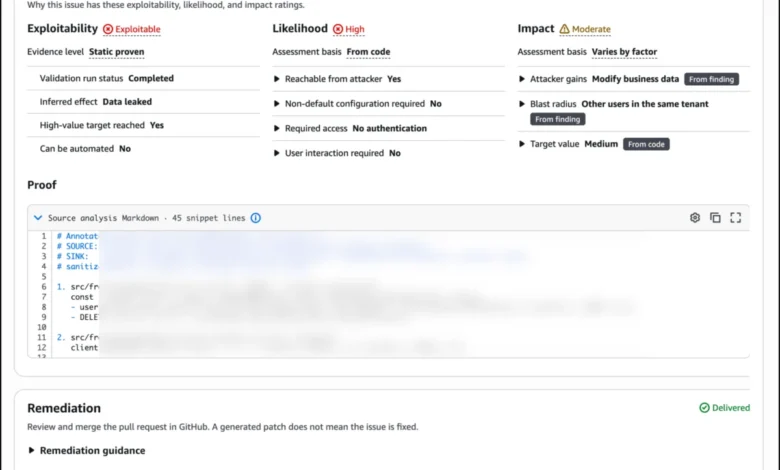
Each security finding processed by the service undergoes rigorous analysis against both the source code and the runtime environment. Continuum assigns an explicit evidence level to each finding—such as a verdict proven definitively through static analysis of the vulnerable code path. For findings capable of programmatic reproduction, the service executes the exploit within an isolated, secure sandbox environment. It then bundles proof-of-concept code, step-by-step reproduction instructions, and a precise blast radius assessment. Rather than presenting security teams with a monolithic risk score, the platform provides actionable intelligence including source analysis, attack paths, and evaluations of whether existing runtime defenses would successfully intercept a validated exploit.
Automated Remediation and the Human-in-the-Loop Workflow
Once AWS Continuum confirms and prioritizes a vulnerability, it generates a precise remediation. Depending on the nature of the flaw, this fix may take the form of a code patch, a dependency version upgrade, or a specific infrastructure configuration modification. The service automatically opens this remediation as a pull request within the organization’s connected code repository, formatting the changes so they are immediately accessible for review.
Crucially, the platform enforces a strict human-in-the-loop governance model during its initial release phases. Every generated patch requires explicit human approval; engineering teams retain absolute authority to review, modify, and merge or reject the pull request. This ensures that the final deployment decision remains firmly under internal control. AWS has indicated that future iterations of the service will introduce configurable automation tiers, permitting organizations to establish guardrails—such as mandatory test coverage thresholds, strict scope bounds, and historical success rates—whereby Continuum can apply trusted remediation classes autonomously.
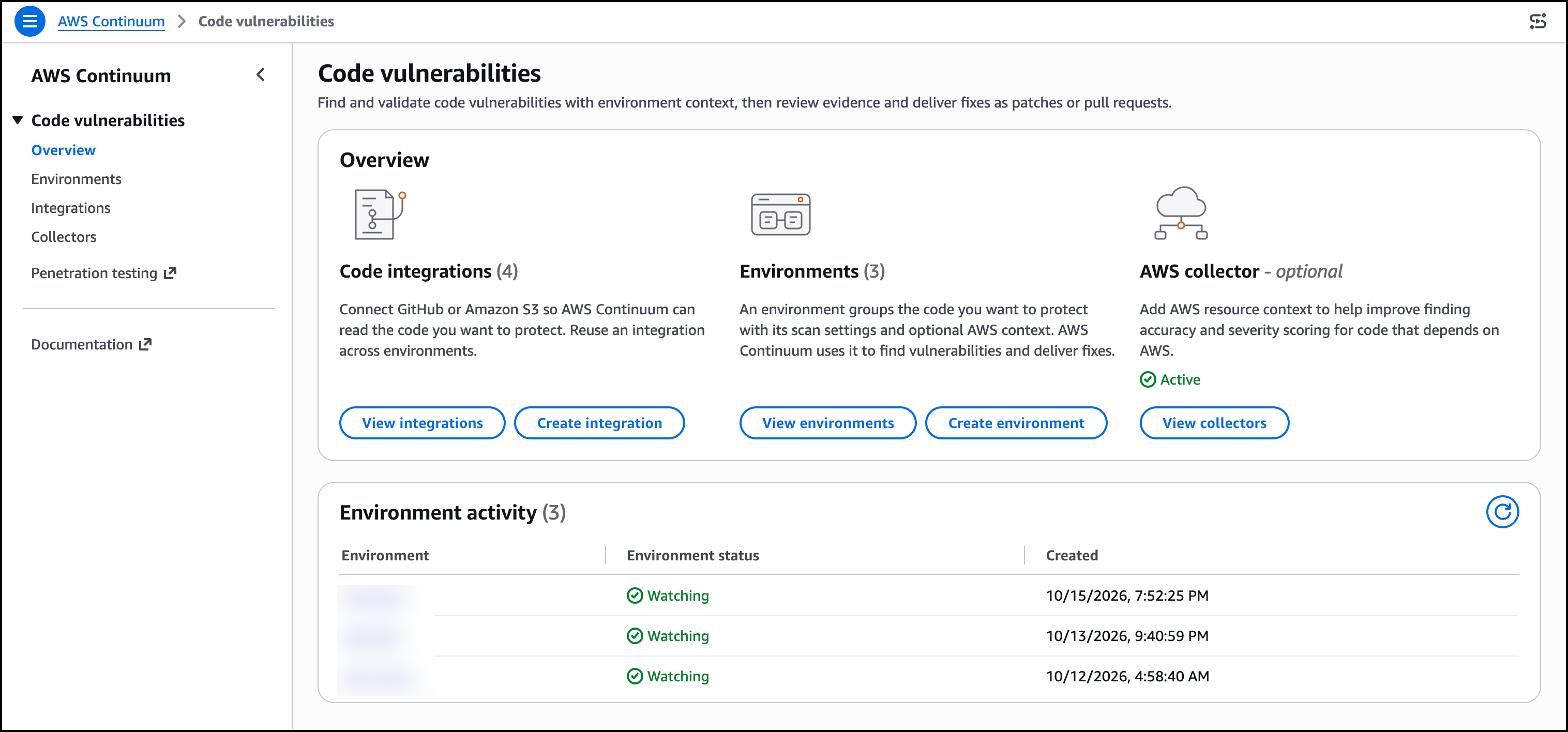
To operationalize the service, administrators navigate to the AWS Continuum console and access the code vulnerabilities management interface. Integrating code sources involves establishing a secure connection with a GitHub organization or designating an Amazon Simple Storage Service (Amazon S3) bucket. S3-based configurations require the storage bucket to reside within the same AWS account and region where Continuum is active, granting access via a securely assumed AWS Identity and Access Management (IAM) role. Users then configure scanning schedules and deploy infrastructure collectors to supply real-time resource context.
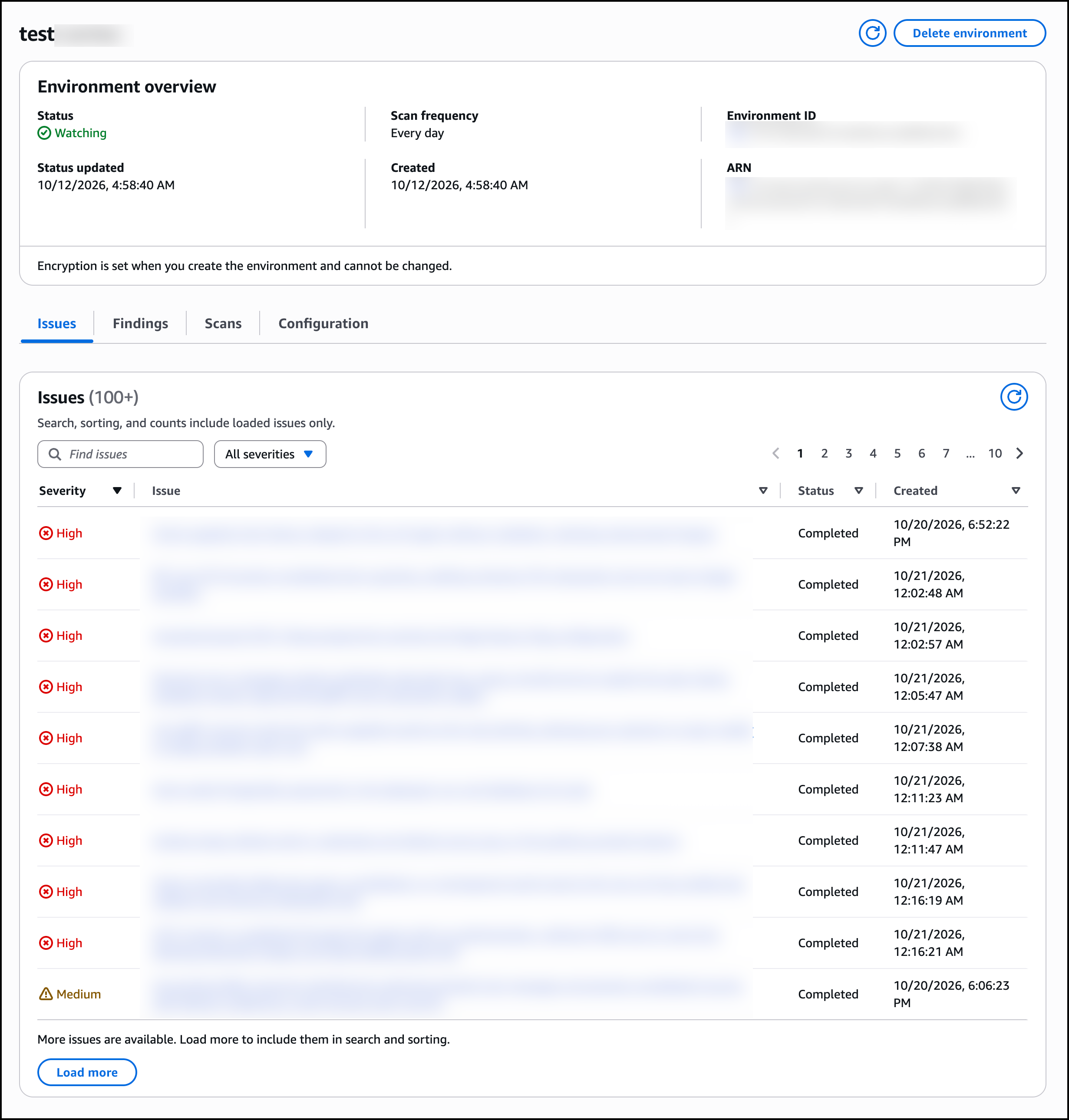
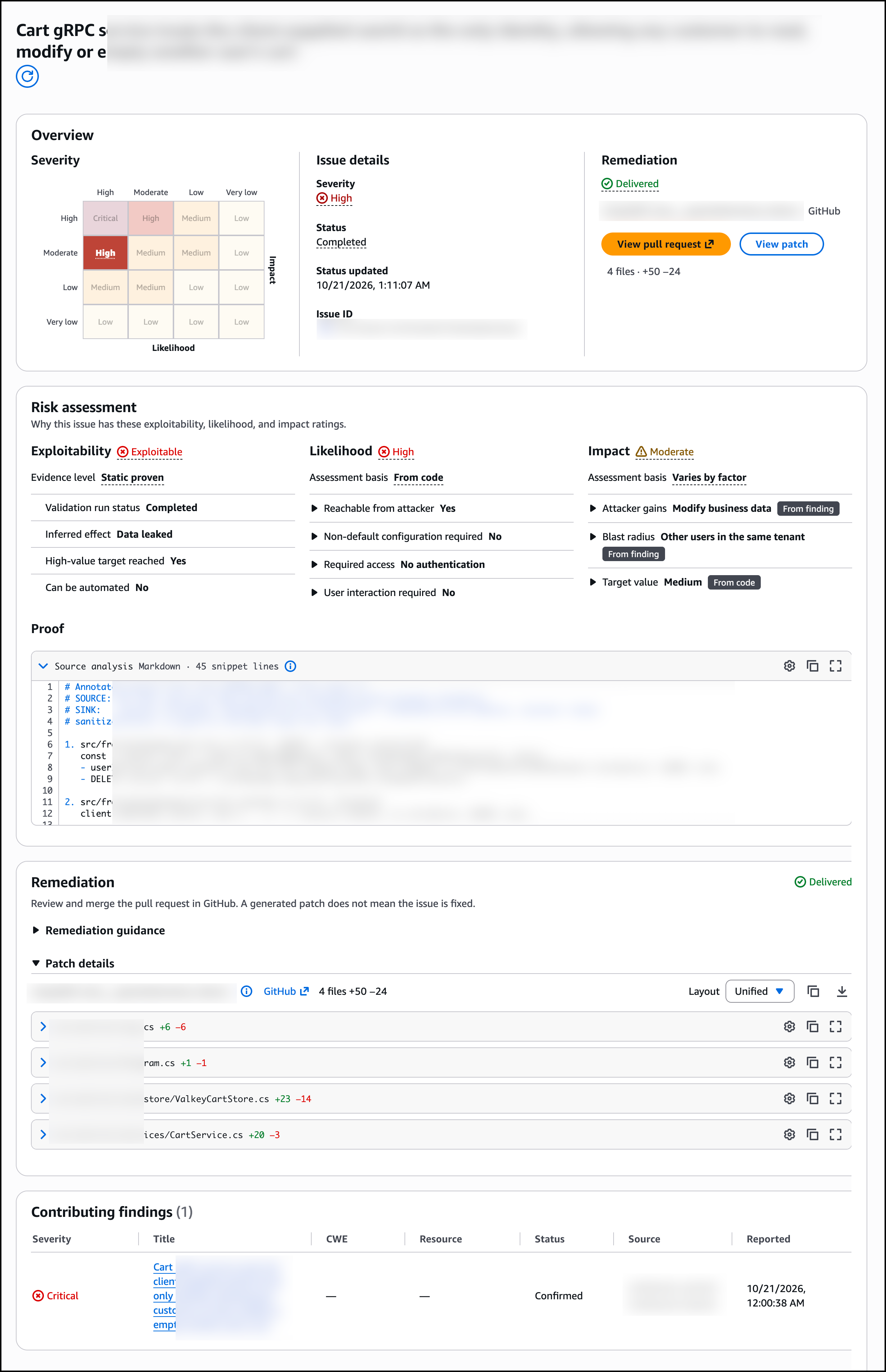
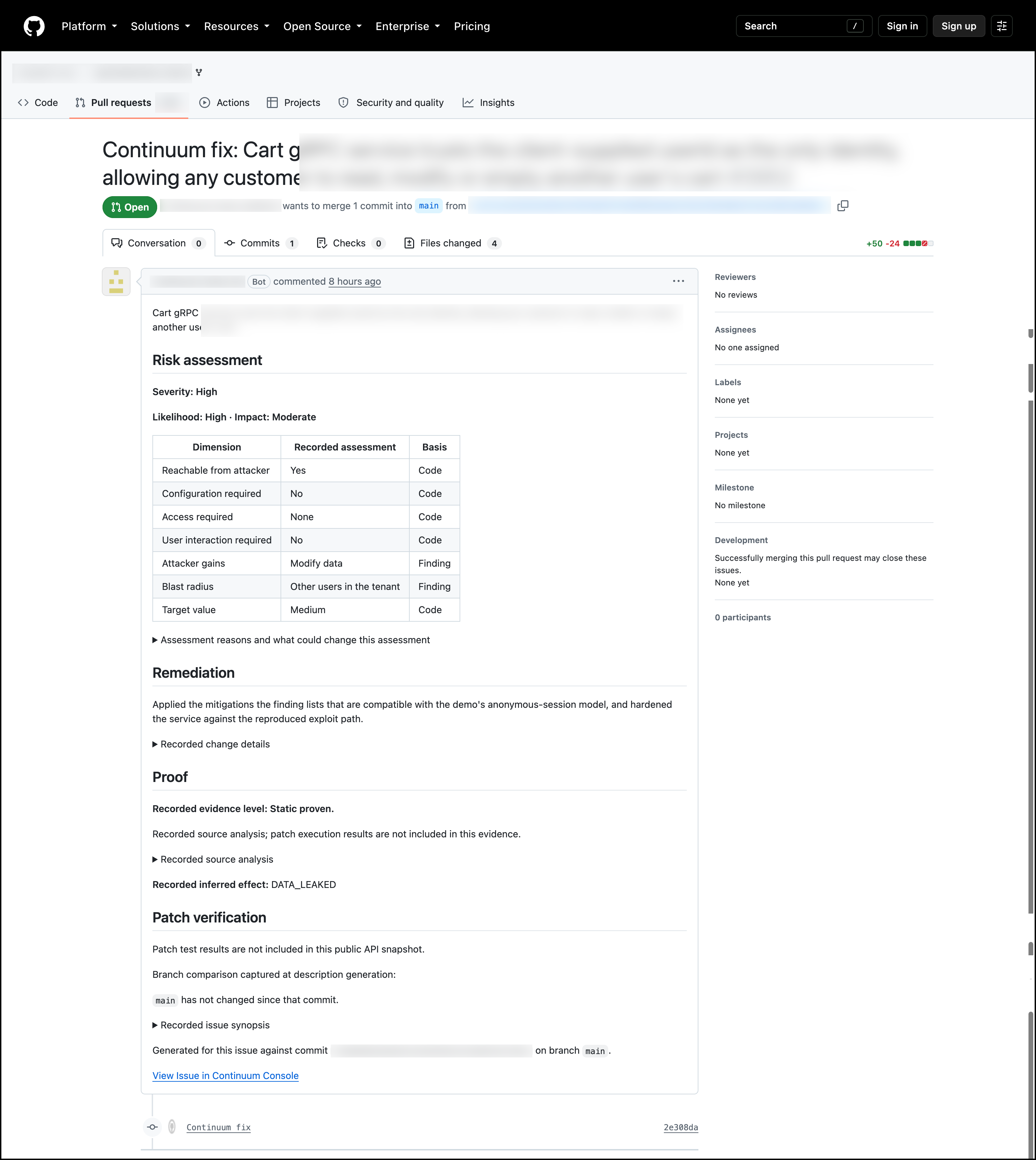
Within the console overview dashboard, administrators gain centralized visibility into active code integrations, associated scanning environments, and collector health statuses. When evaluating an individual environment, the issues tab surfaces validated, prioritized vulnerabilities rather than raw scanner outputs. Selecting a specific vulnerability reveals a detailed risk assessment outlining exploitability, likelihood, impact, and a thorough proof section detailing the underlying source analysis.
The integrated remediation view displays the exact file alterations made by the service—such as line additions and deletions across affected microservices—alongside a direct link to the corresponding pull request in GitHub. The pull request description mirrors the comprehensive risk assessment and remediation summary found in the console, ensuring that code reviewers can evaluate the evidence without context-switching between platforms. Additional tabs within the console allow security teams to audit historical scan execution logs, configure scan frequencies on demand, and manage environment-level settings.
Industry Implications and Future Outlook
The introduction of AWS Continuum for code vulnerabilities arrives as enterprises grapple with escalating application complexity and a persistent shortage of specialized cybersecurity personnel. Industry analysts note that as software supply chains expand and microservices architectures proliferate, the manual auditing of vulnerabilities has become mathematically unsustainable for large enterprises. By automating the correlation between static code analysis and dynamic cloud topology, services like Continuum represent a significant evolution in Application Security Posture Management (ASPM) and Cloud Native Application Protection Platforms (CNAPP).
Security executives emphasize that the principal value of context-aware remediation lies in the reduction of "noise" that frequently paralyzes development teams. By filtering out unreachable vulnerabilities and providing verified proof-of-concept exploits accompanied by ready-to-merge patches, organizations can drastically reduce their Mean Time to Remediation (MTTR) without sacrificing code stability or operational velocity. Furthermore, the granular transparency provided by proof-level evidence fosters greater trust between security operations centers (SOCs) and software engineering departments, bridging a historically contentious cultural divide.
Availability and Deployment Specifications
AWS Continuum for code vulnerabilities is commercially available today. Initial regional availability includes the US East (N. Virginia) and US West (Oregon) AWS Regions. Comprehensive pricing structures, usage tiers, and cost calculators are detailed on the official AWS Continuum pricing portal. Detailed technical documentation, integration guides, and prerequisites for connecting GitHub and Amazon S3 repositories are maintained within the official AWS Continuum User Guide. As organizations continue to scale their cloud-native estates, the rollout of automated, context-driven validation and remediation tools underscores the ongoing transition toward proactive, machine-assisted defensive architectures in enterprise computing.
Related posts: