The AI Era: Every Excuse to Transform Your Life Is Gone. What’s Left Is Permission.


The dawn of widespread artificial intelligence has fundamentally altered the landscape of personal and professional development, dissolving traditional barriers and leaving individuals with a stark, unvarnished choice: to evolve or to remain stagnant. This paradigm shift, accelerated by the rapid integration of AI technologies, presents an unprecedented opportunity for transformation, but it simultaneously eliminates many of the external excuses that once buffered against change. The core of this new era, therefore, is not about acquiring new skills in the conventional sense, but about granting oneself the permission to embark on a journey of reinvention.
The personal narrative of leaving the familiar for the unknown is a potent metaphor for the current technological revolution. Reflecting on a pivotal moment at seventeen, a journey undertaken with both trepidation and excitement, signifies the first deliberate step through a doorway into a larger world. This act of choosing the unknown over the perceived safety of the familiar is a recurring theme. The rooms we inhabit, whether they are comfort zones, established routines, or outdated skill sets, offer a sense of security. However, they are inherently limited. The doors we choose to open, though initially daunting, invariably lead to expansions of our potential and understanding. Today, Artificial Intelligence has collectively thrown open such a door for humanity, yet the discourse often overlooks what lies beyond.

AI is not a deceptive ploy; its gifts are tangible and measurable, paving the way to an uncharted territory. These gifts, four in number, offer profound advantages for individuals and organizations alike.
The Gift of Unearned Expertise
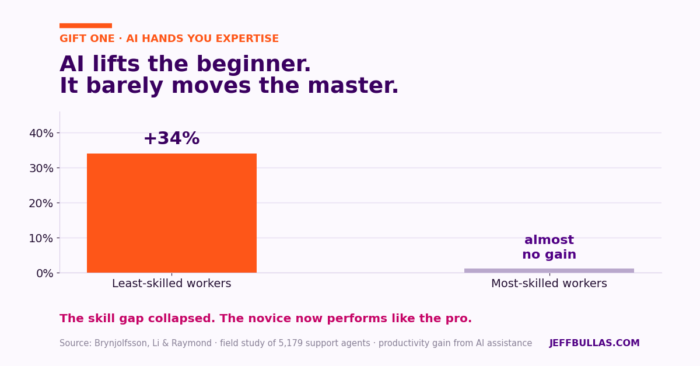
One of the most significant contributions of AI is its ability to democratize expertise. Research conducted by Stanford and MIT on customer support workers revealed that the implementation of an AI assistant led to a 14% average increase in productivity. Crucially, the least skilled workers experienced a remarkable 34% improvement, while those already highly experienced saw minimal gains. This data, documented in a National Bureau of Economic Research working paper (Brynjolfsson, Li & Raymond, NBER), highlights AI’s capacity to elevate novices to a level of proficiency that previously required years of dedicated practice and training. The skill gap, particularly in rote or data-intensive tasks, effectively collapses, handing the foundational patterns of expertise to those who have yet to master them through experience. This phenomenon democratizes access to advanced capabilities, leveling the playing field for individuals and smaller organizations that may not have had the resources to cultivate such expertise internally.
The Demise of Friction
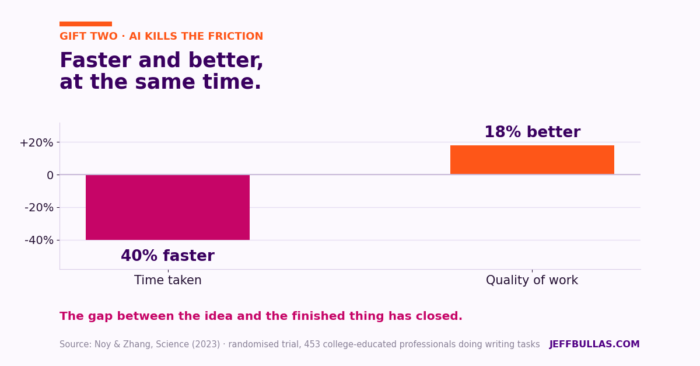
Another transformative gift is the radical reduction of friction between an idea and its execution. A study published in the journal Science examined professionals engaged in writing tasks, with one group utilizing ChatGPT. This group demonstrated a 40% decrease in task completion time while simultaneously improving work quality by 18% (Noy & Zhang, Science). This dual improvement of speed and quality suggests that AI significantly shortens the distance between conceptualization and tangible output. Tasks that were once time-consuming and complex can now be accomplished with remarkable efficiency. This has profound implications for innovation, allowing individuals and teams to iterate more rapidly and bring new products, services, and ideas to market with unprecedented velocity.
The Collapse of Complexity
AI’s ability to process vast amounts of information and execute intricate tasks with precision has led to the collapse of complexity in many domains. Work that historically required specialized teams, substantial budgets, and years of accumulated knowledge can now be initiated and often completed with relative ease, sometimes within an afternoon, given the right prompts. The arduous has become accessible. This reduction in complexity empowers individuals to tackle challenges previously deemed insurmountable, fostering a more agile and adaptive approach to problem-solving across industries. For instance, in fields like scientific research, AI can accelerate data analysis and hypothesis generation, significantly shortening discovery timelines.
The Unnamed Gift: Permission to Venture
The fourth, and perhaps most potent, gift offered by AI is the freedom to embark on personal and professional adventures. Historically, significant undertakings were often hindered by perceived limitations such as a lack of capital, insufficient skills, no established team, limited time, or simply not knowing where to begin. AI tools, by addressing the skill and efficiency deficits, have effectively dismantled these common barriers. The remaining obstacle is not a lack of capability, but a deficit of self-permission. This internal hurdle, the psychological barrier to taking a leap of faith, is what AI cannot overcome.
The Gate is Within
The assertion that "everything standing in your way is behind your own eyes" is a critical insight. The process of personal and professional advancement now hinges on two steps: granting oneself permission to pursue a new path and then taking action. A compelling idea, left unacted upon, inevitably withers. This internal gate, the decision to move forward, is uniquely human and beyond the purview of any machine.
The Unforeseen Consequence: Crowded Doors
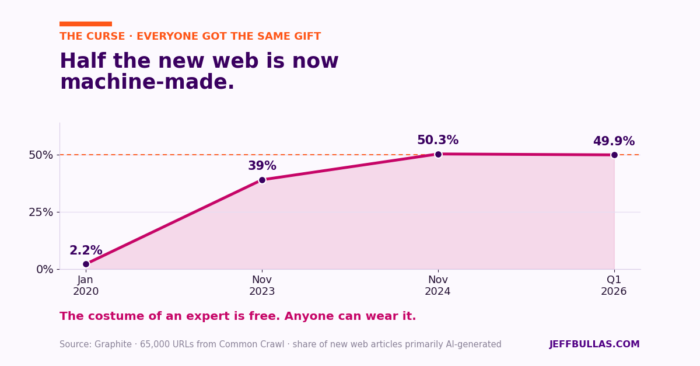
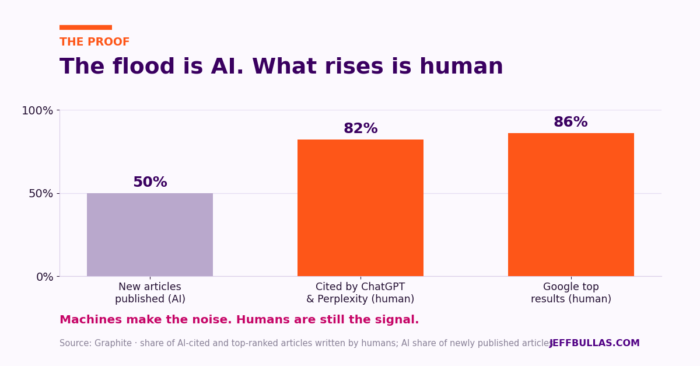
However, this technological revolution is not without its complexities. The universal availability of these AI-powered tools, disseminated simultaneously and at minimal cost, has led to a significant influx of individuals venturing through the newly opened doors. In January 2020, machine-generated web articles constituted approximately 2% of online content. By late 2024, this figure had surpassed 50%, with AI now contributing roughly half of all new web articles. This surge in content creation, driven by the ease of access, is a direct consequence of arithmetic – more people can start, leading to more output. This is not a flaw in the system, but an inevitable outcome of its accessibility. The "costume of an expert" has become readily available, allowing virtually anyone to don it.
The True Obstacle: Diminished Difficulty
The real antagonist in this narrative is not the machine, but the historical reliance on difficulty as a barrier to entry. For years, the challenge of execution, the sheer effort required to produce content or complete complex tasks, served as a natural moat, protecting established players and deterring casual participation. When the author began their blog in 2009, the technical hurdles were significant, acting as a formidable, albeit unintentional, safeguard. This difficulty, while arduous, was performing a service by regulating access. AI has now effectively drained this moat, opening the floodgates for both seasoned professionals and a multitude of new entrants. The trade-off presented by AI is the provision of powerful tools alongside an exponential increase in competition and audience saturation.
The Price of Passage
The act of stepping through a new door, of venturing into the unknown, has always demanded a price. This price is often paid in fear, anxiety, and sustained effort without immediate guarantee of success. The author’s personal journey illustrates this: leaving home at seventeen, departing a deeply ingrained religious upbringing at twenty-seven, and transitioning to self-employment at fifty-two. Each step involved confronting the fear of rejection, ostracism, and uncertainty. The cost was real – years of dedication, financial risk, and the gnawing doubt of whether the endeavor would ultimately succeed. This is the often-omitted reality behind the romanticized notion of "following your dream."
However, the rewards of paying this price are profound. They include the freedom to grow, the resilience forged through failure, and an intrinsic motivation that transcends the need for external discipline. This drive, this desire to engage with one’s work, is not born from self-help books or productivity systems; it is a direct consequence of embracing the challenge and walking through the door. While AI can furnish skills, speed, and finished products, it cannot impart the fundamental reason for one’s engagement or the deep-seated motivation that fuels sustained effort.
AI’s Limits: Doing vs. Deciding
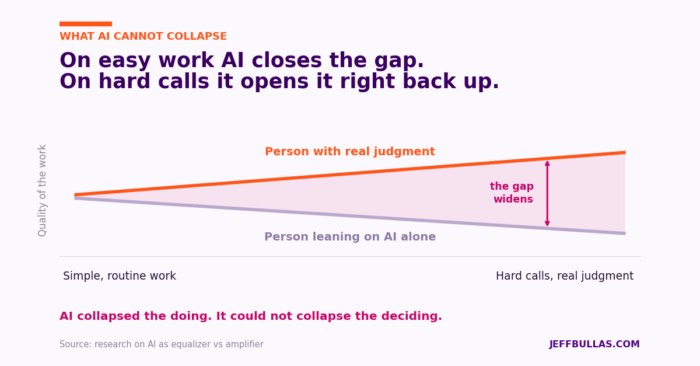
The narrative of AI’s capabilities often overlooks a critical distinction. While AI excels at streamlining and democratizing routine and repetitive tasks, thereby closing the gap between beginners and experts, its efficacy diminishes when faced with complex decisions requiring nuanced judgment, taste, and context. In these instances, AI acts as an amplifier for existing human expertise, rather than an equalizer. It magnifies the capabilities of those who already possess deep domain knowledge and decision-making acumen.
This dynamic is evident in the market’s response. While approximately half of all new web articles are now machine-generated, a significant disparity emerges when examining content that achieves high visibility. Data indicates that 86% of articles ranking in Google Search were written by humans, and 82% of articles cited by leading AI platforms like ChatGPT and Perplexity were also human-authored (Graphite analysis). This suggests that while AI can generate a flood of content, human authorship remains the signal of quality and authority in discerning audiences and search algorithms. The machines are creating the noise; humans are still providing the signal.
Building True Authority in the Age of AI
If the ability to merely "produce" is no longer the primary differentiator, the question arises: what then becomes the valuable currency? The answer lies in cultivating a unique and trusted record of judgment. In a world where AI can replicate output, genuine authority is built on the foundation of human discernment and accountability.
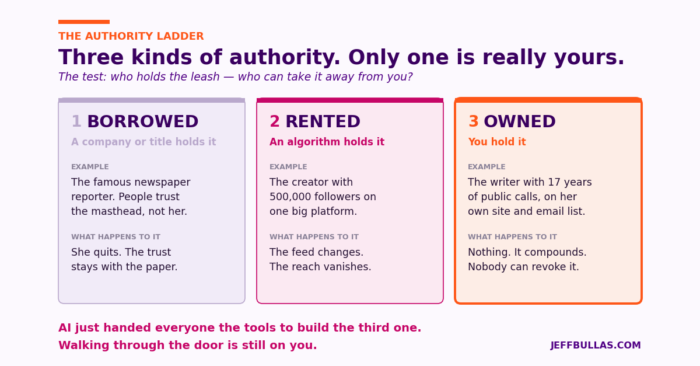
There are distinct forms of authority, each defined by who ultimately holds control: borrowed, rented, and owned. Borrowed authority is transient, dependent on external validation. Rented authority is subject to the whims of platforms and algorithms. Owned authority, however, is earned and immutable.
The erosion of trust in traditional institutions is a growing global concern. A recent Edelman Trust Barometer report highlights that a significant majority of people globally worry about deliberate misinformation from government officials, business leaders, and journalists, and perceive institutions as serving narrow interests. This decline in institutional trust necessitates a shift towards person-to-person earned authority. When titles lose their inherent credibility, trust must be built through consistent, reliable, and transparent engagement.
Owned authority is constructed not through shortcuts, but through five fundamental pillars:
- Authenticity: Genuine self-expression and transparency.
- Curiosity: A relentless pursuit of learning and understanding.
- Courage: The willingness to take risks and express unpopular opinions.
- Credibility: Demonstrable expertise and a track record of reliable information.
- Commitment: Unwavering dedication to one’s principles and audience.
Building this authority involves an ongoing loop:
- Choose a question: Identify a problem or area of inquiry.
- Seek the answer: Engage in research, experimentation, and critical thinking.
- Test your findings: Apply your knowledge and assess the outcomes.
- Share your judgment: Articulate your conclusions publicly and transparently.
- Listen and iterate: Engage with feedback and refine your understanding.
The final step, actively listening to feedback and iterating on one’s judgments, is the most frequently overlooked yet most crucial element. It is in this continuous process of refinement that unique authority is forged, making it the most accessible and yet unclaimed form of influence in the current landscape.
The Door, Not the Room
The purpose of writing is not to project an image of infallibility, but to engage in a process of understanding. This journey of discovery resonates with audiences more profoundly than mere performance. While machines can deliver instant answers, they cannot replicate a lifetime of earned judgment. That is a path walked, one deliberate step at a time, often through challenging circumstances.
We stand at a juncture where the tools are abundant, the barriers to entry have dissolved, and the familiar rooms are now densely populated. The only enduring, inimitable, and non-revocable asset is the demonstrable journey of a person who consistently learns, takes calculated risks, and communicates truth in the public sphere, thereby building irrefutable trust.
AI has opened the door for everyone. The decision to walk through it, and what one chooses to build on the other side, remains a profoundly human undertaking. The question that lingers is not about the technology, but about the individual: what room are you still standing in?