Volt Typhoon linked to sophisticated Silent Train covert access network for strategic cyber espionage

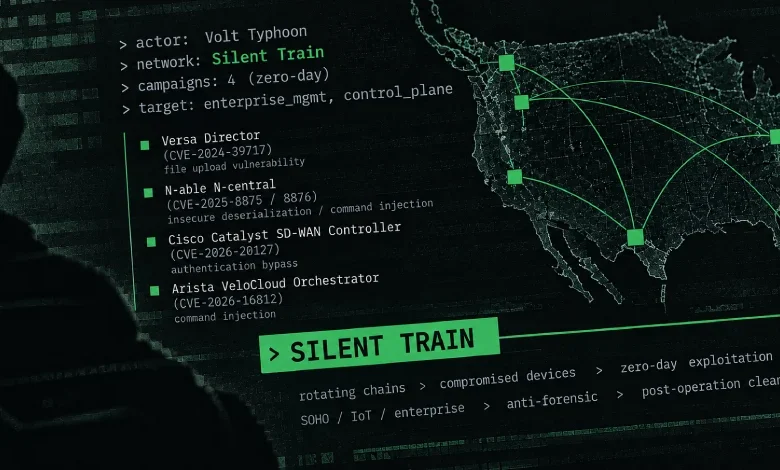
The China-nexus cyber espionage collective known as Volt Typhoon has been definitively linked to a highly sophisticated and previously undisclosed covert access network identified by security researchers as "Silent Train." This infrastructure, which emerged in late 2023, has served as a primary engine for the group’s zero-day exploitation efforts and its long-term strategic positioning within critical U.S. infrastructure. Unlike traditional botnets that rely on persistent, easily identifiable command-and-control (C2) servers, Silent Train utilizes a rotating, ephemeral architecture of compromised Small Office/Home Office (SOHO), Internet of Things (IoT), and enterprise-grade devices to mask its movements and avoid detection by national security agencies.
The discovery, detailed in a comprehensive report by Lumen Technologies’ Black Lotus Labs, highlights an evolution in the tactics employed by Volt Typhoon—also tracked by various intelligence entities as Bronze Silhouette, Insidious Taurus, UNC3236, Vanguard Panda, and Voltzite. By leveraging a multi-hop, transient framework, the group has successfully conducted reconnaissance, credential harvesting, and data exfiltration while maintaining a level of operational security that has consistently challenged defensive efforts.
Chronology of Operational Evolution
The development of the Silent Train network appears to be a direct response to the successful disruption of earlier state-sponsored infrastructure. In late 2023, just weeks before a coordinated international effort dismantled the KV-botnet—a major IoT network associated with Chinese state-sponsored actors—Volt Typhoon began establishing the foundations for its new, more resilient framework.
Following the second, more decisive disruption of the KV-botnet in January 2024, Volt Typhoon accelerated its migration toward the ephemeral infrastructure model. While previous campaigns often relied on static nodes that could be identified and sinkholed by federal authorities, Silent Train utilizes one-time-use chains of compromised devices. These chains are rapidly assembled, utilized for a specific operation, and subsequently dismantled, with all forensic artifacts purged.

Throughout 2024, the group demonstrated a mastery of zero-day exploitation. A notable example occurred in August 2024, when the group leveraged a file upload vulnerability in the Versa Director platform (CVE-2024-39717). This exploit enabled the deployment of the custom-built "VersaMem" web shell, allowing the threat actors to harvest credentials and gain unauthorized, persistent access to the downstream customers of the compromised service providers.
By early 2025, the architecture underwent further maturation. While the initial iteration of Silent Train was entirely ephemeral, researchers observed a shift toward a hybrid model. This newer iteration retains high-value enterprise devices for periods ranging from one to three months, augmenting their utility through the use of open-source proxy tools such as Chisel and FRP to establish robust reverse-tunnels.
Architectural Breakdown of Silent Train
Silent Train functions as a layered, multi-hop relay system designed to obscure the origins of malicious traffic. By routing commands through several intermediaries before reaching the ultimate target, the operators ensure that forensic investigators see only the final hop of a complex chain.
Each class of hardware within the network serves a designated strategic function. For instance, low-end devices like Intelbras modems have been consistently observed acting as initial relay nodes, while more powerful, U.S.-based appliances—such as Netgear Orbi routers and Fortinet FortiGate firewalls—are utilized as the final intermediary or exit points. This deliberate compartmentalization allows the threat actors to separate their "utility" infrastructure from their "operational" infrastructure.
The scale of the exploitation is significant, with researchers cataloging at least 27 distinct device classes enrolled into the network. These range from common consumer-grade hardware from vendors like TP-Link, Zyxel, and SATO to sophisticated enterprise platforms including Cisco and Mirth Connect. During a typical operation, a session might last only four hours, during which the attackers deploy temporary SSH services, modify configuration files, and execute "living-off-the-land" binaries—utilities already present on the system that allow the attackers to blend into legitimate administrative traffic.

Impact on Critical Infrastructure
The victimology of the Silent Train campaign underscores a clear strategic intent: the long-term positioning for potential disruption of mission-critical services. Hundreds of entities have been impacted, spanning the telecommunications, energy, maritime, rail, aviation, and emergency services sectors. Furthermore, the campaign has deeply penetrated government, defense contracting, and satellite communication providers.
Geographically, the activity is heavily concentrated in the United States, with a particular focus on Hawaii, California, and Texas. These regions are host to a dense concentration of military installations, critical logistics hubs, and essential telecommunications infrastructure. Security analysts suggest that this geographic targeting is not coincidental but rather a calculated effort to maintain a "pre-positioned" presence within networks that would be essential during a period of geopolitical crisis, particularly concerning tensions in the Indo-Pacific region.
Defensive Implications and Strategic Challenges
The shift toward ephemeral, self-managed sessions represents a significant hurdle for traditional signature-based detection systems. Because the infrastructure is constantly refreshed and the artifacts are cleaned post-operation, defenders have a shrinking window of opportunity to detect an active breach.
"The resulting picture is one of a highly structured framework built to acquire, protect, and sustain strategic access at scale," noted the researchers at Black Lotus Labs. By focusing on centralized management platforms and control-plane technologies, Volt Typhoon has demonstrated an ability to achieve broad visibility across large, complex enterprise environments.
The use of zero-day vulnerabilities, such as the previously undisclosed flaw in Quest KACE that was patched in October 2025, further complicates the defensive landscape. Each successful zero-day campaign provides the threat actor with a "clean" entry point into highly secure environments, bypassing traditional perimeter defenses that rely on known threat intelligence.

Official Response and Outlook
While the U.S. government has not issued a new, specific indictment regarding the Silent Train infrastructure, the findings align with long-standing warnings from the Cybersecurity and Infrastructure Security Agency (CISA) and the FBI regarding the persistent threat posed by China-linked actors to the nation’s "critical life-support" systems.
The move toward hybrid, longer-lived proxy infrastructure suggests that Volt Typhoon is balancing the need for stealth with the desire for more reliable, persistent access. As the group continues to refine its techniques, the challenge for network defenders shifts from mere perimeter hardening to a need for deeper, host-based monitoring and behavioral analysis.
The transition to using diverse, multi-vendor device chains makes it nearly impossible for any single hardware manufacturer to "patch" their way out of the threat. Instead, security experts argue that the industry must move toward a zero-trust architecture, where the compromise of a single edge device—regardless of its function—does not automatically grant an adversary lateral movement capabilities or access to the control plane of a larger, mission-critical network.
As geopolitical tensions continue to influence the cyber threat landscape, the Silent Train network stands as a reminder that state-sponsored actors are continuously evolving their operational models. By moving away from brittle, static infrastructure, these groups are ensuring that their capabilities remain active, agile, and difficult to dismantle, necessitating a more proactive and coordinated response from the global cybersecurity community.
Related posts: