AWS Lambda now supports GPU instances for Event Functions on Lambda Managed Instances | Amazon Web Services

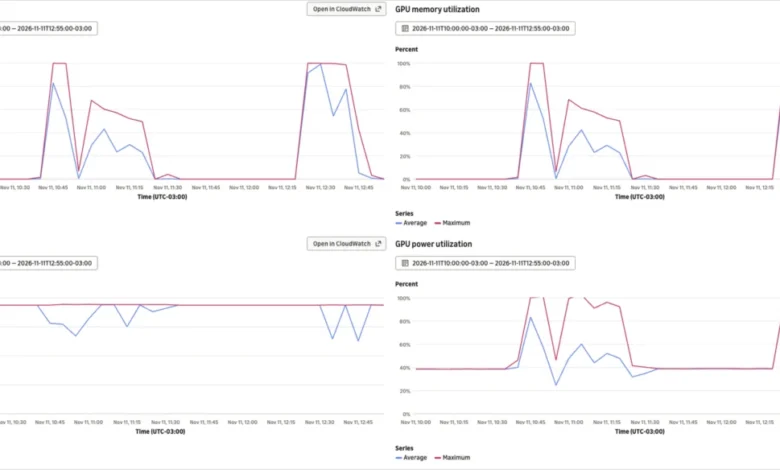
Amazon Web Services (AWS) has officially announced the general availability of native Graphics Processing Unit (GPU) support for Amazon EC2 G-series instances running on AWS Lambda Managed Instances (LMI). This major capability bridges a long-standing architectural divide in cloud computing: the operational complexity of managing specialized hardware versus the straightforward, pay-as-you-go agility of serverless architectures. By eliminating the manual overhead traditionally required to provision, configure, and scale accelerated compute environments, AWS aims to democratize access to high-performance infrastructure for machine learning inference, real-time media processing, scientific computing, and complex data rendering tasks.
The rollout of serverless GPUs arrives at a pivotal moment in the evolution of enterprise cloud applications. Until now, organizations seeking to leverage GPU acceleration faced a stark compromise. They could either build and maintain self-managed infrastructure—which demands rigorous planning, manual installation of CUDA libraries, constant driver reconciliation, and bespoke auto-scaling logic—or rely on proprietary third-party platforms that frequently sit outside the native security, identity, and networking perimeter of their broader cloud architectures. Furthermore, traditional GPU provisioning often resulted in notoriously low utilization rates. Because a single specialized workload rarely saturates an entire high-end accelerator, organizations frequently found themselves paying for idle capacity while smaller inference tasks languished on monolithic nodes.
Core Architecture and Technical Mechanics
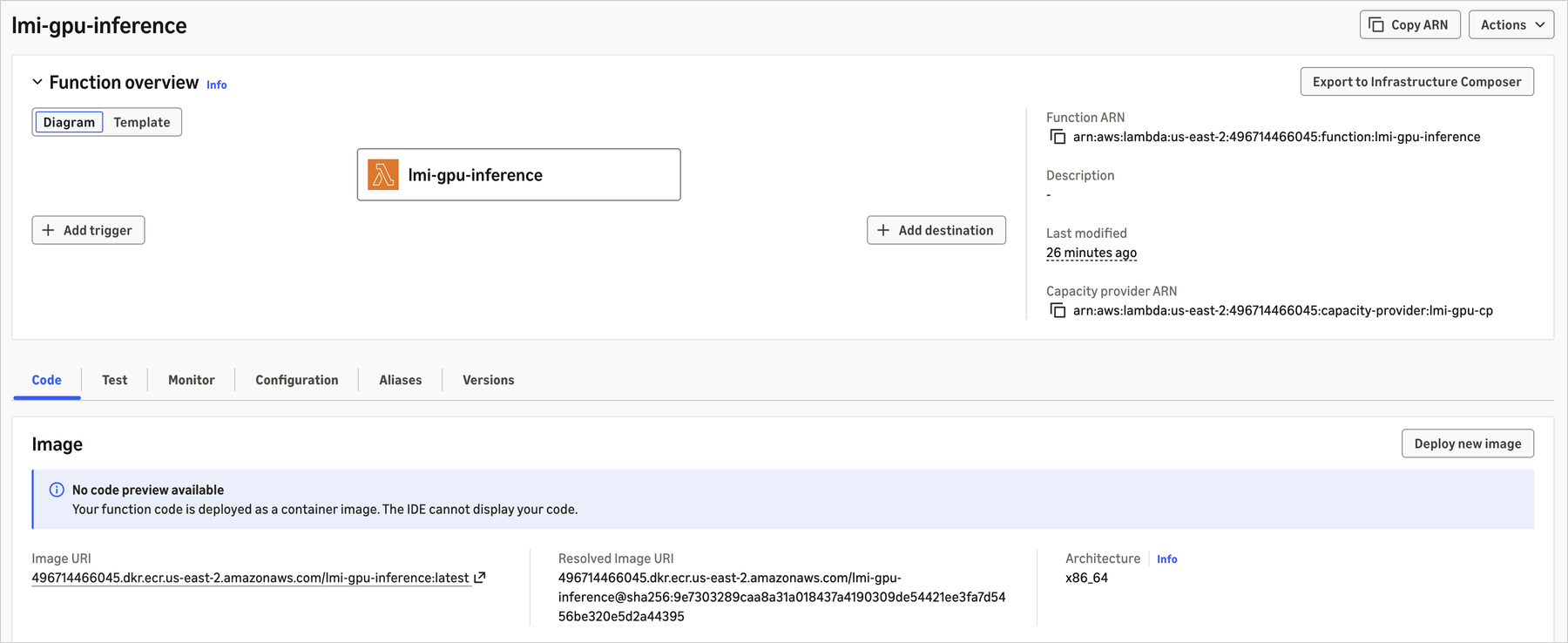
The newly introduced feature fundamentally re-engineers how GPU workloads integrate into serverless environments. Rather than requiring developers to write custom deployment scripts or manage underlying node clusters, AWS Lambda Managed Instances package GPU-accelerated functions as Open Container Initiative (OCI) standard container images. Developers simply build their OCI image, designate the target function, and delegate all subsequent provisioning, lifecycle management, and event integration responsibilities directly to the Lambda service.
At the technical level, the architecture completely removes the need to handle low-level device plugins, cluster configurations, or driver versions. The service natively leverages the foundational infrastructure of Lambda Managed Instances, matching Amazon EC2 pricing structures while offering specialized compute capabilities without server management overhead.
To streamline the development process, AWS provides a curated suite of base container images. These include optimized environments pre-configured with the CUDA toolkit (base:cuda), mathematical and data-processing libraries (cupy:cuda), deep learning frameworks like PyTorch and Transformers (pytorch:cuda), as well as dedicated inference servers such as vllm:cuda and sglang:cuda. These images allow engineering teams to deploy sophisticated models—such as instruction-tuned open-source Large Language Models (LLMs) from Hugging Face—without writing a single line of custom server or inference handling code.

Streamlined Deployment and Configuration
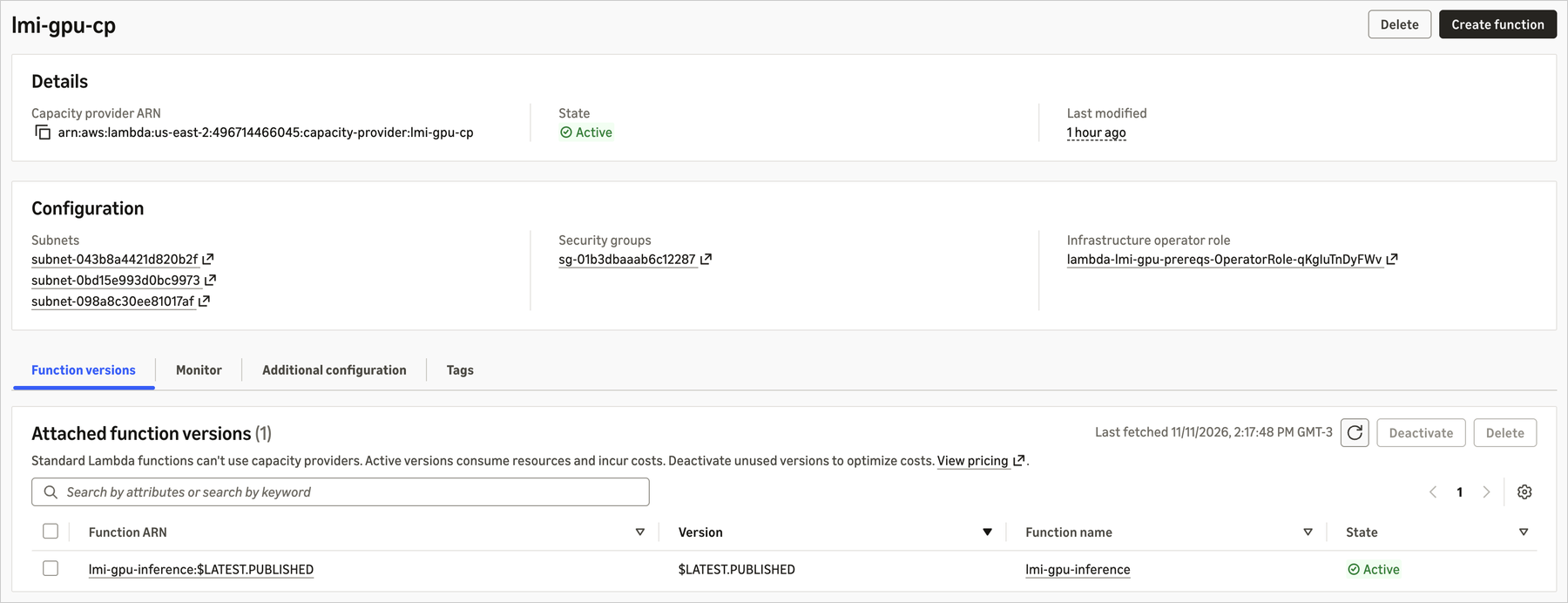
Deploying an accelerated workload via the updated Lambda programming model involves a structured, multi-step workflow designed for operational efficiency. First, system administrators establish a capacity provider, specifying the permitted G-series instance types (such as g5.2xlarge, g6.2xlarge, or g6e.2xlarge) and configuring auto-scaling parameters to optimize cost and availability. By defining multiple instance types, Lambda automatically selects the most cost-effective and available hardware, seamlessly falling back across generations if capacity constraints arise.
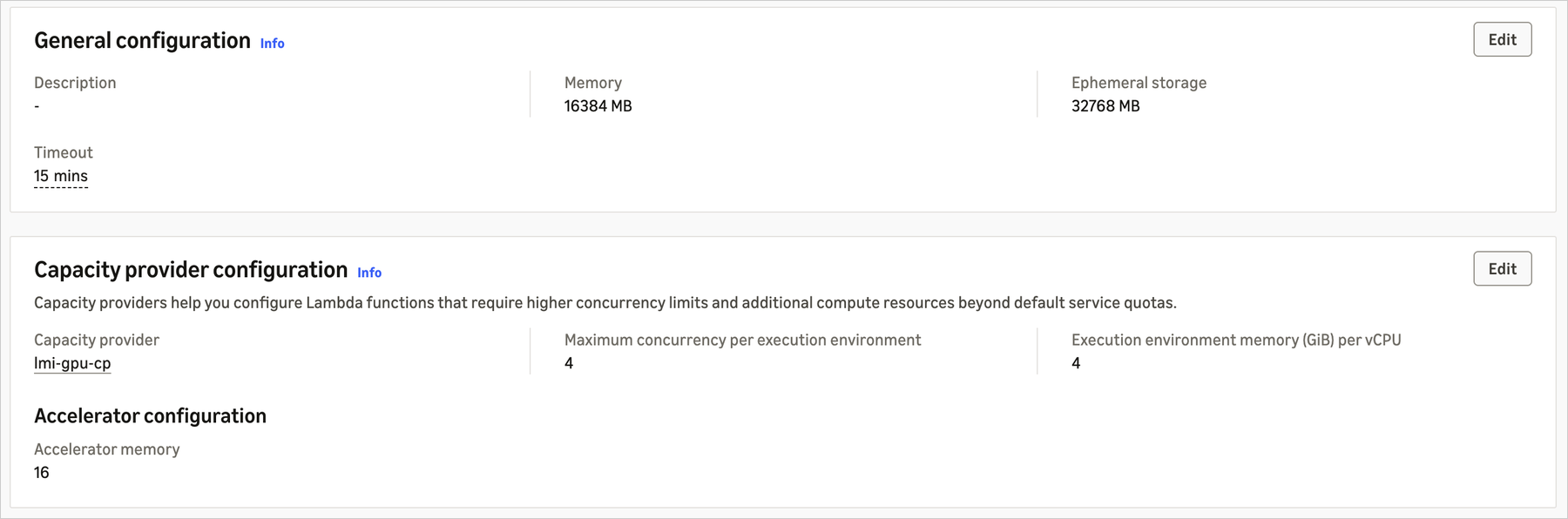
Next, developers build and push their container images to Amazon Elastic Container Registry (ECR). When configuring the Lambda function itself, operators utilize the AcceleratorConfig parameter to dictate minimum GPU memory requirements (AcceleratorMemorySize). The service automatically routes the execution environment to the smallest available GPU that satisfies the threshold.
Crucially, the architecture supports high concurrency within individual execution environments. Through the PerExecutionEnvironmentMaxConcurrency setting, multiple concurrent invocations can share a single copy of a model loaded into GPU memory. This capability dramatically increases hardware utilization, allowing teams to derive significantly more throughput from the exact capacity they purchase. Additionally, Seekable OCI (SOCI) lazy loading technology allows functions to begin execution before container images are fully downloaded, cutting startup latency by up to 70 percent.
Integration Across the Broader AWS Ecosystem
The new GPU-accelerated functions do not operate in a vacuum; they integrate seamlessly with the broader ecosystem of AWS event-driven services and Lambda capabilities. Because these functions are treated as standard event-driven components, they can be triggered directly by more than 200 native AWS event sources, including Amazon S3, Amazon SQS, Amazon API Gateway, and Amazon EventBridge, without requiring custom integration glue code.
For complex, multi-step workflows, GPU functions integrate directly with Lambda durable functions, enabling long-running orchestration complete with automated checkpointing and recovery. Meanwhile, Lambda MicroVMs handle untrusted or model-generated code in isolated sandboxes, separating CPU-based agentic tool-use logic from the heavy lifting of GPU inference. Extended function timeouts—reaching up to 90 minutes for asynchronous and event source mapping invocations—further empower organizations to execute heavy batch jobs, such as multi-step inference or extensive media transcoding, without undergoing radical architectural redesigns.
Industry Implications and Market Analysis
Industry analysts view the introduction of serverless GPUs as a transformative step for enterprise artificial intelligence adoption. By lowering the technical barriers to entry, AWS enables smaller development teams and resource-constrained startups to deploy sophisticated AI inference pipelines without employing dedicated infrastructure or DevOps specialists.
The economic implications are equally significant. Historically, the high capital expenditure associated with dedicated GPU instances deterred many organizations from exploring real-time AI integration for non-core workflows. By multiplexing concurrent requests across shared execution environments and billing strictly for active computation paired with underlying EC2 rates plus a nominal management fee, AWS is shifting the economic calculation of AI deployment. Furthermore, the inclusion of native CloudWatch telemetry—providing real-time tracking of GPU utilization, memory consumption, and power draw—gives engineering teams the granular observability required to enforce strict cost controls.
Availability and Pricing Structure
The native GPU support for Lambda Managed Instances is generally available today across supported AWS Regions. At launch, the feature extends compatibility to a wide array of Amazon EC2 G-series instances, including G4dn, G5, G6, G6f, Gr6, Gr6f, and G6e families, with additional hardware options planned for future rollout.
From a financial standpoint, customers pay the standard underlying EC2 instance fee—which remains fully compatible with existing Compute Savings Plans and Reserved Instances—alongside a 9.75 percent management fee for the GPU instances and standard Lambda request fees. For organizations requiring guaranteed infrastructure availability, the service fully supports integration with Amazon EC2 On-Demand Capacity Reservations (ODCR).
As enterprises continue to seek out efficiencies in their cloud spending while accelerating their artificial intelligence roadmaps, the convergence of serverless simplicity and high-performance hardware represents a fundamental shift in how modern cloud-native applications are architected, deployed, and scaled.