Supercharging Small Language Models: Reusing the Prompt Prefix with a Key-Value Cache for Narrow Automation

The deployment of Small Language Models (SLMs) in production environments has increasingly shifted from broad, general-purpose conversational agents to highly specialized, task-specific automation pipelines. In organizational workflows such as customer support triage, legal document classification, and automated data entry, efficiency is paramount. Engineers frequently encounter scenarios where the vast majority of an inference prompt—including task instructions, taxonomic definitions, and few-shot examples—remains entirely static across millions of individual API calls or batch inference runs. Only a negligible fraction of the prompt, such as an incoming customer support ticket or a newly logged transaction, changes from one execution to the next.
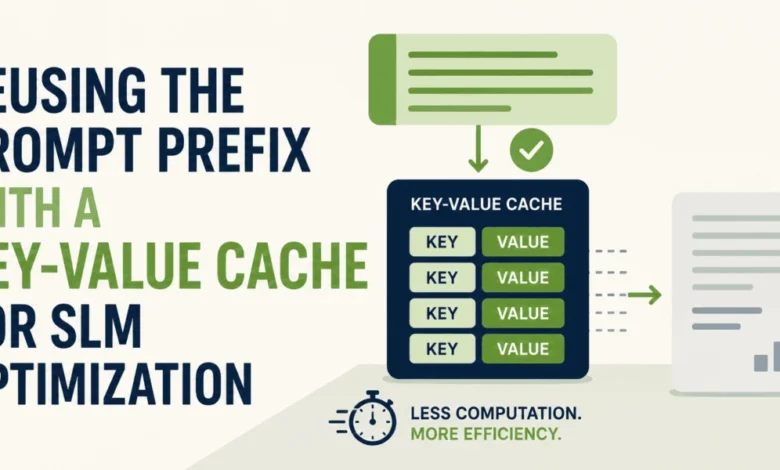
Historically, standard transformer architectures forced inference engines to recompute the key and value vectors for the entire prompt on every single execution. This redundant computation represents a significant computational bottleneck, particularly when operating on resource-constrained edge devices or local hardware setups. Addressing this inefficiency, recent optimization methodologies focus on prompt prefix reuse via key-value (KV) caching. By executing the static instruction block a single time, storing its resulting key-value states, and appending only the dynamic trailing tokens during subsequent iterations, engineering teams can drastically accelerate inference throughput without sacrificing predictive accuracy.
Background Context and Architectural Foundations
To understand the mechanics of prompt prefix caching, one must examine the fundamental workings of the transformer architecture. When a large or small language model processes a text sequence, it transforms tokens into internal representations across multiple layers, calculating key and value vectors for each token. Critically, the key and value vectors for any given token depend exclusively on the tokens that precede it in the sequence. Consequently, for a static prompt prefix—such as a rigid system prompt containing classification taxonomies and few-shot examples—these vectors are identical across every single inference call.
In standard execution loops, omitting optimization techniques results in the model re-encoding the entire sequence from scratch. For instance, in a typical customer support classification task utilizing a model like Qwen2.5-0.5B-Instruct, an instruction block might consume 145 tokens, while an individual incoming ticket adds another 22 tokens, bringing the total prompt length to 167 tokens. If an organization processes hundreds of thousands of records daily, the system wastes immense compute cycles repeatedly parsing the identical 145-token preamble.
By leveraging caching mechanisms available in modern deep learning frameworks—such as Hugging Face Transformers’ DynamicCache class—developers can compute the static prefix once, retain the KV states in memory, and feed subsequent inputs by pointing the model to the cached tensors. This alters the computational burden of the pre-fill phase, restricting it solely to the newly introduced suffix tokens.
Experimental Setup and Methodology
To quantify the performance gains of this optimization, recent technical benchmarks examined the classification of 600 synthetic customer support records using the Qwen2.5-0.5B-Instruct model in float16 precision. The hardware environment comprised an Apple M2 MacBook Air equipped with 24GB of unified RAM and a 16-core Neural Engine, running Python with PyTorch and the Hugging Face ecosystem.
The evaluation compared two distinct execution strategies:
- The Baseline Approach: The entire prompt—combining the 145-token static system instruction and the dynamic ticket suffix—was re-encoded in full for every single record in the dataset.
- The Cached Prefix Approach: The 145-token system instruction was passed through the model once to populate a dynamic key-value cache. For each subsequent classification task, only the dynamic ticket suffix was processed, utilizing the pre-computed cache while appropriately managing attention masks and cache positions.
Both pipelines utilized constrained scoring techniques. By formatting the prompt to terminate immediately at the start of the assistant’s generation turn, the model evaluates the logits of the first token for each permitted category label (billing, technical, account), enabling deterministic classification via a single forward pass without generating extraneous text tokens.
Quantitative Findings and Performance Metrics
The empirical results demonstrate a profound reduction in computational overhead when implementing key-value cache reuse for static prompt prefixes.
In the baseline execution, where the complete prompt was re-encoded for every ticket across the 600-record dataset, the total processing time reached 184.85 seconds. This translated to an average latency of approximately 308.1 milliseconds per individual ticket.
Conversely, implementing the cached prefix strategy reduced the total processing time for the identical 600 records to 80.07 seconds. The average latency per ticket dropped to 133.5 milliseconds. This represents an aggregate runtime reduction of approximately 57 percent.
Crucially, verification checks confirmed that the predictive accuracy of the model remained completely unaffected. Because key-value caching is a pure computational optimization rather than an approximation technique or model quantization method, the classification outputs generated via the cached pipeline matched the baseline outputs with 100 percent fidelity. The optimization accelerates execution speed without altering model behavior or compromising output quality.
Industry Implications and Enterprise Scalability
The implications of prefix caching extend far beyond local development benchmarks, offering profound advantages for enterprise-grade automation systems. As organizations increasingly deploy Small Language Models to handle high-volume, narrow automation tasks—such as real-time content moderation, automated email sorting, and financial transaction labeling—inference latency and operational costs become primary constraints.
Industry analysts note that traditional deployments often penalize well-crafted, highly detailed system prompts because longer instructions translate directly into higher pre-fill computational costs. Prompt prefix caching fundamentally inverts this economic dynamic. Because the static portion of the prompt is computed only once, engineering teams are actively incentivized to provide richer context, more comprehensive taxonomies, and exhaustive few-shot examples to improve model accuracy, knowing that the performance penalty of a lengthy instruction block is effectively neutralized after the initial pass.
Furthermore, this optimization strategy enhances the economic viability of running SLMs on local hardware or resource-efficient cloud instances. By cutting processing time by more than half, organizations can scale their automated workflows to handle significantly higher throughput without scaling their underlying hardware infrastructure proportionally.
Technical Implementation Considerations
While the performance benefits are clear, successfully deploying KV caching for static prefixes requires careful attention to tokenization mechanics and framework-specific implementations.
A primary technical requirement is ensuring that the prompt can be split at a token-clean boundary. If the concatenation of the separately encoded prefix and suffix does not yield the exact same token IDs as encoding the entire prompt as a single continuous string, the cached key-value tensors will misalign with the model’s expectations, leading to runtime errors or subtle classification inaccuracies. Developers must rigorously validate token boundaries prior to populating the cache.
Additionally, production systems must account for memory management. While small models like the 0.5B parameter variant impose minimal memory overhead for their key-value caches, scaling to larger architectures or handling concurrent multi-tenant requests requires robust cache eviction and management strategies to prevent memory leaks or out-of-memory exceptions on accelerator hardware.
Conclusion and Future Outlook
The integration of key-value caching for static prompt prefixes marks a maturation point in how engineering teams approach small language model optimization. By moving away from treating every inference call as an isolated, stateless event, developers can unlock dramatic performance gains that make SLMs not merely a viable alternative, but often the optimal architectural choice for narrow automation tasks.
As the artificial intelligence ecosystem continues to evolve, optimization techniques that bridge the gap between theoretical model capability and practical execution efficiency will define the success of enterprise AI deployments. Prompt prefix caching exemplifies this shift—turning a routine computational redundancy into a streamlined pathway for high-speed, cost-effective automated intelligence.