AWS Weekly Roundup: OpenAI GPT-6.1 Terra on Bedrock, Step Functions as AI Agent Tools, and Post-Quantum Security Updates

The landscape of enterprise cloud computing and artificial intelligence orchestration shifted significantly this past week, driven less by raw model capability and more by systemic reach, cost optimization, and infrastructure integration. Rather than requiring organizations to rewrite existing architectures, recent deployments across Amazon Web Services (AWS) focus on exposing trusted enterprise workflows, APIs, and services directly to AI agents.
Chief among these developments is the integration of AWS Step Functions into the Amazon Bedrock AgentCore Gateway. This allows autonomous agents to invoke complex, pre-existing orchestration workflows without disrupting established business logic. Simultaneously, OpenAI’s GPT-6.1 Terra model debuted on Amazon Bedrock at a substantially lower price point, offering enhanced performance for everyday workloads. Beyond artificial intelligence, AWS introduced critical security enhancements, including post-quantum cryptography features in the AWS Key Management Service (KMS) and cross-Region trusted identity propagation for the AWS IAM Identity Center.
Major Artificial Intelligence and Orchestration Launches
The intersection of generative AI and deterministic enterprise workflows marked the most prominent theme of the week. Enterprises have long grappled with the challenge of giving AI agents enough autonomy to be useful while retaining strict control over execution paths, regulatory compliance, and security boundaries.
OpenAI GPT-6.1 Terra Arrives on Amazon Bedrock
OpenAI’s newest everyday-workload model, GPT-6.1 Terra, is now generally available on Amazon Bedrock. Positioned as the workhorse of the GPT-6 family, Terra balances high execution speed with cost efficiency, targeting high-volume enterprise applications.
According to evaluation metrics released by OpenAI during its Agents Last Exam benchmark testing, GPT-6.1 Terra scored 15 percentage points higher than the previous-generation GPT-5.6 Terra model. Furthermore, it performed on par with the higher-tier GPT-6 Astra while completing tasks more than three times faster than both predecessors. From a financial perspective, the model introduces input and output token pricing that is at least 50% lower than both GPT-6.1 Sol and GPT-5.6 Terra, significantly reducing the cost barrier for large-scale enterprise deployments.
The model supports up to 1 million input tokens, accommodating extensive text and image inputs within a single context window. Developers and enterprise users can access GPT-6.1 Terra directly via Bedrock APIs, as well as through collaborative enterprise channels such as ChatGPT Work and Codex. Industry analysts note that this aggressive pricing and performance positioning makes high-context AI integration economically viable for standard business processes that previously could not justify the operational expense of frontier models.
AWS Step Functions as AI Agent Tools via AgentCore Gateway
Addressing the long-standing enterprise concern regarding agent reliability, AWS announced that Step Functions workflows can now be utilized directly as AI agent tools through the Amazon Bedrock AgentCore Gateway. The gateway connects autonomous agents to enterprise tools utilizing the Model Context Protocol (MCP).
This architecture implements a strict division of labor. The AI agent determines when a specific workflow should be executed and what input parameters to supply. However, the execution logic remains entirely deterministic: Step Functions executes each predefined step in the exact sequence established by the systems architects. For example, in a customer support scenario, an agent may trigger a refund process, but the underlying eligibility verification, managerial sign-off, and financial credit issuance occur in a rigid, programmatic order every time. This design prevents the AI model from improvising or bypassing critical business logic and compliance checks.
Existing Standard and Express workflows are fully compatible as connector targets, and agents possess the capability to query past execution runs for monitoring and debugging. This integration is now globally accessible in all AWS Regions where AgentCore Gateway operates, billed at standard workflow and gateway rates.
Infrastructure, Security, and Core Service Updates
While AI orchestration captured significant attention, AWS rolled out foundational updates addressing post-quantum cryptography, cross-Region identity management, and performance acceleration for containers.
Post-Quantum Cryptography in AWS KMS and Amazon Aurora
To mitigate the long-term threat of quantum decryption—commonly referred to as "harvest now, decrypt later," where adversaries intercept encrypted data today to decrypt it once quantum computing matures—AWS introduced support for ML-KEM (Module-Lattice-Based Key-Encapsulation Mechanism) within the AWS Key Management Service (KMS).
Customers can now establish cryptographic shared secrets utilizing post-quantum algorithms directly through KMS keys, with private keys securely isolated within FIPS 140-3 Level 3 validated Hardware Security Modules (HSMs). The service supports all three NIST FIPS 203 parameter sets via newly introduced Encapsulate and Decapsulate API actions. The Encapsulate function generates a random 32-byte shared secret alongside its corresponding ciphertext, while Decapsulate recovers the secret on the receiving end.
This post-quantum capability is deployed across all standard KMS regions, excluding the Middle East (UAE and Bahrain) and China Regions. Complementing this network security update, Amazon Aurora PostgreSQL incorporated post-quantum TLS key exchange natively in database versions 18 and higher, ensuring end-to-end transport security against quantum threats.
Cross-Region Trusted Identity Propagation in AWS IAM Identity Center
Architectural constraints regarding multi-Region data flows were lifted with the introduction of cross-Region trusted identity propagation for the AWS IAM Identity Center. Previously, trusted identity propagation required all downstream services processing a user request to reside within the exact same geographical Region. This forced engineering teams to choose between using overly broad IAM roles that obscured individual user accountability or consolidating entire multi-region architectures into a single location.
With the new update, a user’s authenticated identity travels automatically alongside the API request across Region boundaries. Organizations can maintain fine-grained access control based on user and group memberships while retaining comprehensive audit trails showing precisely which individual accessed specific resources. This capability is provided at no additional cost across all Regions where IAM Identity Center is supported.
GPU Sharing on Amazon ECS via NVIDIA MPS
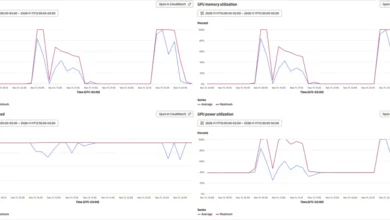
To optimize hardware utilization for workloads that require only a fraction of a physical graphics processing unit—such as small-model inference and multi-model serving—Amazon Elastic Container Service (ECS) added native support for GPU sharing via NVIDIA Multi-Process Service (MPS).
Platform engineers can explicitly declare the precise GPU memory requirements for individual containers and optionally throttle their share of computational capacity. As services scale, ECS automatically schedules tasks onto GPUs with available capacity without requiring any modifications to application code. Supported on ECS Managed Instances and standard Amazon EC2 deployments, the managed instance architecture actively monitors the underlying MPS control daemon, automatically replacing unhealthy instances to maintain high availability across commercial and AWS GovCloud (US) Regions.
Seekable OCI (SOCI) Lazy Loading for AWS Lambda and SageMaker AI
Container startup latency has historically presented challenges for serverless architectures and machine learning training pipelines. AWS addressed this by introducing Seekable OCI (SOCI) lazy loading for AWS Lambda Managed Instances, allowing functions to fetch only the specific file chunks required at each distinct stage of execution rather than downloading an entire container image upfront. AWS internal benchmarks indicate container startup time reductions of up to 70%.
To implement this, developers generate a SOCI index, push it to Amazon ECR, and configure the image URI to point to the indexed tag, allowing Lambda to manage lazy loading automatically. This technology also expanded to Amazon SageMaker AI training and processing workloads. Independent performance benchmarks demonstrate that lazy loading maintains startup latencies between 3 and 11 seconds regardless of overall image size, contrasting sharply with median startup times of 3 minutes and 42 seconds observed for traditional 13.2 GB images—representing an efficiency gain ranging from 8x to 46x.
Kubernetes Gateway API Support in EKS Auto Mode
Amazon EKS Auto Mode expanded its networking capabilities by introducing native support for the Kubernetes Gateway API. Developers can now manage inbound application traffic using standard Gateway and HTTPRoute resources without deploying independent third-party ingress controllers.
EKS Auto Mode automatically provisions and lifecycle-manages the underlying AWS load-balancing infrastructure. The integration delivers advanced traffic management features, including HTTP and gRPC routing, cross-namespace routing, weighted traffic distribution, header-based traffic steering, and automated TLS certificate provisioning via AWS Certificate Manager. Existing Ingress workloads continue to operate seamlessly alongside Gateway API resources, ensuring non-disruptive, additive adoption.
Enterprise Case Studies and Real-World Implementation
Recent migration reports highlight how large-scale enterprises are leveraging these automated tooling frameworks and storage optimizations to drive efficiency.
Nubank Automates Disaster Recovery with the AWS DevOps Agent
Financial technology institution Nubank, which supports over 140 million customers across Brazil, Mexico, and Colombia, relies on strict regulatory compliance frameworks that mandate regular disaster recovery simulations for more than 300 classified business flows.
By integrating the AWS DevOps Agent to automate evidence collection and compliance reporting, Nubank reported a reduction in test cycle durations from approximately 4.3 hours down to 40 minutes. Furthermore, the automation enabled a quadrupling of tested critical business flows, exceeding 160 active flows. In one operational stress test, the system systematically terminated over 900 Amazon EKS instances under synthetic production-level traffic using the AWS Fault Injection Service (FIS), successfully generating the comprehensive validation reports required by financial regulators.
MoEngage Scales API Tooling via AgentCore Gateway
Engagement platform MoEngage faced a complex integration hurdle: exposing approximately 400 internal REST API operations—developed across 25 independent engineering teams, deployed in private VPCs spanning seven global Regions—to AI agents without violating tenant data isolation boundaries.
By routing these endpoints through the Amazon Bedrock AgentCore Gateway, MoEngage bypassed an estimated six months of bespoke platform engineering. Crucially, the engineering team avoided passing a monolithic tool catalog to the AI model, which would have consumed over 20,000 tokens per connection. Instead, agents query a dynamic tool registry by describing tasks in natural language, retrieving only the precise API schema required for the immediate execution step.
Storage Cost Reduction via Evidence-Based S3 Lifecycles
Organizations managing petabyte-scale repositories frequently encounter challenges when identifying cold data assets for archival storage tiers. Utilizing Amazon S3 Storage Lens groups combined with Storage Class Analysis, an enterprise audit of 5.8 petabytes of application logs stored in Amazon S3 Standard—incurring baseline storage expenditures of approximately $241,000 monthly—revealed an access ratio dropping below 0.1% after 90 days.
Transitioning these identified workloads to Amazon S3 Glacier Instant Retrieval after the 90-day threshold achieved an estimated 70% reduction in monthly storage expenditures for the analyzed dataset, demonstrating the efficacy of metric-driven lifecycle governance.
Upcoming Industry Events
As the 2026 calendar draws toward its close, the cloud computing community prepares for the annual flagship conference. AWS re:Invent 2026 is scheduled to take place in Las Vegas from November 30 through December 4, featuring more than 2,200 technical sessions, breakout tracks, and architectural chalk talks. The comprehensive event catalog is currently live, and registered attendees can secure session reservations through the official AWS re:Invent portal. Meanwhile, localized AWS Community Days are concluding their 2026 seasonal runs, connecting regional developers and systems architects prior to the Las Vegas gathering.