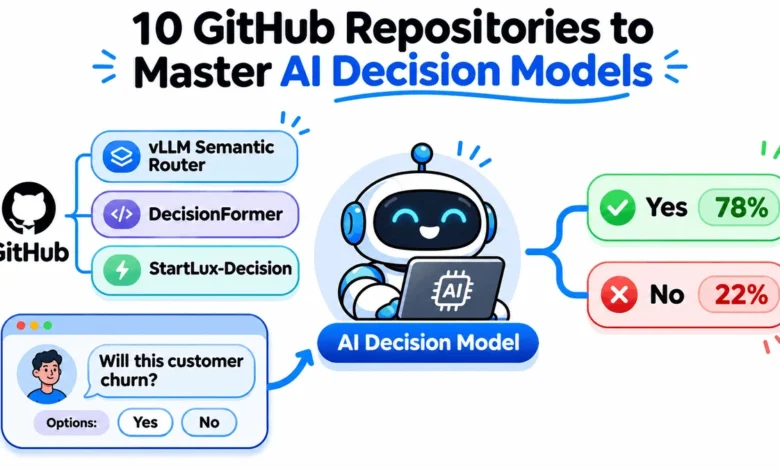
The landscape of artificial intelligence is experiencing a subtle yet profound paradigm shift, moving away from purely generative text interfaces toward specialized systems built for functional execution. Following the introduction of specialized frameworks like Jev by TypeSafe AI, the technological ecosystem has begun carving out a dedicated category of machine learning architectures: AI decision models. Unlike traditional large language models (LLMs) designed to produce extensive, conversational text responses, these specialized systems are engineered to evaluate contextual data against predefined choices, outputting structured decisions paired with rigorous probability distributions.
This evolution addresses a longstanding inefficiency in software engineering. Historically, developers seeking to automate discrete choices—such as financial risk assessment, automated credit underwriting, content moderation, or dynamic tool routing—faced a binary choice. They could either train traditional, isolated classification models that lacked broader semantic contextual understanding, or deploy massive, computationally expensive LLMs requiring intricate prompt engineering and strict output parsing to force structured responses. Decision models bridge this gap by offering a lightweight, general-purpose alternative that significantly slashes inference latency and hardware expenditure.
The Technological Evolution and Background Context
To understand the sudden proliferation of decision models on platforms like GitHub, one must examine the operational bottlenecks of generative AI over the preceding three years. Since the widespread adoption of transformer architectures, the default approach to nearly every natural language processing task has been generative inference. If an application required knowing whether a customer support ticket demanded escalation, an LLM was prompted to read the text and write a paragraph explaining its reasoning, followed by a designated tag.
This methodology introduced severe inefficiencies. Generating tokens sequentially is computationally intensive, driving up cloud infrastructure costs and introducing response latency unacceptable in high-frequency trading, automated security filtering, or real-time web routing. Furthermore, probabilistic drift—where generative models occasionally ignore structural formatting instructions—has plagued enterprise software pipelines.
The conceptual breakthrough behind decision models lies in modifying the model’s readout mechanism. By optimizing the final layers of pre-existing transformer models to evaluate specific categorical logits or decision heads, researchers found they could bypass text generation entirely. The system ingests a query, scans the contextual parameters, and evaluates the probability space of predefined choices (such as binary approvals, multi-class categorizations, or numerical scoring ranges) in a single forward pass.
This architectural shift gained immense momentum in late 2024 and early 2025, culminating in open-source releases that democratized access to decision-head training. Industry analysts note that enterprise adoption of these models is projected to accelerate as companies seek ways to reduce the carbon footprint and financial overhead associated with running massive LLM clusters for binary logic tasks.
Curated GitHub Ecosystem: Essential Frameworks for Developers
As the open-source community rapidly builds out infrastructure for this nascent field, a handful of repositories have emerged as foundational pillars for developers looking to master AI decision models. These projects span end-to-end training, semantic routing, architectural conversion, and rigorous performance benchmarking.
1. vLLM Semantic Router
Serving as a critical middleware layer, the vLLM Semantic Router offers an open-source decision architecture designed to intercept user requests and dynamically direct them to appropriate underlying AI models based on immediate operational requirements. Crucially, the repository incorporates native support for the D3 family of decision models. By evaluating predefined options and returning precise probability distributions without triggering costly text generation, this router enables high-throughput environments to optimize computational resources dynamically.
- Practical Application: Engineering an intelligent API gateway that inspects incoming queries and routes them instantaneously—dispatching complex logic problems to deep reasoning engines while offloading simple queries to lightweight, high-speed models.
2. DecisionFormer
For organizations hesitant to train models from scratch, DecisionFormer provides a streamlined framework designed to convert pre-existing Hugging Face transformer models into specialized decision engines. Rather than utilizing standard autoregressive training loops, this repository guides developers through fine-tuning architectures to evaluate discrete choices and output structured decision metrics.
- Practical Application: Fine-tuning a compact open-weight Qwen model to categorize incoming enterprise procurement requests into distinct operational outcomes—Approve, Reject, or Manual Review—while benchmarking its accuracy against standard prompted LLMs.
3. StartLux-Decision
Tackling the inherent tension between processing speed and analytical depth, StartLux-Decision delivers open decision models scaled from 0.8 billion to 27 billion parameters. The repository’s defining innovation is its "AutoThink" mechanism, which calibrates model behavior based on confidence scores. When the system exhibits high statistical confidence, it executes an immediate decision; when confidence dips below a predefined threshold, it triggers secondary reasoning pathways.
- Practical Application: Developing a customer-facing risk assessment tool that delivers instant automated approvals for straightforward cases while gracefully escalating ambiguous files to deeper analytical routines.
4. JevTrainer
Designed specifically for experimentation and model optimization, JevTrainer provides a comprehensive toolkit for training decision models. Supporting both Parameter-Efficient Fine-Tuning (PEFT) via Low-Rank Adaptation (LoRA) and full-parameter training, the framework accommodates multiple decision-head architectures and flexible training pipelines handling scoring, binary, and multiple-choice modalities.
- Practical Application: Training three distinct decision models utilizing varying readout heads on an identical dataset to compare downstream accuracy, operational latency, and probability calibration.
5. Laya
Laya is positioned as a lightweight decision engine engineered specifically for rapid, non-autoregressive inference across massive multilingual corpora. Supporting upwards of 100 languages, the framework simplifies the deployment of multilingual classification systems without requiring complex infrastructure setups.
- Practical Application: Constructing a global digital content moderation pipeline capable of instantly sorting user-generated text into Allow, Review, or Block categories across multiple regional dialects.
6. Kev
Built upon advanced foundational architectures including Qwen3.5 and Qwen3.8, the Kev repository supplies pretrained decision models alongside complete training, benchmarking, and serving scripts. By integrating modern Python environment managers like uv, the repository drastically minimizes the friction traditionally associated with establishing machine learning development pipelines.
- Practical Application: Training a specialized decision model tasked with selecting the optimal software tool or API endpoint for an autonomous AI agent based on real-time conversational context.
7. JevAny
JevAny delivers an end-to-end framework encompassing the entire lifecycle of a decision model: training, evaluation, and deployment. Expanding beyond text-only modalities, JevAny accommodates multimodal inputs, allowing developers to experiment with decision systems that process visual and textual data simultaneously.
- Practical Application: Training a localized decision model on historical technical support tickets, complete with attached diagnostic screenshots, and exposing the resulting model via a local API endpoint.
8. AnyJev
Addressing the computational cost of fine-tuning, AnyJev introduces a novel inference-time approach. Instead of altering model weights, it extracts and processes the internal token probabilities of standard open-source language models to evaluate predefined choices directly, effectively transforming generic LLMs into Jev-style decision systems on the fly.
- Practical Application: Converting a standard base Qwen model into a real-time financial sentiment classifier (Buy, Hold, Sell) without fine-tuning, evaluating its efficacy against conventional prompted approaches.
9. Decision Index
Recognizing that high stated model confidence does not inherently correlate with real-world accuracy, Decision Index focuses entirely on rigorous evaluation. It provides a standardized, reproducible benchmark suite that can be executed locally or via continuous integration pipelines.
- Practical Application: Running comparative benchmarks across D3, Kev, and traditional classifiers using a unified evaluation dataset to map trade-offs between inference latency and probability calibration.
10. Awesome Decision Models
Functioning as a comprehensive meta-resource, Awesome Decision Models aggregates curated lists of architectures, academic research papers, SDKs, and benchmarking frameworks. While it does not provide raw training code, it serves as an indispensable catalog for tracking the rapidly evolving ecosystem.
- Practical Application: Conducting a comparative market analysis by deploying three distinct open-weight decision models onto a shared workload to profile their memory footprints and execution speeds.
Broader Industry Implications and Future Outlook
The rapid emergence of AI decision models signals a maturing software engineering discipline within artificial intelligence. For years, the industry suffered from "generative bloat"—applying resource-intensive conversational models to deterministic categorization problems simply because those models offered superior linguistic comprehension.
By decoupling semantic understanding from text generation, decision models offer a compelling economic and technical value proposition. Enterprises can leverage the deep contextual training of modern foundational models while eliminating the compute-heavy decoding steps that drive up cloud bills. Furthermore, the deterministic nature of probability distributions returned by decision heads simplifies downstream software integration, reducing the parsing errors common in programmatic JSON generation from LLMs.
As open-source repositories mature, industry observers anticipate that decision models will become standard components in enterprise software stacks, particularly within automated logistics, financial compliance, cybersecurity routing, and customer service triage. For developers and data scientists, engaging with these ten GitHub repositories offers an early foothold in what is rapidly shaping up to be the next major efficiency frontier in applied machine learning.