Abacus.AI Unveils Smaug: A New Family of Open-Weight Models Optimized for Autonomous Agent Workflows


The landscape of artificial intelligence development has shifted decisively from single-turn chat responses to autonomous multi-step agents capable of handling extended workflows, interacting with external databases, and executing complex software engineering tasks. However, general-purpose foundation models frequently struggle with the architectural demands of long-horizon tasks, often drifting from their primary objective, encountering prompt caching degradation, or failing to properly execute tool calls. To address these operational challenges, enterprise AI platform Abacus.AI has officially announced the launch of the Smaug model family, a suite of three open-weight models specifically fine-tuned for agentic workloads.
Released publicly on Hugging Face, the Smaug line comprises Smaug Flash, Smaug Mini, and Smaug Agentic, built upon distinct open-weight base architectures. According to Abacus.AI’s engineering and research disclosures, the overarching development philosophy centers on a rigorous training methodology rather than superficial prompting adjustments or weight modifications designed merely to game benchmarks. By utilizing a uniform recipe combining human-curated real-world agentic trajectories with synthetic data targeting high-difficulty scenarios, the company sought to solve a foundational issue in modern LLM fine-tuning: preserving the underlying reasoning capabilities of a model while eliminating the specific failure modes that disrupt multi-hour automation pipelines.
Background and the Agentic Bottleneck

For software engineering teams and enterprise developers, deploying artificial intelligence as an autonomous agent introduces operational hurdles that static chatbots rarely encounter. While a conventional conversational model answers a prompt in isolation, an enterprise agent must maintain context across dozens or hundreds of sequential steps, correctly identify and invoke appropriate APIs, read from multiple documents, and execute code without human intervention.
In internal operations at Abacus.AI, developers observed that state-of-the-art base models routinely ran out of computational steam during extended workflows. Tasks spanning several hours frequently suffered from context bloat, leading to recursive errors, broken logic loops, and eventual task failure. Traditional remedies—such as extensive prompt engineering, dynamic prompt caching, or ad-hoc system instructions—proved insufficient for stabilizing models during extended reasoning loops.
Abacus.AI’s internal research concluded that turning a frontier-scale language model into a reliable agentic worker is fundamentally a training challenge. General language models, despite high proficiency on static benchmarks, were simply not engineered for extended autonomous operation. Consequently, the research team engineered the Smaug training methodology, prioritizing genuine problem-solving capabilities over mere format compliance to ensure models could handle sustained production environments.
Anatomy of the Smaug Lineup
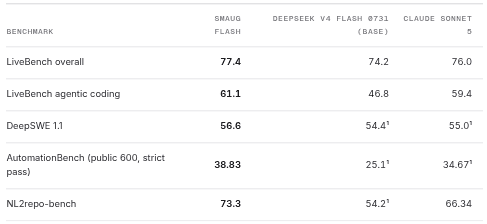
The Smaug series spans three distinct capability tiers, each tailored to different operational points on the performance-efficiency curve. Despite sharing a unified training recipe, the performance gains and behavioral shifts vary significantly depending on the baseline architecture.
Smaug Flash: The Enterprise Workhorse
Built on top of the DeepSeek V4 Flash 0731 architecture, Smaug Flash is a 304-billion parameter model optimized for always-on enterprise agents requiring high speed and cost efficiency. The base model, while economical and fast, historically suffered from susceptibility to confusion and infinite loops during long-context tool utilization. The Smaug fine-tuning process directly targeted this vulnerability.
The resulting performance metrics on LiveBench and secondary evaluations demonstrate substantial correction of these baseline deficiencies. Smaug Flash achieved a notable +14.3 point gain in agentic coding, jumping from 46.8 to 61.1, representing the single largest category delta across the entire Smaug collection. Furthermore, AutomationBench scores rose by 13.7 points (moving from 25.1 to 38.83), while NL2Repo-Bench saw a 19-point increase, soaring from 54.2 to 73.3. These gains indicate that the fine-tuning successfully closed genuine capability gaps in production environments.
Smaug Mini: Compact Multimodal Efficiency
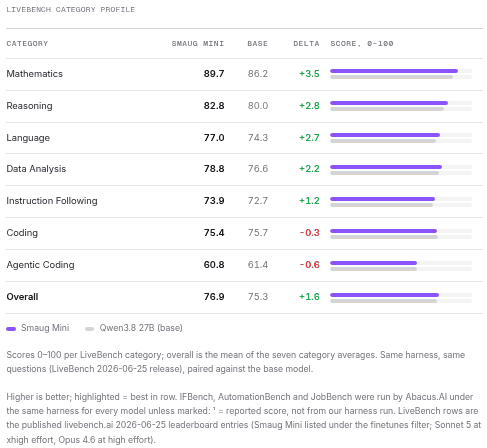
Representing the lightweight tier of the series, Smaug Mini is a 28-billion parameter model fine-tuned from the Qwen3.8-27B base. Designed for multimodal applications, image and video interpretation, instruction following, and one-off tasks, Smaug Mini offers deployment advantages on restricted hardware configurations.
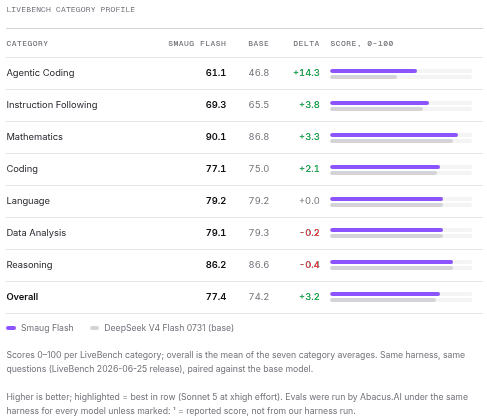
While its base model was already proficient in coding-style tasks, Smaug Mini’s fine-tuning yielded its most pronounced improvements in Mathematics (+3.5 points) and Reasoning (+2.8 points). Interestingly, while its agentic coding score dropped marginally by 0.6 points, Smaug Mini outperformed several prominent closed-weights frontier models on IFBench (instruction following), AutomationBench, and JobBench. Notably, JobBench performance surged by 17.1 points over the base model, moving from 33.4 to 50.5. This divergence highlights the nuanced difference between narrow benchmark metrics and real-world utility.
Smaug Agentic: Frontier-Scale Endurance
At the apex of the series lies Smaug Agentic, a massive Mixture of Experts (MoE) model boasting 2.8 trillion parameters, built upon Moonshot AI’s Kimi K3 architecture. Because the base model already resides at the frontier of AI capabilities, its benchmark score deltas appear relatively modest compared to Flash and Mini. However, Abacus.AI emphasizes that the primary achievement of Smaug Agentic lies in behavioral stability rather than raw numerical score inflation.
During rigorous testing involving 113 complex agentic coding tasks over seven hours of continuous operation, Smaug Agentic successfully executed a median of 78 agent steps per task with zero infrastructure errors and zero timeouts. The fine-tuning successfully suppressed runaway reasoning loops while preserving normal deliberation, preventing the structural breakdowns that typically plague frontier-scale models during extended operational workflows.
Methodology and Benchmark Integrity

A central claim of the Smaug release is the generalizability of its training methodology across radically different architectures and parameter scales. By filtering training datasets to eliminate instances that merely exploit task scoring criteria, Abacus.AI sought to reinforce authentic problem-solving. This approach directly confronts a common industry pitfall wherein fine-tuning inadvertently overwrites a model’s underlying reasoning logic to satisfy structural formatting rules.
The evaluation of these models heavily relies on LiveBench, an ICLR Spotlight evaluation framework developed by Abacus.AI designed to mitigate data contamination. LiveBench continuously refreshes its question sets every month using contemporary sources such as mathematics competitions, LeetCode repositories, arXiv research papers, and Kaggle datasets. Crucially, scoring relies strictly on ground truth validation rather than LLM-as-a-judge methodologies, which are prone to inaccuracies on complex inputs.
Complementary benchmarks utilized in the evaluation include AutomationBench, NL2Repo-Bench, Terminal-Bench 2.1, MMMU-Pro, IFBench, and JobBench. Industry analysts note that discrepancies between these specialized benchmarks explain why a model might experience a negative delta in one category while outperforming competing systems across enterprise-focused task evaluations.
Implications for Enterprise AI Deployment
The introduction of the Smaug model family provides enterprise developers and AI engineering teams with robust open-weight alternatives for agentic automation. By making these models publicly available on Hugging Face, Abacus.AI lowers the barrier to entry for organizations seeking to deploy self-improving agents without relying exclusively on proprietary, closed-source API ecosystems.
However, industry experts advise that benchmark metrics should serve merely as an initial screening tool rather than a definitive guarantee of production success. Factors such as localized hardware configurations, context length limitations, token latency, and exact task difficulty continue to dictate real-world inference behavior.
Ultimately, the Smaug release illustrates that fine-tuning strategies must be precisely tailored to address the distinct architectural gaps of individual base models. Whether organizations require the high-speed enterprise throughput of Smaug Flash, the resource-efficient multimodality of Smaug Mini, or the multi-hour operational endurance of Smaug Agentic, the new lineup offers empirical proof that targeted, behavior-focused training can significantly enhance the reliability of autonomous artificial intelligence agents in production environments.