TikTok has officially labeled over 1 billion videos as AI-generated, a staggering milestone that underscores the rapid integration of synthetic media into the world’s most influential short-form video platform. As artificial intelligence tools become more sophisticated and accessible, the line between reality and digital fabrication has blurred, prompting TikTok to implement stringent transparency requirements. For brands and content creators, navigating this regulatory landscape is no longer optional; it is a fundamental requirement for maintaining platform compliance, audience trust, and brand integrity.
The Evolution of TikTok’s AI Policy

The rise of generative AI began in earnest around 2022, but the surge in "deepfake" technology and hyper-realistic AI avatars in late 2023 and 2024 forced social media platforms to respond. TikTok’s policy, which has undergone several iterations throughout 2025 and 2026, is rooted in the platform’s commitment to "Integrity and Authenticity." The core objective is to prevent the spread of deceptive content while allowing creators to utilize the creative benefits of AI.
At its inception, the policy was relatively hands-off, relying on voluntary user disclosure. However, as the potential for misinformation grew—particularly during global election cycles and the rise of sophisticated voice cloning—TikTok moved toward a more mandatory disclosure model. Today, the policy dictates that any content featuring realistic-looking people or scenes that have been generated or significantly edited by AI must be clearly labeled. Failure to comply can result in content removal, shadow-banning, or the platform forcibly applying a label that the creator cannot remove.
Categorizing AI Content: What Requires a Label?

Understanding the distinction between "creative editing" and "AI-generated content" is the most common hurdle for social media managers. TikTok’s threshold for disclosure hinges on realism. If an image, video, or audio track could reasonably deceive a viewer into believing it is a recording of an actual person or event, it must be disclosed.
Content that requires a label includes:
- AI-generated video or images of realistic people or settings.
- Voice cloning technology that mimics the cadence and timbre of real individuals.
- Deepfake-style edits where a person’s face is swapped or their speech is altered to depict them saying things they did not say.
- Significant structural edits that alter the reality of a scene, such as adding or removing individuals in a way that changes the narrative context.
Conversely, standard post-production tools are exempt. This includes color grading, basic cropping, reframing, and the use of "everyday" filters that enhance appearance (like virtual makeup). Furthermore, AI-assisted productivity tools, such as scripts generated by large language models or text-to-speech features provided by TikTok’s native library, do not require labels, provided they do not involve realistic voice cloning of a specific person.

The Three Pillars of Disclosure
TikTok’s current enforcement mechanism relies on three distinct types of disclosure: the Creator Toggle, Auto-Labels, and Ad Disclosure.
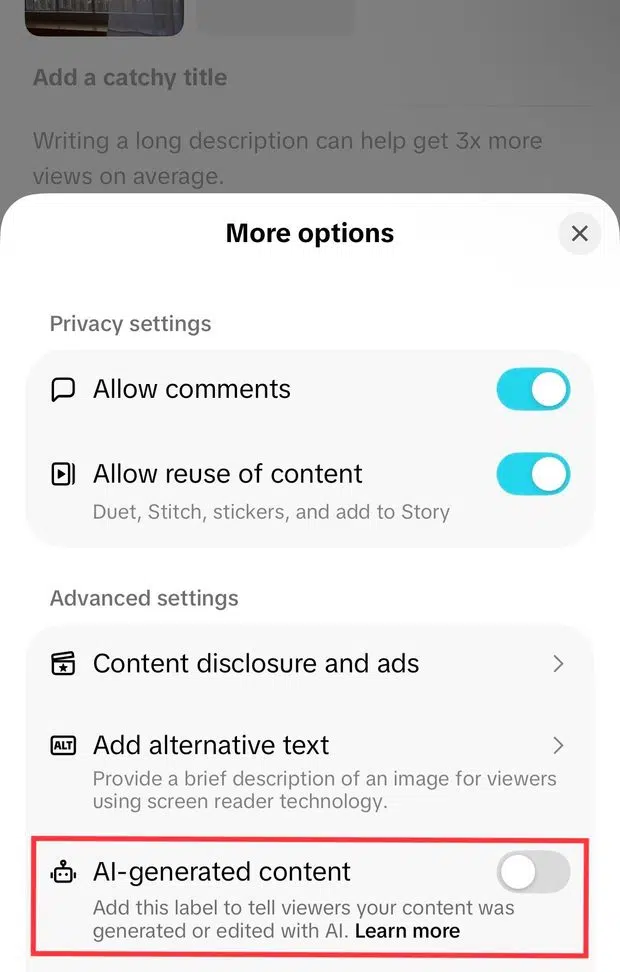
The Creator Toggle is the primary manual tool. When publishing a video, users can navigate to "More options" and select the "AI-generated content" switch. This adds a permanent tag to the post. The Auto-Label, however, is the platform’s "safety net." Utilizing Content Credentials—a standard developed by the Coalition for Content Provenance and Authenticity (C2PA)—TikTok’s backend systems can automatically detect metadata embedded in files created by major AI platforms. Finally, paid advertising carries the most stringent requirements. Advertisers must use a mandatory disclosure toggle within the TikTok Ads Manager. Once a campaign is submitted, this status is locked; duplicating an ad does not carry over the setting, meaning advertisers must remain vigilant during campaign scaling to avoid non-compliance.

Implications for Brand Reputation and Trust
The business case for transparency is increasingly tied to long-term brand equity. According to recent industry surveys, nearly 70% of social media users feel that brands should explicitly state when AI is used in their marketing materials. When a brand fails to disclose AI usage, it risks a "trust deficit."
Brittany Garcia, a prominent social media strategist, notes that as synthetic content becomes indistinguishable from reality, the label becomes the only "truth anchor" for the viewer. "When you hide the use of AI, you aren’t just hiding a technical process; you are potentially hiding the fact that your ‘customer testimonials’ or ‘product experiences’ were entirely fabricated," Garcia observes. "In an era of high skepticism, that is a PR crisis waiting to happen."

The risk extends beyond public perception. Regulatory bodies, including the Federal Trade Commission (FTC) in the United States, are increasingly looking at AI-generated advertising under the lens of deceptive marketing practices. Brands that use AI to mimic real-world results without disclosure may find themselves facing legal scrutiny that goes far beyond TikTok’s internal community guideline penalties.
Strategic Workflow Integration
To manage these risks, marketing teams must transition from ad-hoc posting to governed workflows. The following four-step process is recommended for agencies and in-house teams:
- Platform-Specific Audits: Disclosure rules are not universal. A video that requires an AI label on TikTok may be subject to different standards on Instagram or YouTube. Teams must maintain a matrix of compliance requirements for every channel in their ecosystem.
- Mandatory Disclosure in Creator Briefs: For brands working with influencers, the contract must explicitly define AI usage. If a creator generates a video for a sponsored campaign, the brand must ensure that the "AI-generated" tag is applied, as the brand is often legally liable for the influencer’s output under FTC guidelines.
- Handoff Protocols: In large organizations, the person who edits the video is rarely the person who posts it. Implementing a "Metadata Check" during the handoff phase—where the editor confirms in the project management tool whether AI was used—prevents the social media manager from inadvertently violating policies.
- Formalized Approval Layers: The integration of software solutions that automate these checks is becoming the standard. Tools like Hootsuite’s "Perch" allow managers to build "compliance checkpoints" into the approval flow. No post can reach the "scheduled" state without a designated team member affirming that the AI disclosure status has been verified.
The Role of Advanced Monitoring
Even with perfect internal processes, external monitoring is essential. The ability to track audience sentiment in real-time allows brands to gauge how their disclosure strategy is being received. If a campaign is being flagged by the community for "feeling fake," tools like "Lumen" can aggregate these mentions across millions of sources. This data provides the necessary feedback loop to adjust creative strategies before a minor misunderstanding escalates into a viral controversy.
Looking Ahead: The Future of Synthetic Media
As of late 2026, TikTok’s policy remains in a state of flux, mirroring the rapid evolution of the technology it regulates. The platform has begun testing settings that allow users to filter their "For You" feeds to minimize AI-generated content. This suggests that in the near future, undisclosed AI content may not just be flagged—it may be effectively hidden from the algorithm, drastically reducing reach.
For businesses, the takeaway is clear: the era of "stealth" AI is over. Transparency is no longer just a regulatory burden; it is a competitive advantage. Brands that lean into the technology while being transparent about its use will likely cultivate deeper, more authentic relationships with their audiences. Conversely, those that attempt to bypass these guardrails will find themselves increasingly isolated by both the platform’s algorithm and a more discerning, AI-literate consumer base.
By standardizing disclosure protocols and treating AI compliance as a core pillar of social media governance, organizations can continue to leverage the immense creative power of artificial intelligence while safeguarding their reputation in a complex, rapidly evolving digital ecosystem. The billion-video milestone is merely the beginning; as the technology matures, the brands that win will be those that treat the "AI-generated" label not as a warning, but as a testament to their commitment to honesty.