Google Ads Introduces Channel Prioritization Feature to Give Advertisers Greater Control Over Budget and Placement

For years, digital marketing professionals and enterprise advertisers have voiced frustration over the rigid, all-or-nothing framework governing Google Ads channel targeting. Historically, campaign configurations offered virtually zero flexibility when it came to granularly selecting or deselecting individual ad networks. For instance, Performance Max campaigns mandated an omnipresent visibility footprint, pushing advertisements concurrently across Google Search, Discover, Gmail, Maps, YouTube, and the sprawling Google Display Network (GDN). Similarly, traditional Search campaigns forced a binary choice regarding Google’s Search partners—either accept placement across the entire partner network or opt out entirely, leaving no room for strategic compromise.
This rigid era of digital advertising mechanics is beginning to shift. In response to mounting industry pressure and demands for enhanced transparency and control, Google officially announced a brand-new feature designated as "channel prioritization." This capability empowers digital marketers to assign explicit "High" or "Low" priority designations to individual channels within their advertising campaigns, fundamentally altering how automated algorithms distribute budgets across Google’s massive ecosystem.
Understanding the Mechanics of Channel Prioritization
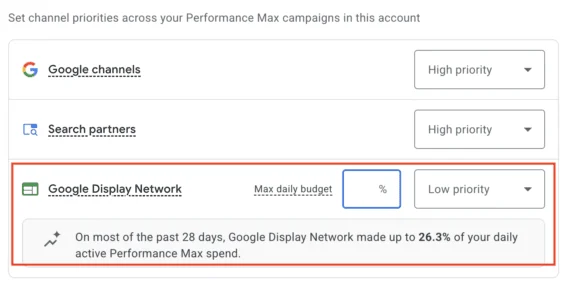
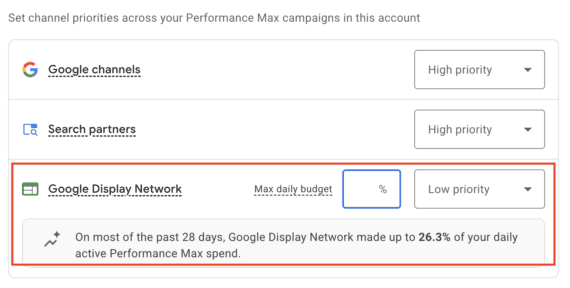
The newly introduced channel prioritization system is designed to provide advertisers with a diagnostic lens coupled with actionable leverage. When a marketer toggles a specific channel to a "Low priority" status within their Google Ads dashboard, the platform begins displaying the channel’s trailing 28-day spend percentage. This metrics breakdown allows media buyers to see precisely how much of their overall campaign budget is being funneled into specific environments.
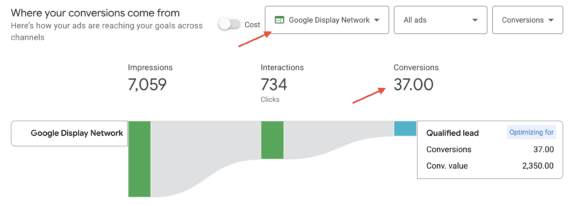
However, raw spend data in a vacuum can be misleading. To accurately evaluate whether a channel deserves prioritization, advertisers must cross-reference spend metrics with conversion outcomes found within the channel performance report, located in the "Insights and reports" section of the Google Ads interface.
For example, consider a scenario where a Performance Max campaign yields a total of 77 conversions. By navigating to the channel performance report, an advertiser might discover that 37 of those conversions originated specifically from the Google Display Network. If the 28-day spend report indicates that the Display Network consumed 26.3% of the overall campaign budget, but delivered 48.1% of the total conversions (37 out of 77), the mathematical conclusion becomes clear. The data demonstrates that the channel is punching above its weight class, delivering an outsized return on investment relative to its cost. Consequently, advertisers can confidently classify such a channel as a "High priority."

Conversely, if a channel consumes a disproportionately high percentage of the budget while generating a minimal number of conversions, it warrants a "Low priority" classification. For these underperforming channels, advertisers can input a maximum daily-spend percentage, placing a strict cap on how much capital Google’s automated algorithms can allocate to that specific placement.
Implementation Flexibility at Account and Campaign Levels
Google has structured the channel prioritization rollout to accommodate diverse account architectures. Advertisers have the operational flexibility to apply channel prioritization settings at either the individual campaign level or universally across an entire advertising account.
For smaller organizations, local businesses, or accounts managing a modest portfolio of campaigns, account-level settings offer a streamlined, efficient method to enforce broad governance over ad placements. Meanwhile, enterprise-level accounts managing extensive, multi-region, or multi-objective campaigns can leverage campaign-level prioritization. This granular approach allows sophisticated media buyers to fine-tune strategies on a campaign-by-campaign basis, aligning ad placement priorities precisely with specific marketing funnels, target audiences, and conversion goals.
Industry veterans have greeted the announcement with measured optimism. Many digital marketing consultants and agency directors note that the feature opens up new avenues for empirical experimentation. For instance, search engine marketing specialists have historically avoided Google’s Search partners entirely, arguing that partner networks frequently generate low-intent, unqualified traffic that rapidly depletes advertising budgets with little return. With the advent of channel prioritization, advertisers no longer need to rely on a total blackout. Instead, they can reintroduce Search partners into their media mix under a controlled environment—assigning them a "Low priority" status coupled with a restricted daily budget—to rigorously test their true profitability and traffic quality.
Structural Limitations and Industry Concerns
Despite the operational advantages offered by channel prioritization, digital marketing analysts have identified several notable limitations that prevent the feature from serving as a silver bullet for campaign optimization.
The most prominent constraint centers around Google’s grouping methodology, specifically the rigid categorization known as "Google channels." This specific grouping bundles five distinct properties into a single administrative unit: Google Search, Discover, Gmail, Maps, and YouTube.
Under the current framework, Google permits advertisers to apply only a single priority setting across all five of these channels collectively. This creates a logical paradox within the platform itself. Google’s own channel performance reporting mechanism tracks each of these platforms individually, tacitly acknowledging that Search, Maps, YouTube, Discover, and Gmail perform differently, attract distinct user intents, and yield varying conversion efficiencies.
Despite this clear recognition of performance disparity in reporting, advertisers remain unable to assign unique, independent priorities to each of these five platforms. If a campaign performs exceptionally well on Google Search but struggles to drive cost-effective conversions on Google Maps or Discover, marketers cannot isolate and adjust them separately. Instead, they are subjected to a localized version of the original all-or-nothing restriction, albeit compressed across a smaller subset of channels.
Furthermore, digital marketing professionals are adopting a "wait-and-see" approach regarding algorithmic compliance. A recurring skepticism surrounds how strictly Google’s machine learning systems will respect the maximum daily spend percentages assigned to Low priority channels. Historically, automated bidding strategies and budget allocation tools have occasionally over-indexed on automated optimizations, sometimes bypassing manual guardrails if the algorithm predicts a conversion opportunity. Advertisers will be closely monitoring platform behavior to determine whether these newly established spending caps are strictly enforced or routinely bent by Google’s automated systems.
Background and Context: The Evolution of Automated Campaign Types
The introduction of channel prioritization arrives at a critical juncture in the evolution of digital advertising. Over the past half-decade, Google has aggressively steered advertisers away from manual, highly controlled keyword and placement campaigns, heavily promoting automated, machine learning-driven solutions such as Performance Max and Demand Gen.
While these automated campaign types have successfully leveraged artificial intelligence to capture cross-channel user intent and scale conversions, they have simultaneously stripped digital marketers of traditional diagnostic controls. The black-box nature of automated campaigns has long been a major friction point between advertisers—who demand radical transparency and precise cost controls—and platform operators seeking to maximize automated inventory utilization.
Channel prioritization represents a regulatory compromise by Google, offering a bridge between the total automation of Performance Max and the granular demands of professional media buyers. By allowing advertisers to peek behind the curtain of spend distribution and apply rudimentary spending caps, Google is attempting to mitigate advertiser attrition while retaining the underlying architecture of its automated machine-learning models.
Broader Implications for the Digital Advertising Landscape
As digital marketing budgets face increasing scrutiny amid broader macroeconomic uncertainties, every dollar spent on paid search and display advertising must be rigorously accounted for. Features that enable tighter budget governance are no longer viewed merely as nice-to-have dashboard upgrades; they are essential tools for maintaining marketing efficiency and protecting profit margins.
The rollout of channel prioritization is expected to prompt a wave of retrospective data analysis across agencies and in-house marketing teams. Advertisers are currently auditing their historical 28-day spend percentages against conversion volume to identify bleeding assets within their existing campaign structures. By setting precise caps on underperforming networks, brands expect to reallocate capital toward high-converting placements, thereby lowering overall customer acquisition costs (CAC) and improving return on ad spend (ROAS).
At the same time, the feature’s limitations highlight the ongoing tension between platform-driven automation and advertiser autonomy. As digital advertising continues its rapid transition toward artificial intelligence and algorithmic bidding, the ongoing dialogue between platform developers and marketing professionals will likely center on finding the optimal balance between machine efficiency and human oversight.
For now, digital marketers must navigate the nuances of the new prioritization tool—leveraging its diagnostic reporting capabilities and budget caps where available, while continuing to advocate for greater channel-level independence within Google’s ever-expanding ecosystem.