DDRop: Researchers Uncover Hardware Interposer Attack Compromising Confidential Computing Memory Integrity

In a significant revelation for the cybersecurity community, a coalition of researchers from KU Leuven, ETH Zurich, Durham University, and Google has disclosed a sophisticated hardware-level vulnerability dubbed "DDRop." This attack exposes a fundamental design limitation in contemporary confidential computing architectures, specifically targeting the memory protection mechanisms used by Intel and AMD. By utilizing a custom-built, low-cost interposer circuit board, the researchers demonstrated the ability to silently drop write operations to server memory. This maneuver forces the processor to rely on stale, previously encrypted data, effectively bypassing the security guarantees that cloud service providers rely on to ensure data isolation.
The Mechanism of DDRop
Confidential computing is designed to protect data while it is actively being processed in RAM, rendering it unreadable even to the host operating system or a malicious cloud provider. While these systems utilize high-level encryption to secure memory, they often prioritize performance by omitting a "freshness" guarantee. In essence, while the processor can verify that data retrieved from memory is encrypted correctly, it possesses no built-in mechanism to confirm that the data retrieved is the most recent version written to that address.
DDRop exploits this gap through an active interposer—a small, inexpensive circuit board inserted between the CPU and the memory module. Unlike passive side-channel attacks that merely observe data flow, DDRop actively manipulates the memory bus. When the interposer intercepts a write command, it forces an error on the command bus and simultaneously cuts the signal path used by the memory module to report that error back to the processor. Consequently, the memory module discards the update, and the processor, unaware of the failure, continues to operate under the assumption that the write was successful. Because the old encrypted data remains valid and decrypts without error, the processor accepts the stale information as the current state, enabling an attacker to maintain persistent, undetected control over manipulated memory segments.

Technical Implications and Attack Methodology
The researchers developed the interposer at a cost of approximately $159, proving that high-end security breaches no longer require nation-state level resources. The device is capable of operating at the full speed of DDR5 memory, a marked improvement over previous generations of interposer attacks that were restricted by latency or limited to older DDR4 technology.
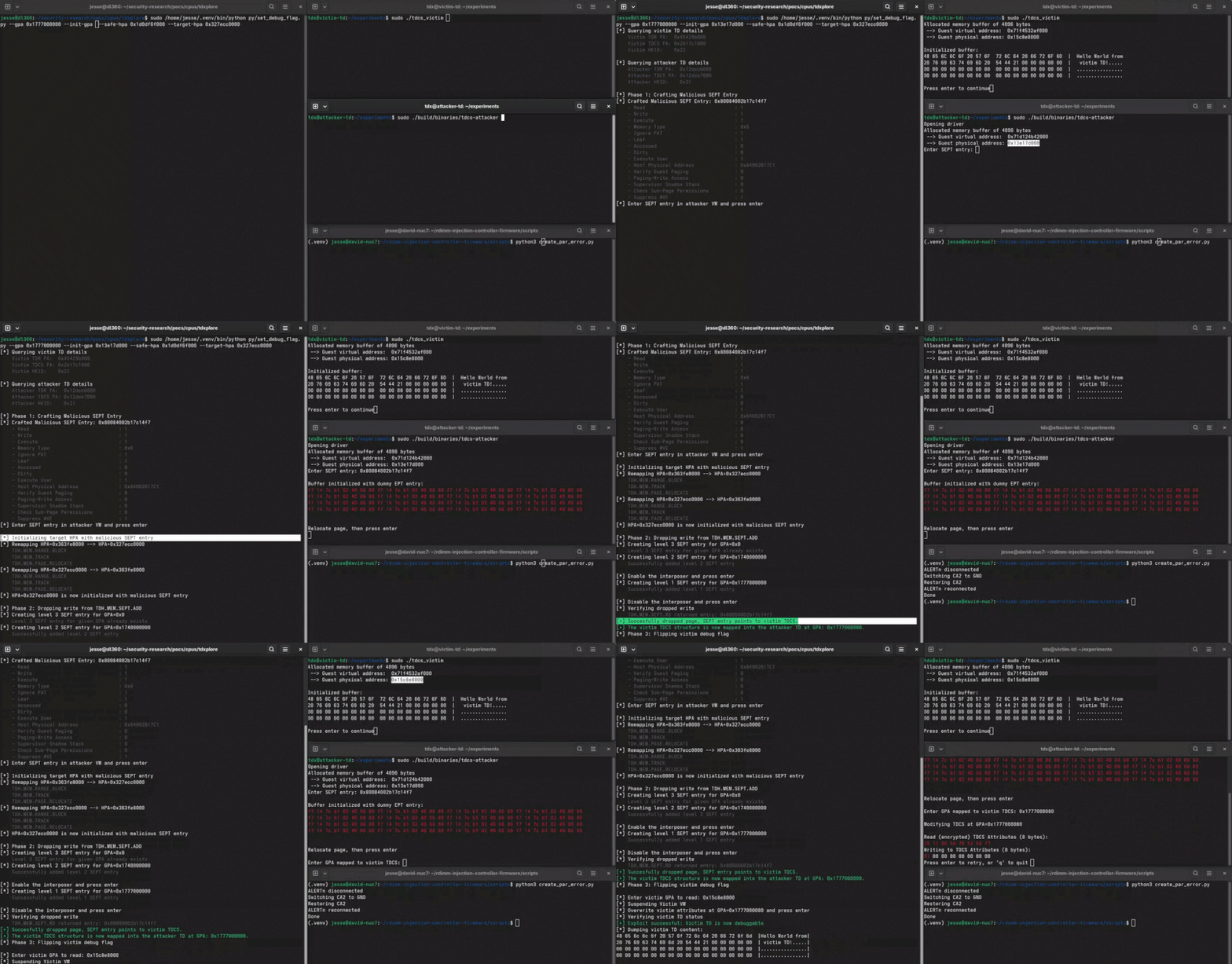
On Intel’s Trusted Domain Extensions (TDX), the researchers successfully weaponized this write-dropping technique to gain full control of protected virtual machines (VMs). By dropping the writes meant to initialize empty page tables, the team forced the system to utilize attacker-controlled data left in memory from previous operations. This allowed the researchers to map their own virtual memory onto physical addresses belonging to the victim, facilitating the reading of private data and the modification of system states.
Furthermore, the team demonstrated the ability to toggle a victim VM into debug mode—a state that allows for the extraction of memory in plaintext—before restoring the original data to hide the evidence of tampering. Perhaps most critically, they showed that it is possible to forge "launch measurements." By overwriting the integrity check that a remote customer uses to verify the state of their cloud instance, an attacker could trick a user into believing their workload is running in a secure, untampered environment when, in fact, it is compromised.
The Broader Security Context: AMD SEV-SNP and Intel TDX
While the attack is most potent against Intel TDX, it also has implications for AMD’s Secure Encrypted Virtualization-Secure Nested Paging (SEV-SNP). In testing, the researchers found that dropping writes during AMD’s page-relocation operations allowed them to duplicate victim memory pages. Although the specific debug-mode and attestation-forgery exploits were tailored for the Intel architecture, the underlying vulnerability—the lack of freshness checks in encrypted memory—is a systemic issue across all major confidential computing platforms.

It is worth noting that older technologies, such as Intel’s legacy Client SGX, are immune to this specific vector due to their use of hardware-based integrity trees that actively monitor for stale data. However, as cloud providers moved toward the massive, scalable memory requirements of modern enterprise computing, these integrity checks were sacrificed to improve speed and efficiency. Current confidential computing solutions offered by industry leaders such as AWS, Microsoft Azure, and Google Cloud remain susceptible to the core premise of the DDRop exploit.
Industry Response and Threat Models
The disclosure of DDRop has reignited the debate over the boundaries of hardware threat models. Both Intel and AMD have maintained a consistent stance: attacks requiring physical access to server hardware fall outside their published security threat models.
Intel, in an official statement regarding similar memory-encryption research, indicated that physical interposer attacks are outside the scope of their protection guarantees and confirmed that they do not intend to assign a Common Vulnerabilities and Exposures (CVE) identifier to such hardware-level vulnerabilities. Intel’s position is that its current "cryptographic integrity" mode—an optional configuration on specific Xeon processors—mitigates parts of the DDRop attack. However, the company acknowledged the research, characterizing it as "out of scope, but not out of mind," and confirmed that they are actively investigating stronger memory-encryption architectures for future generations of processors, including a concept known as "cache-line versioning."
AMD, meanwhile, noted that its own security bulletin regarding the findings was slated for publication in mid-September 2026. The company reaffirmed that its SEV-SNP architecture is designed to protect against software-based threats and malicious cloud administrators, rather than physical hardware tampering within a secured data center.

Future Implications and Challenges
The researchers, who are scheduled to present their findings at the ACM CCS 2026 conference in November, have provided their board designs, controller firmware, and proof-of-concept code on GitHub. By making this information public, they aim to drive a shift in industry standards, arguing that the current trajectory of confidential computing is unsustainable if it continues to prioritize performance at the total expense of memory freshness.
There is no simple software patch for DDRop. Because the vulnerability is rooted in the physical design of the memory bus and the way processors interact with encrypted memory, addressing it would require significant hardware revisions. Proposed mitigations, such as verifying the success of critical memory writes or implementing physical anti-tamper measures on server motherboards, provide only incremental security improvements rather than a fundamental resolution.
The requirement for physical access—whether through a compromised supply chain, a rogue data-center technician, or legal seizure—remains the primary barrier to a widespread attack. However, the success of the DDRop experiment highlights an uncomfortable reality for cloud customers: the security of "confidential" workloads is currently tied to the physical integrity of the underlying hardware. As long as the freshness of memory remains unverified, the threat posed by low-cost, high-performance interposers will remain a critical, albeit niche, concern for high-security environments.
As organizations continue to migrate sensitive workloads to the cloud, the DDRop disclosure serves as a timely reminder of the limitations of hardware-based security. While confidential computing remains a powerful tool against remote, software-based adversaries, the physical layer continues to represent a persistent, largely unaddressed attack surface that will likely define the next generation of hardware-security research and development. The findings by the KU Leuven-led team force a necessary industry-wide conversation about whether the speed of today’s servers justifies the current design trade-offs that leave data vulnerable to physical interposition.