AWS Builder Center Celebrates One Year Milestone with Launch of Sandbox Environments and Enhanced Community Features

The Amazon Web Services (AWS) ecosystem reached a significant milestone last week as the AWS Builder Center celebrated its first anniversary, marking twelve months of rapid expansion from a nascent community hub into a comprehensive technical ecosystem. Originally launched on July 9, 2025, the platform was designed to bridge the gap between static documentation and hands-on implementation for developers, architects, and students. In the year since its inception, the platform has transitioned from a basic interface featuring community profiles and a rudimentary toolbox into a sophisticated environment offering sandbox accounts, guided workshops, and a specialized Builders’ Library.
To commemorate the anniversary, AWS leadership and key contributors released a series of retrospectives detailing the platform’s trajectory and introducing the most requested feature to date: Sandbox Environments. This new addition represents a fundamental shift in how cloud education is delivered, providing users with ephemeral, pre-provisioned AWS accounts to test services without the financial risks or administrative burdens typically associated with cloud experimentation.
A Year of Exponential Growth and Community Engagement
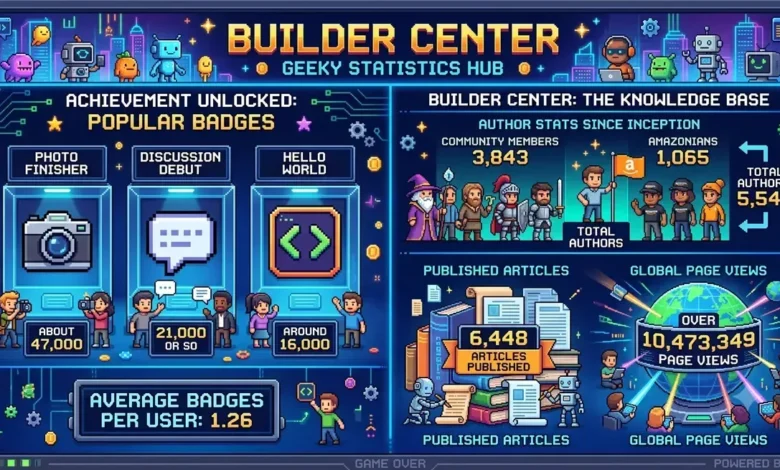
The scale of the AWS Builder Center’s growth over the past 365 days highlights a significant appetite for community-driven technical content within the cloud sector. According to data released by Jeff Barr, a prominent voice within the AWS community, the platform has hosted 5,548 unique authors who have collectively published 6,448 technical articles. These contributions have resonated deeply with the global developer community, garnering more than 10.4 million page views.
Engagement metrics suggest that the platform’s gamification and recognition systems have been primary drivers of retention. Since the introduction of the badge and streak system in March 2026, community members have earned 99,226 badges. These digital credentials recognize various milestones, from publishing high-impact technical guides to maintaining consistent learning habits. The integration of "student status" and "availability notifications" has further tailored the experience for those in academic settings or those monitoring specific regional service launches.
The platform’s infrastructure has also expanded to mirror the global reach of AWS itself. The "AWS Capabilities by Region" tool now tracks over 1,500 services across 37 geographic regions, providing builders with real-time data on where specific features are available—a critical resource for architects designing low-latency or compliant global applications.
Strategic Innovation: The Launch of Sandbox Environments
The headline announcement of the anniversary week was the introduction of Sandbox Environments, a feature authored and spearheaded by Rick Suttles. This initiative addresses one of the most persistent barriers to entry in cloud computing: the fear of unexpected costs and the complexity of resource cleanup.
The Sandbox Environments provide users with a free, pre-provisioned AWS account specifically designed to facilitate workshop exercises. Each environment remains active for a duration of eight hours, a window optimized for the completion of complex architectural labs. At the conclusion of this period, the account and all associated resources—such as EC2 instances, S3 buckets, and RDS databases—are automatically de-provisioned.
The policy governing these sandboxes is designed to ensure equitable access while preventing abuse. Users are permitted one active sandbox at a time and may request one environment per week. Crucially, the system requires no personal AWS account, no credit card information, and no manual cleanup. This "frictionless" entry point is expected to significantly increase the throughput of the AWS workshop program, particularly for developers in emerging markets or students who may not have the financial means to maintain a personal testing account.
Technical Milestones and a Chronology of Development
The evolution of the AWS Builder Center over the past year has been characterized by a steady cadence of feature releases aimed at improving the "builder experience." A timeline of the platform’s development reveals a strategic focus on community autonomy and resource accessibility:
- July 2025: The platform launches with community profiles, a wishlist for feature requests, and a basic toolbox.
- Late 2025: Introduction of "Spaces," allowing community members to form specialized groups based on technology stacks (e.g., Serverless, Generative AI, or Edge Computing).
- March 2026: Launch of the formal Badge and Streak system to incentivize peer-to-peer knowledge sharing and consistent platform engagement.
- Spring 2026: Integration of GitHub and Amazon OAuth for streamlined sign-in, alongside the introduction of "Article Series" to help authors organize multi-part technical deep dives.
- July 2026: The one-year anniversary marks the release of the Sandbox Environments and the "AWS Capabilities by Region" visualization tool.
This chronology demonstrates a shift from a content-consumption model to an interactive-learning model. The introduction of category and complexity filters for workshops has further refined this, allowing users to navigate a library that spans from foundational cloud concepts to advanced machine learning orchestration.
Impact of Community-Led Technical Documentation
One of the most notable successes of the AWS Builder Center has been its ability to surface high-quality, third-party technical content that addresses real-world challenges. The "Builders’ Library" has become a repository for practical solutions that often go beyond standard documentation.
Leading the charts in community impact is Dineshraj Dhanapathy’s article, "Building an AWS Study Buddy with MCP + Strands Agents SDK." Reaching over 50,000 views, the piece explores the intersection of Multi-Cloud Platforms (MCP) and agentic AI, providing a blueprint for developers to build personalized educational assistants. This was followed closely by Chris Miller’s "Migrating an EOL Linux Server to AWS in 8 Hours with Kiro," which garnered 45,000 views. Miller’s article addressed a critical legacy infrastructure problem, offering a time-sensitive migration strategy that resonated with enterprise IT professionals.
In the realm of social impact and specialized technology, Yash Aggarwal’s "AIdeas: NeuroVoice – Multimodal AI for Early Screening of Neurological Diseases" reached 38,000 views. This article highlighted the potential of AWS’s multimodal AI capabilities in the healthcare sector, specifically in identifying markers for neurological conditions through voice analysis. These examples underscore the platform’s role as a launchpad for innovative applications of cloud technology.
Data-Driven Feedback: The Wishlist System
The "Wishlist" has emerged as a vital mechanism for democratic platform governance. Since the launch, community members have submitted 565 formal requests for new features or improvements. AWS has demonstrated a commitment to this feedback loop, with 10 major wishes already shipped—including the Sandbox Environments—and another 20 currently prioritized on the near-term roadmap.
This transparent approach to product development has fostered a sense of ownership among the user base. By allowing builders to vote on the tools they need, AWS has reduced the gap between corporate product cycles and the actual requirements of the developer on the ground.

Broader Implications for the Cloud Industry
The success of the AWS Builder Center reflects a broader trend in the technology industry toward "developer-first" ecosystems. As cloud services become increasingly complex, the ability of a provider to offer low-barrier, high-quality educational resources becomes a competitive advantage.
The introduction of free sandboxes, in particular, places pressure on other major cloud providers to offer similar risk-free learning environments. Traditionally, cloud training has often required users to navigate "free tiers" that can inadvertently lead to charges if resources are not properly terminated. By automating the lifecycle of the learning environment, AWS is setting a new standard for educational UX (User Experience).
Furthermore, the platform’s focus on community authors helps AWS scale its documentation efforts. With over 6,000 articles published in a year, the Builder Center provides a diversity of perspectives and use cases that a centralized documentation team would struggle to replicate. This "crowdsourced" approach ensures that the content remains current with the latest open-source trends and third-party integrations.
Future Outlook and Conclusion
As the AWS Builder Center enters its second year, the focus appears to be shifting toward deeper integration of AI-assisted building and more granular community controls. The 20 items currently on the roadmap suggest improvements to the "Spaces" functionality and potentially more sophisticated sandbox configurations that could support multi-account architectural testing.
The platform’s first year has proven that a centralized, community-focused hub can effectively consolidate the fragmented landscape of cloud learning. By combining social networking elements with high-end technical tools like the Sandbox Environments, AWS has created a self-sustaining loop of contribution and education.
For the millions of "builders" who have engaged with the platform, the message from the anniversary retrospectives is clear: the platform will continue to evolve based on the direct input of its users. As Esra Kayabali noted in the anniversary announcement, the goal remains to provide a space where developers can meet, contribute solutions, and find the resources necessary to keep building in an ever-changing technological landscape. With the summer months ahead, the community is encouraged to utilize these new tools to recharge their skills and prepare for the next wave of cloud innovation.