Navigating the Digital Frontier: Social Media Strategies for the Highly Regulated Financial Services Sector


Social media marketing for financial services encompasses the strategic utilization of digital platforms to educate audiences, cultivate trust, generate leads, and provide customer support within an industry characterized by stringent regulatory oversight. This approach is critical for a diverse range of organizations, including traditional banks, credit unions, insurance companies, wealth management firms, and agile fintech innovators. The core challenge lies in a delicate balancing act: maintaining an engaging and authentic brand presence while rigorously adhering to complex regulatory requirements, safeguarding sensitive customer data, and fostering an advisory relationship built on unwavering trust. Every piece of content published carries significant compliance implications, underscoring the paramount importance of a well-defined strategy and robust governance alongside creative execution. When effectively managed, social media transforms into a powerful conduit for engaging individuals at the nascent stages of their financial journeys and remaining a top-of-mind resource as their needs evolve.
The Evolution of Financial Services in the Digital Landscape

Historically, financial services relied heavily on traditional marketing channels such as print advertisements, direct mail, and face-to-face interactions. The advent of the internet in the late 20th century marked the first significant shift, bringing online banking and digital information access. However, the rise of social media platforms in the 2000s presented a new paradigm, one initially approached with considerable caution by the highly regulated financial sector. Early apprehension stemmed from the dynamic, often informal nature of social media, which seemed at odds with the industry’s need for strict record-keeping, clear disclosures, and controlled messaging. Concerns over data privacy, security breaches, and the potential for miscommunication or non-compliance were formidable barriers.
Over the past decade, this landscape has undergone a profound transformation. The pervasive adoption of social media by consumers, particularly younger generations, compelled financial institutions to reassess their digital engagement strategies. What began as experimental forays into brand awareness on platforms like Facebook has matured into sophisticated, multi-channel approaches that integrate social media across marketing, customer service, and sales functions. This evolution has been driven by the undeniable shift in consumer behavior, where digital platforms are increasingly the first point of contact for information and advice, even in complex financial matters.
Reaching New Audiences and Building Trust in a Digital Age

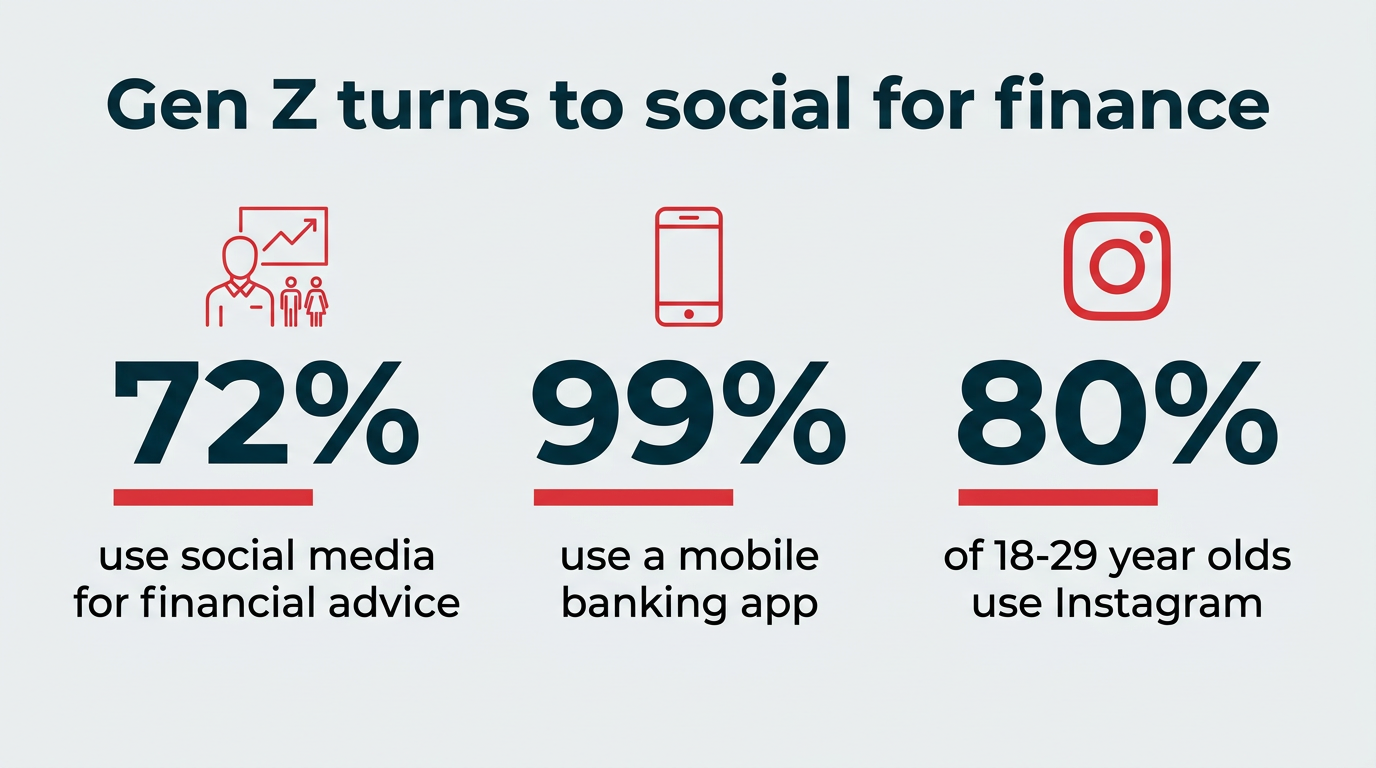
The imperative for financial services to embrace social media is underscored by its growing influence on how individuals, especially younger demographics, learn about finances and make decisions regarding who to trust. Data from early 2025 indicates a significant trend: 80% of 18–29-year-olds are active on Instagram alone, highlighting the platform’s reach among future financial clients. Gen Z, now entering key life stages that require financial planning, actively utilizes social platforms to learn about money, with 72% seeking financial advice there. This demographic’s comfort with mobile banking apps (99% usage) further solidifies the need for a strong digital presence. Financial brands that engage early and consistently on these platforms are better positioned to capture and retain these valuable long-term relationships.
Beyond mere reach, social media is instrumental in strengthening relationships. In an industry where trust is paramount, digital platforms facilitate "social selling," allowing advisors and institutions to organically build rapport. Observing milestones such as new jobs, retirements, or business launches on platforms like LinkedIn provides natural opportunities for engagement, transforming transactional interactions into advisory relationships. This proactive, empathetic approach distinguishes brands and builds loyalty over time, prioritizing relationship building over immediate sales pitches.
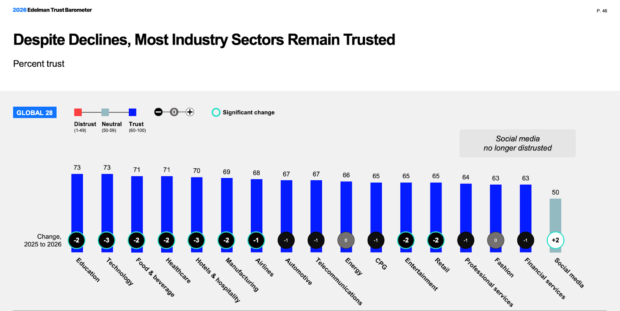
Furthermore, social media offers a powerful avenue to build trust and articulate brand values. Modern consumers, particularly millennials and Gen Z, are increasingly focused on the ethical and sustainable implications of their investments. A Morgan Stanley report from 2025 revealed that 99% of Gen Z and 97% of millennials are interested in sustainable investing. Social media enables financial brands to transparently communicate their values, explain their investment philosophies, and demonstrate their commitment to societal impact. While trust in financial services has seen improvements, it remains one of the least trusted sectors, according to the 2026 Edelman Trust Barometer. Social media provides a critical platform to bridge this trust gap by humanizing the brand. Studies show that 82% of people are more likely to trust a company when its senior executives are active on social media, making executive thought leadership a vital component of a comprehensive strategy.
Strategic Imperatives for Financial Services Social Media
An effective social media strategy for financial services is built upon several core imperatives:
-
Audience Engagement & Education: Financial topics can often be complex and intimidating. Social media allows brands to demystify these subjects through accessible, bite-sized content, explainer videos, infographics, and live Q&A sessions. This educational approach positions the brand as a helpful resource rather than just a service provider.
-
Trust & Transparency: In an industry prone to skepticism, transparency is key. Brands can use social media to share behind-the-scenes glimpses, highlight community involvement, publish ethical guidelines, and showcase customer success stories (with appropriate disclaimers). Executive visibility on platforms like LinkedIn reinforces credibility.
-
Customer Service & Relationship Building: Social media has evolved into a crucial customer service channel. Financial institutions can use platforms like Facebook and X (formerly Twitter) to address inquiries, resolve issues, and provide timely support. Integrating these interactions with CRM systems ensures compliance and a holistic customer view. Social selling, as mentioned, fosters long-term relationships rather than short-term transactions.
-
Market Intelligence & Insight Generation: Social listening tools are invaluable for tracking industry trends, monitoring competitor activities, and understanding customer sentiment in real-time. This "early warning system" can alert brands to emerging opportunities, potential crises, and shifts in consumer needs, allowing for agile strategic adjustments.
-
Operational Efficiency & Cost Reduction: A unified social media management platform can streamline workflows, centralize content creation and approval, and facilitate employee advocacy. By providing pre-approved, compliant content, these platforms empower advisors to engage authentically while ensuring brand consistency and regulatory adherence, thereby reducing manual effort and potential compliance costs.
-
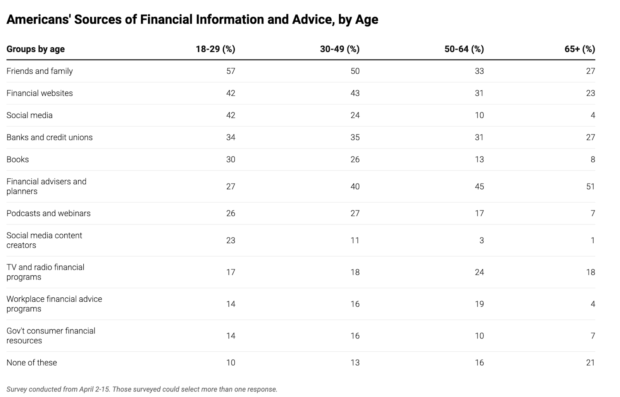
Driving Measurable Business Results: Ultimately, social media must contribute to tangible business outcomes. A 2025 Gallup poll indicated that 42% of Americans under 30 get financial advice from social media, with 23% following "finfluencers." Even those with financial advisors still turn to social media for planning insights (45% of U.S. consumers). This highlights social media’s role in the customer journey, from initial awareness to conversion and ongoing retention.
Optimizing Platform Usage: A Multi-Channel Approach
The selection of social media platforms should align with specific audience demographics and strategic objectives. Each platform offers unique strengths for financial services:
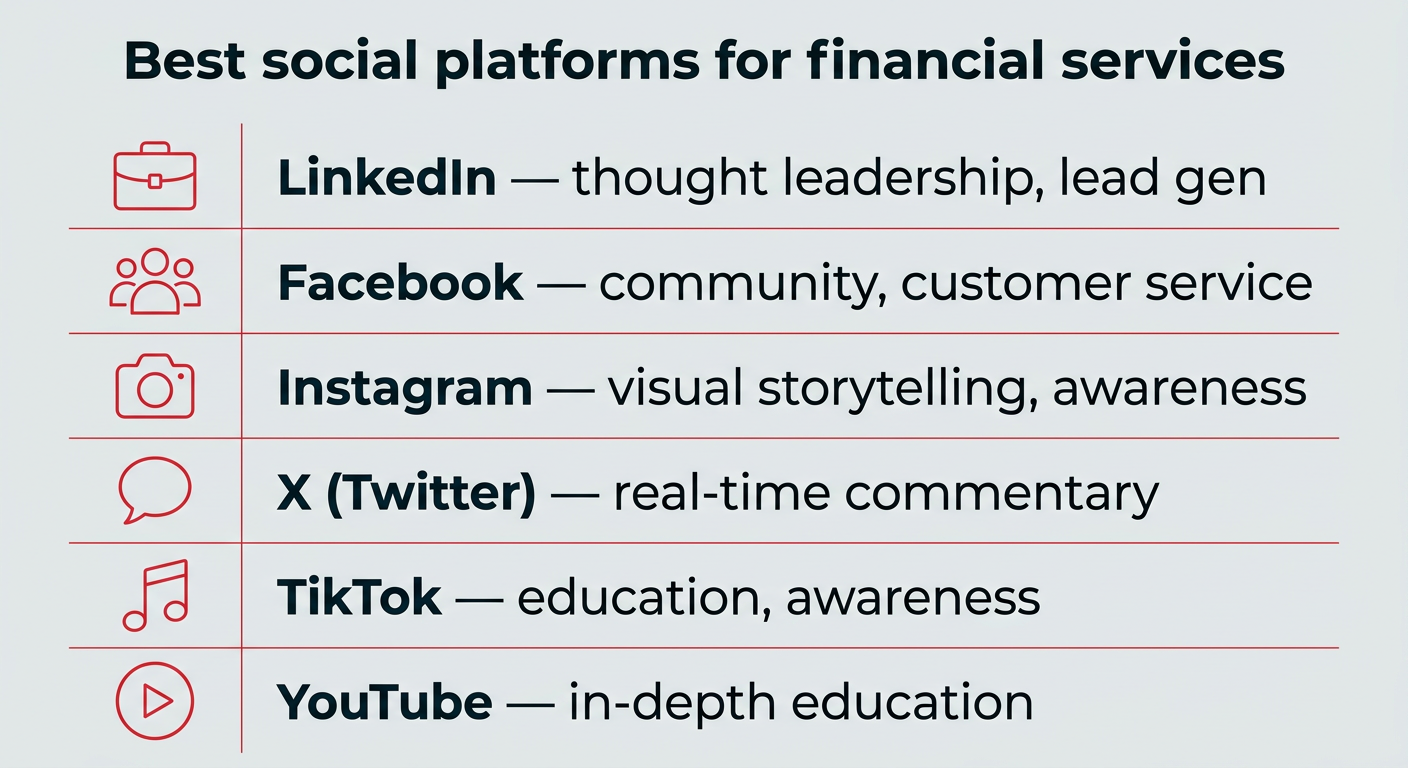
- LinkedIn: Ideal for thought leadership, professional networking, and B2B lead generation. Its audience is 2x more likely to seek financial advice on the platform. Long-form articles and professional updates resonate well here, making it perfect for reaching business decision-makers and showcasing executive expertise.
- Meta (Facebook & Instagram): Facebook excels at community building, localized branch presence, and customer service due to its broad user base and messaging capabilities. Instagram, with its visual focus, boasts the highest engagement rate (3.8%) and fastest follower growth (2.26%) in FinServ, making it ideal for visual storytelling, brand awareness, and reaching younger audiences through Reels and Stories.
- X (formerly Twitter): A fast-paced platform for real-time commentary, news reactions, and live customer service. Its brevity rewards clear opinions and timely insights, fostering direct engagement with news-focused audiences and industry discussions.
- TikTok: Increasingly vital for reaching Gen Z and younger millennials. Its short-form video format is excellent for explaining complex financial topics in an accessible, engaging, and often humorous way. Brands must adopt a native, casual tone to succeed here, while also monitoring its evolving regulatory status in key markets.
- YouTube: The premier platform for long-form video content, including educational explainers, webinars, and podcasts. YouTube content has a longer shelf life and significant SEO value, making it invaluable for in-depth education and building evergreen resources.
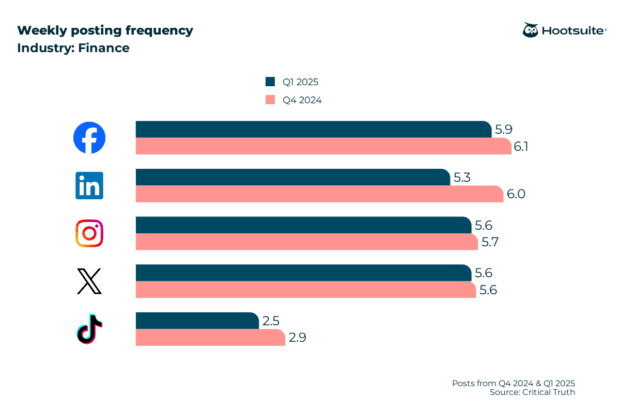
Industry benchmarks from early 2025 suggest varying posting frequencies and engagement rates. Financial institutions post most frequently on Facebook (5.9 times/week), followed by Instagram (5.6 times/week) and LinkedIn (5.3 times/week). Instagram leads in average engagement (3.8%) and follower growth (2.26%), underscoring its importance for brand visibility. These figures serve as a starting point, emphasizing the need for ongoing testing and optimization to determine optimal posting schedules for specific audiences.
Building a Robust Social Media Strategy: A Six-Step Framework

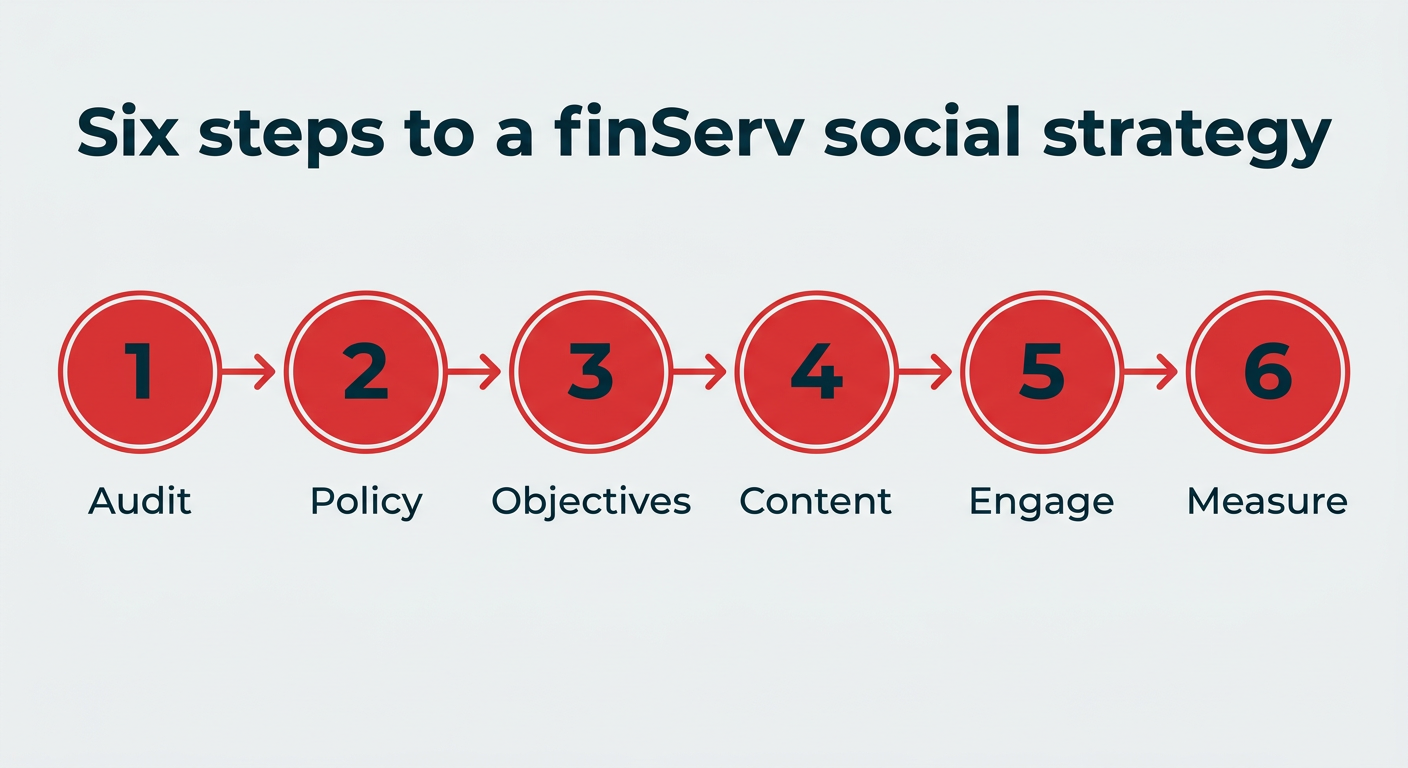
Developing an effective social media strategy in financial services requires a structured, iterative approach:
-
Conduct a Social Media Audit: Begin by inventorying all existing social profiles, including official brand accounts, departmental pages, and individual advisor profiles. Crucially, identify and address any impostor or unofficial accounts to protect brand integrity. This audit also highlights platforms where a presence is lacking but handles should be claimed.
-
Implement a Comprehensive Social Media Policy: A robust policy is the cornerstone of compliant social media use. This document must guide all social media activity within the organization, covering official brand accounts and individual advisor/agent profiles. Key stakeholders—including legal, compliance, marketing, HR, IT, and executive leadership—must collaborate in its creation. The policy should delineate roles, approval workflows, content guidelines (e.g., prohibitions on testimonials, specific disclaimers), crisis communication protocols, and strict security measures like password hygiene and access controls. This collaborative approach ensures consistency and mitigates compliance risks.

-
Establish Clear Objectives and Define Your Target Audience: Before any content is published, define measurable goals tied to specific business outcomes. These could range from brand awareness and lead generation to improved customer satisfaction scores or reduced customer service response times. Simultaneously, segment your target audience (e.g., retail banking clients, high-net-worth individuals, B2B clients) and map their needs and preferred platforms to your objectives.
-
Create Compliant, Engaging Content: Content creation must strike a balance between educational value, engagement, and strict compliance. Tailor content formats to platform strengths—long-form thought leadership for LinkedIn, visually rich stories for Instagram, educational shorts for TikTok. A well-structured content calendar ensures consistent delivery. Leveraging AI tools for ideation and drafting, coupled with approval workflows (e.g., Perch in Hootsuite Social OS), streamlines content production while maintaining brand standards and regulatory adherence.
-
Engage and Nurture Relationships: Publishing content is only half the equation; active engagement is vital. Customers expect timely responses on their preferred channels. Social customer service tools that integrate with CRM systems (e.g., Nest in Hootsuite Social OS with Salesforce/Microsoft Dynamics) enable teams to manage private messages, public comments, and mentions across platforms. This centralized approach ensures personalized, compliant responses and comprehensive record-keeping.

-
Measure, Report, and Optimize: Continuously track performance against established goals. Utilize social media analytics to identify what resonates with your audience and what doesn’t. Reporting results to leadership in terms of tangible business impact (e.g., leads generated, customer sentiment shifts, ROI) validates the strategy’s value. Social media strategy should be viewed as an iterative loop, constantly refined based on data-driven insights.
Compliance and Risk Management: The Bedrock of FinServ Social Media
Social media compliance in financial services is a multifaceted discipline requiring adherence to various regulatory frameworks, rigorous record-keeping, and proactive risk mitigation.
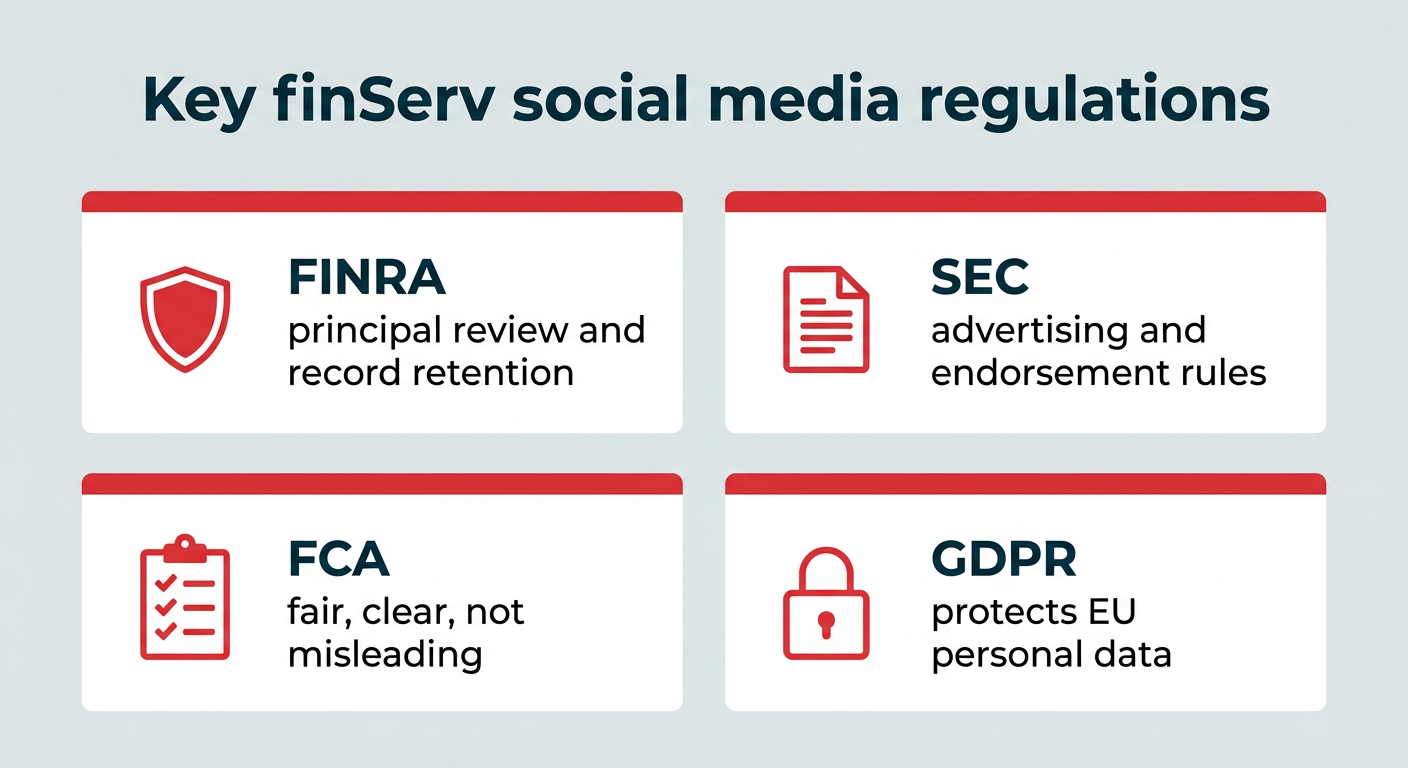
Regulatory Requirements: Financial firms operate under the watchful eye of bodies like FINRA and SEC in the U.S., FCA in the UK, and GDPR across the EU, among others.
- FINRA (Financial Industry Regulatory Authority): Regulates broker-dealers, emphasizing the supervision of all communications, ensuring suitability, proper disclosure, and the prohibition of misleading statements. All business-related social media activity by associated persons must be reviewed by a registered principal.
- SEC (U.S. Securities and Exchange Commission): Oversees investment advisors, focusing on anti-fraud provisions, restrictions on testimonials, and rules for performance advertising. Social media content must be truthful, non-misleading, and adequately supervised.
- FCA (Financial Conduct Authority – UK): Operates on principles-based regulation, requiring firms to ensure all communications are clear, fair, and not misleading, and that customers are treated fairly.
- GDPR (General Data Protection Regulation – EU): Governs data privacy and protection for all individuals within the EU. Financial firms engaging with EU citizens on social media must adhere to strict rules on data collection, processing, consent, and the right to be forgotten.
The complexity of these regulations necessitates robust compliance processes and specialized tools. Platforms with compliance layers (e.g., Vigil in Hootsuite Social OS) can enforce approval chains and policies across teams, providing a critical safeguard against non-compliance. Collaboration with legal and compliance teams is non-negotiable from the outset of strategy development.
Archiving and Record-Keeping: A critical component of compliance is the mandatory archiving of all business-related communications. FINRA, for instance, requires records to be stored for at least three years. This includes every social media post, comment, direct message, and interaction. Integrations with compliance solutions like Brolly and Smarsh automatically archive social media communications in secure, searchable databases, complete with original context, ensuring audit readiness.
Social Media Risks and Challenges: Beyond regulatory non-compliance, which can lead to severe fines and legal action, financial services face several acute risks:
- Reputational Damage: A single public misstep, a poorly handled complaint, or an inappropriate post can quickly go viral, eroding public confidence in an already low-trust industry.
- Fraud and Impersonation: Scammers frequently create fake accounts mimicking legitimate financial brands or advisors to defraud customers. Robust monitoring and swift action are required to identify and report such fraudulent activities.
- Customer Privacy Violations: Sharing or inadvertently exposing personal financial information, even indirectly, can lead to severe legal penalties under data protection laws like GDPR and significantly damage customer trust.
- Cybersecurity Threats: Social media platforms can be vectors for phishing attacks, malware, and other cyber threats if not managed securely.
Mitigating these risks requires strong governance, continuous monitoring, stringent access controls, and ongoing employee training on social media best practices and compliance.
Emerging Trends and Future Outlook (2026)
The financial services social media landscape in 2026 is shaped by three dominant trends: the integration of AI, the continued dominance of video content, and the amplification of authentic human voices.
-
AI-Powered Content Creation and Social Intelligence: Artificial intelligence is revolutionizing how financial brands operate on social media. AI tools are accelerating content drafting and ideation, ensuring consistency, and even personalizing messages at scale. More critically, AI-powered social listening (e.g., Lumen in Hootsuite Social OS) provides contextual intelligence, helping teams detect shifting sentiment, identify emerging trends, and spot potential crises far earlier than manual methods. This combination of speed, insights, and governed workflows offers a significant competitive advantage in a regulated environment.
-
Short-Form Video and Creator Partnerships: The explosion of short-form video on TikTok, Instagram Reels, and YouTube Shorts continues unabated. Financial brands are increasingly leveraging these formats to deliver concise, engaging educational content. The rise of "finfluencers"—personal finance content creators—presents both opportunities and challenges. Partnerships with these creators can help reach younger, digitally native audiences who distrust traditional advertising. However, these collaborations demand rigorous due diligence and robust compliance frameworks to ensure accuracy, avoid misrepresentation, and adhere to testimonial and endorsement regulations.
-
Employee Advocacy as a Growth Channel: Financial services firms are recognizing the power of their employees’ voices. Advisors and executives who share compliant, pre-approved content on their personal social profiles often achieve greater reach and credibility than corporate accounts. Platforms like Parliament (in Hootsuite Social OS) facilitate scaled employee advocacy by providing a library of approved content, ensuring messaging remains on-brand and compliant. This strategy transforms a firm’s workforce into a powerful network of authentic brand advocates, significantly enhancing trust and organic reach.
Beyond these trends, discussions around the implications of the metaverse and Web3 for financial services are gaining traction, although practical applications on social media remain nascent. Continued focus on data privacy and ethical AI usage will also be critical as regulations evolve.
Successful Social Media Strategies in Practice

Leading financial services brands demonstrate that successful social media campaigns prioritize education, authentic storytelling, and consistent engagement:
-
Current x MrBeast: Current, a mobile banking services provider, strategically partnered with high-profile influencers like MrBeast to build brand awareness. Their collaboration resulted in highly engaging YouTube videos that significantly boosted app activity and visibility in the Apple App Store. This campaign effectively met a young audience where they were, leveraging a trusted creator to make the brand feel relatable and shareable, bypassing traditional advertising skepticism.
-
BNY Mellon #DoWellBetter: BNY Mellon’s #DoWellBetter campaign focused on spotlighting the positive impact their clients were making through smart investing and thoughtful wealth management. Featuring compelling portraits and video interviews, the campaign humanized finance by showcasing real-life stories of clients driving positive change. This approach built an emotional connection that pure product messaging could not achieve, resonating with an audience increasingly interested in purpose-driven finance.

-
Vanguard Group #GettingSocial: Investment giant Vanguard Group implemented a weekly social video series titled #GettingSocial, offering clear and helpful insights into investing and other financial topics. The consistency of this series was key; by publishing on a regular schedule, Vanguard built an expectation among followers, positioning itself as a reliable educational resource. These short-form videos delivered valuable takeaways efficiently, perfectly suited for busy audiences, and were often supported by complementary social ads to broaden reach and drive conversions.
In conclusion, for financial services institutions, a robust, compliant, and agile social media strategy is no longer optional but essential for thriving in the digital economy. By embracing a multi-platform approach, prioritizing ethical conduct, leveraging advanced tools, and focusing on genuine engagement, financial brands can effectively navigate the complexities of the digital frontier, build lasting trust, and drive meaningful business results. The integration of social media into core business functions, supported by strong governance and continuous optimization, will define success for the sector in the years to come.