Qilin Ransomware Affiliates Exploit Critical Palo Alto Networks PAN-OS Vulnerability for Domain-Wide Breach


The cybersecurity landscape has been jolted by the revelation that affiliates of the Qilin ransomware-as-a-service (RaaS) operation are actively weaponizing a critical authentication bypass vulnerability in Palo Alto Networks’ PAN-OS software. The flaw, identified as CVE-2026-0257, resides in the GlobalProtect gateway and portal, providing threat actors with a direct path to bypass security restrictions and establish unauthorized VPN connections. According to a comprehensive investigation by cybersecurity firm Arctic Wolf Labs, this vulnerability has become a primary entry point for high-impact ransomware attacks, leading to domain-wide encryption and the theft of sensitive corporate data.
The exploitation of edge-facing infrastructure, particularly Virtual Private Networks (VPNs), has become a hallmark of modern cyber-extortion. As organizations increasingly rely on remote access solutions to support a globalized workforce, these gateways have become the "front doors" of corporate networks. When a vulnerability as severe as CVE-2026-0257 is discovered in a product as widely deployed as Palo Alto Networks’ GlobalProtect, the implications for global commerce and data security are profound. Palo Alto Networks currently serves over 70,000 customers worldwide, including the vast majority of the Fortune 10 and the largest financial institutions in the United States, making the potential attack surface nearly unparalleled.
Technical Overview of CVE-2026-0257
CVE-2026-0257 is characterized as an authentication bypass vulnerability within the PAN-OS software that powers Palo Alto Networks’ firewall appliances. Specifically, the flaw affects the GlobalProtect feature, which is used to provide secure, encrypted connections for remote users. An attacker who successfully exploits this vulnerability can bypass the traditional authentication handshake, effectively tricking the system into granting access without valid credentials.
Once the bypass is achieved, the attacker gains an unauthorized VPN connection. In the context of an enterprise network, this is equivalent to sitting inside the physical office with a direct plug into the internal switch. From this vantage point, threat actors can conduct lateral movement, scan for sensitive databases, compromise domain controllers, and eventually deploy ransomware across the entire environment. The critical nature of this flaw is reflected in its CVSS score and the speed with which it was added to federal "must-patch" lists.
The Qilin Ransomware Operation: A Profile in Aggression
The Qilin ransomware group, which first emerged in August 2022 under the moniker "Agenda," has rapidly ascended the ranks of the cybercriminal underworld. Operating on a RaaS model, the core developers provide the encryption software and negotiation infrastructure, while "affiliates" carry out the actual intrusions. This model allows for a high volume of simultaneous attacks across diverse sectors.

Since its rebranding to Qilin, the group has been linked to more than 2,000 successful breaches documented on its dark web leak site. Qilin is known for its "double-extortion" tactics, where attackers not only encrypt the victim’s files but also exfiltrate massive amounts of data. If the ransom is not paid, the group threatens to publish the stolen information, creating a two-pronged pressure campaign on the victim organization.
Qilin’s victimology is diverse and includes several high-profile targets. Notable victims include the automotive giants Nissan and Yanfeng, the Japanese beverage conglomerate Asahi, and the publishing firm Lee Enterprises. One of the group’s most disruptive attacks involved Synnovis, a pathology services provider, which led to significant operational delays at several major London hospitals. The group’s ability to pivot from "big game hunting" in the private sector to hitting critical infrastructure highlights its versatility and the danger it poses to public safety.
Chronology of the Exploitation
The timeline of CVE-2026-0257 reveals a rapid transition from discovery to active exploitation by sophisticated threat actors.
- May 13, 2026: Palo Alto Networks officially addresses the vulnerability, releasing patches for affected PAN-OS versions and issuing a security advisory. The company warns of limited exploit attempts on unpatched devices.
- May 17, 2026: Rapid7, another prominent cybersecurity firm, reports observing the vulnerability being exploited against numerous customers. This marks the beginning of a broader wave of automated scanning and manual exploitation.
- May 29, 2026: The U.S. Cybersecurity and Infrastructure Security Agency (CISA) adds CVE-2026-0257 to its Known Exploited Vulnerabilities (KEV) catalog. CISA issues a binding operational directive ordering federal agencies to secure their GlobalProtect VPN instances within a strict three-day window.
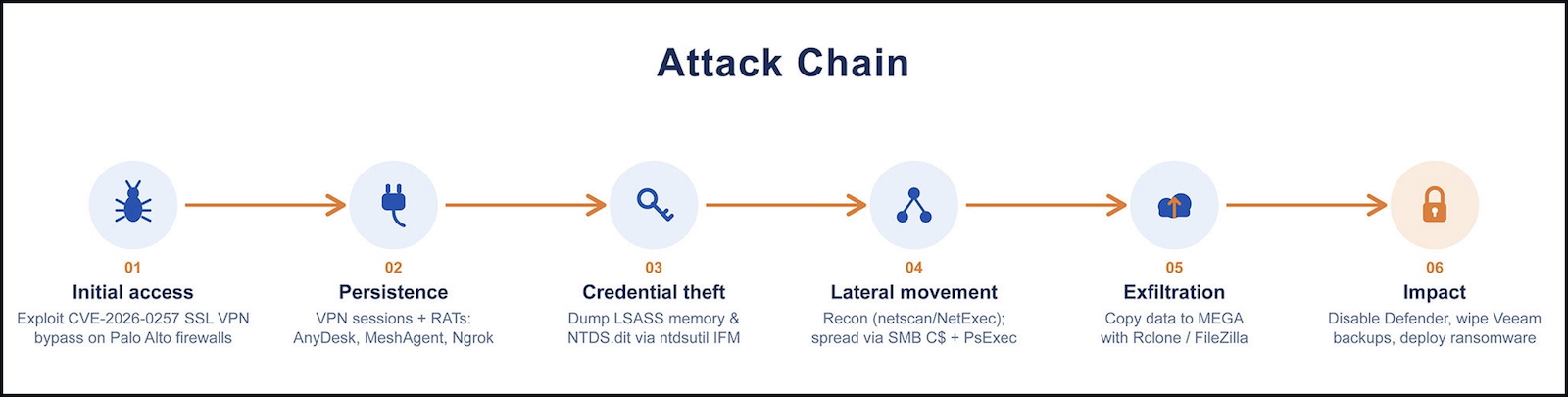
- June 2026: Arctic Wolf Labs investigates multiple distinct intrusions. Their findings confirm that Qilin ransomware affiliates are the primary drivers behind these attacks. The investigations reveal that the flaw is being used to gain initial access, followed by rapid deployment of ransomware.
Arctic Wolf Labs’ Investigation and Findings
During June 2026, Arctic Wolf Labs responded to several incidents where Qilin ransomware was deployed following the exploitation of CVE-2026-0257. Their analysis suggests that the tradecraft used post-exploitation varied significantly between cases, which is a strong indicator that multiple different affiliates are utilizing the same exploit.
In some instances, the attackers moved with extreme speed, focusing purely on encryption to disrupt operations as quickly as possible. In other cases, the affiliates engaged in more methodical "full double-extortion" operations, spending time within the network to identify and steal high-value data before launching the ransomware.
"Arctic Wolf Labs assesses with moderate confidence that intrusions leveraging CVE-2026-0257 and leading to Qilin ransomware deployment are likely ongoing," the firm stated in its technical blog. This assessment is bolstered by the observation of extensive scanning activity across the internet, as affiliates hunt for remaining unpatched Palo Alto appliances.

Global Exposure and the Scale of the Threat
The scale of the potential threat is underscored by data from internet monitoring services. Shadowserver, a threat watchdog, currently tracks over 167,000 GlobalProtect VPN instances exposed to the public internet. Similarly, the search engine Shodan has identified over 172,000 unique IP addresses associated with GlobalProtect fingerprints.
While it is unclear how many of these instances have been patched since the May 13 advisory, the sheer volume of exposed gateways represents a massive opportunity for ransomware groups. Even if 90% of organizations have patched, the remaining 10%—roughly 17,000 entities—remain vulnerable to a flaw that requires no user interaction to exploit.
The "RaaS model" further complicates the defense. Because the exploit for CVE-2026-0257 is now effectively a "commodity" in the cybercriminal underground, it is being shared and sold among various threat actors. This means that even if the Qilin group were to cease operations, other ransomware families would likely pick up the slack, continuing to target the same vulnerability.
Broader Implications for Enterprise Security
The exploitation of CVE-2026-0257 by Qilin is a stark reminder of the vulnerability of "edge" devices. In recent years, there has been a noticeable shift in ransomware tactics. Rather than relying solely on phishing emails to trick employees, attackers are increasingly focusing on "N-day" vulnerabilities—known flaws for which patches exist but have not yet been applied by all organizations.
This trend highlights several critical issues in modern cybersecurity:
- Patch Management Lag: Despite the critical nature of the flaw and the CISA mandate, thousands of devices remain unpatched weeks after a fix is available. The complexity of enterprise networks often slows down the deployment of patches for core infrastructure.
- The Single Point of Failure: VPNs are intended to be security tools, but when they contain vulnerabilities, they become the single point of failure that compromises the entire perimeter.
- The Speed of the Ransomware Lifecycle: The time between the disclosure of a vulnerability and its active exploitation in a ransomware campaign is shrinking. Organizations no longer have weeks to plan a patch cycle; they have days or even hours.
Official Responses and Recommended Mitigations
Palo Alto Networks has urged all customers to upgrade to the latest versions of PAN-OS immediately. For organizations unable to patch instantly, the company has provided specific mitigation steps, though it emphasizes that these are temporary measures and not a substitute for the full security update.
CISA’s involvement underscores the national security implications of the flaw. By mandating federal agencies to patch within 72 hours, the agency sent a clear signal to the private sector about the urgency of the situation. Security experts recommend that organizations not only patch their systems but also conduct a thorough "threat hunt" within their networks if they were running a vulnerable version of GlobalProtect during the period of active exploitation.
Recommended actions for IT security teams include:
- Immediate Patching: Prioritize the update of all PAN-OS devices to a non-vulnerable version.
- Log Analysis: Examine VPN logs for unusual authentication patterns or connections from unexpected geographic locations.
- Enhanced Monitoring: Implement robust monitoring for lateral movement and the use of administrative tools (like PowerShell or PsExec) that are commonly used by ransomware affiliates after gaining entry.
- Multi-Factor Authentication (MFA): While CVE-2026-0257 is an authentication bypass, maintaining strict MFA across all other services can help limit the damage if an attacker gains an initial foothold.
As the Qilin ransomware group continues to refine its tactics and exploit critical infrastructure, the battle between defenders and attackers remains a race against time. The exploitation of CVE-2026-0257 serves as a definitive case study in the risks associated with modern remote access and the relentless nature of the RaaS ecosystem. Organizations must view the security of their edge devices as a top-tier priority to avoid becoming the next entry on a dark web leak site.
Related posts: