The history of social media explained in a clear timeline, with key milestones from early online communities of Facebook to AI-driven feeds.

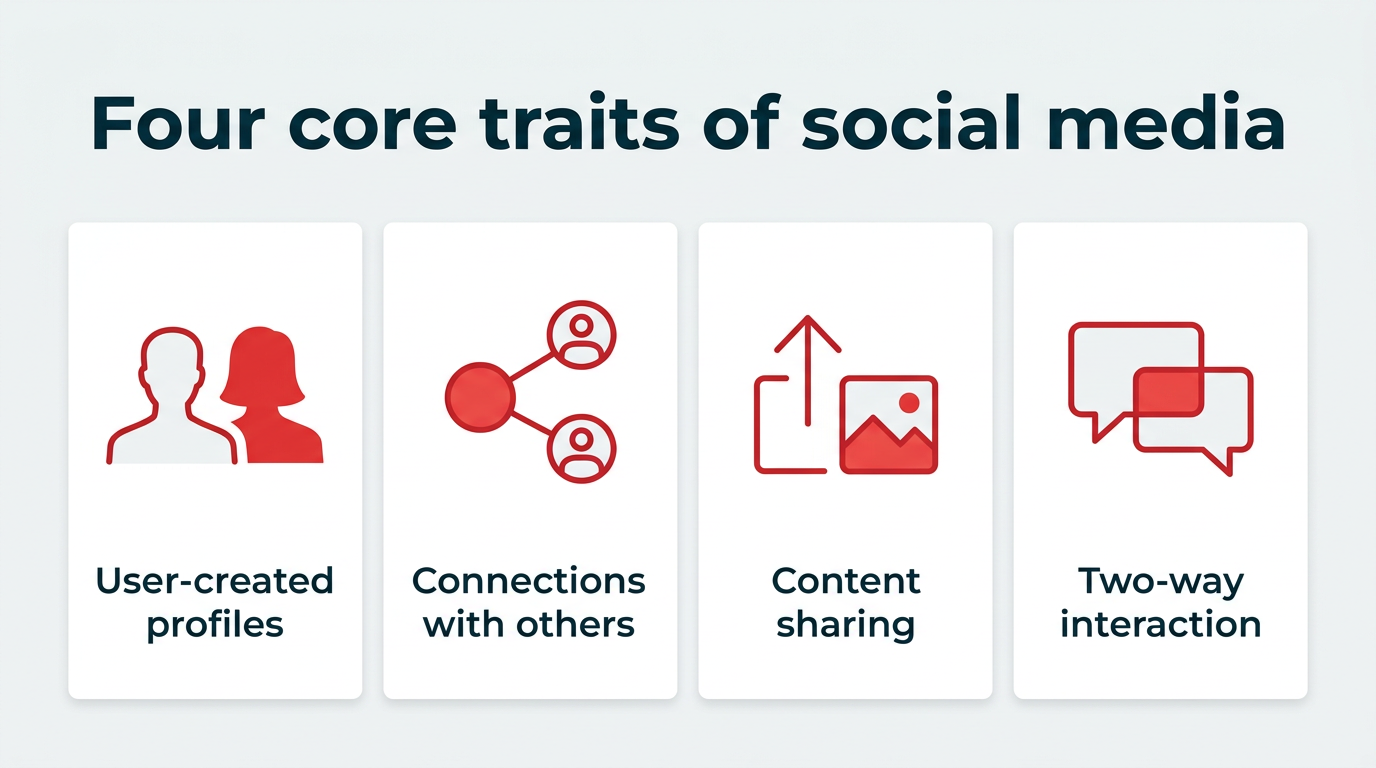
Social media, in its modern iteration, refers to online platforms that empower individuals to construct personal profiles, forge connections with others, and disseminate user-generated content in real-time. It is defined less by any single application and more by a distinctive set of shared characteristics that differentiate a social network from a mere website or a simple chat utility. This critical distinction becomes paramount when attempting to identify the "first" platform, as the answer often hinges on where one delineates the precise beginning of "social" functionality. Fundamentally, these platforms revolve around the ability for users to engage in synchronous or asynchronous communication, share aspects of their lives, and build digital communities. Understanding this foundational definition allows for the recognition of social media’s journey as a steady, continuous evolution rather than a singular, sudden invention.
The Genesis of Digital Connection: Proto-Social Systems (1970s – Early 1990s)
Long before the advent of elaborate profiles and dynamic news feeds, the innate human desire for connection spurred the development of early networked computer systems. These pioneering platforms, often referred to as proto-social media, laid the essential groundwork for everything that followed, initiating the concept of people interacting through digital means.
The PLATO system, developed by the University of Illinois in 1970, exhibited many features akin to an early social network, albeit primarily within an academic context. It allowed users to communicate, share information, and even play games. Building on this nascent idea, Community Memory, launched in Berkeley, California in 1973, established one of the first public computerized bulletin board systems. This revolutionary system enabled individuals to post and read messages at shared terminals, demonstrating a fundamental truth: people were eager to leverage computers for interpersonal communication, extending beyond mere calculations. These early, text-only and technically oriented systems proved the inherent demand for digital interaction.

The 1980s and early 1990s saw the aggregation of crucial building blocks for what would become modern social media. Usenet, conceived by Tom Truscott and Jim Ellis in 1979-1980, emerged as a distributed discussion system frequently cited as the first truly open social media application. It allowed users worldwide to exchange messages within various "newsgroups," effectively forming specialized online communities around shared interests. By 1988, Internet Relay Chat (IRC) popularized real-time, text-based group conversations, fostering instant digital communities. The mid-1990s brought further innovations: GeoCities, launched in 1994, empowered everyday users to construct and share their own personal web pages, fostering individual online expression. Shortly thereafter, AOL Instant Messenger (AIM), while primarily a chat tool, introduced "buddy lists" and "status messages," integrating persistent social cues into daily online life. Collectively, these early tools cultivated a generation’s habits of digital interaction, from messaging friends to publicly sharing interests, setting the stage for the scaled social platforms that would soon follow.
The Rise of Profile-Based Networks: Forging Digital Identities (1997-2003)
The late 1990s and early 2000s marked a pivotal shift with the emergence of the first social media platforms recognizable by contemporary standards, characterized by profile-based networks. This era solidified the modern model of a personal digital identity linked to a curated list of connections.
SixDegrees.com, launched in 1997, stands as the first widely recognized profile-based social network. Users could establish personal profiles, compile lists of friends, and exchange messages within their established networks. The platform garnered approximately 3.5 million registered members before its eventual acquisition and closure in 2000, underscoring the early appetite for such digital connections. Following this, LiveJournal (1999) offered an early blogging and social journaling community, enabling users to share personal narratives and connect through shared interests.
The early 2000s saw a surge of innovation in this space. Friendster, launched in 2002, initially envisioned as a dating site leveraging mutual friends, pioneered mainstream social networking. It allowed users to create profiles, post "status updates," and even indicate their mood. However, a rapid surge in popularity in 2003 overwhelmed its server infrastructure, leading to performance issues and user frustration, which inadvertently paved the way for competitors. A lighter, though influential, footnote from this period was AmIHotorNot.com (2000), a site where users uploaded photos for others to rate their attractiveness. While seemingly superficial, it is rumored to have inspired elements in the early development of platforms like Facebook and YouTube, highlighting the foundational human interest in social validation and comparative aesthetics online.

The Web 2.0 Revolution: Feeds, Sharing, and User-Generated Content (2004-2010)
This period witnessed social media’s transition from a niche curiosity to a mainstream daily habit for millions globally, fundamentally defining the Web 2.0 era. Real-time feeds, widespread video sharing, and the explosion of user-generated content transformed digital interaction, marking a significant acceleration in the evolution of social media.
The early 2000s saw the "platform wars" intensify. While Friendster stumbled, Myspace (launched 2003) rapidly filled the void, becoming the dominant social network for millions of teenagers. Its highly customizable public profiles, often featuring embedded music, videos, and personal photos, offered a stark contrast to Friendster’s more private settings. By 2005, Myspace had accumulated 25 million users and ranked as the fifth most popular website in the U.S. Its sale to NewsCorp that year, however, paradoxically coincided with the beginning of its decline, as a new challenger emerged.
In 2003, Mark Zuckerberg launched Facemash at Harvard, a predecessor to what would become the behemoth Facebook. "The Facebook" officially launched in 2004, initially restricted to university students, but quickly expanded its reach. By 2005, it dropped "The" and registered its millionth user, beginning its ascent to become the world’s largest social network. Concurrently, a "tidal wave" of other transformative social media sites swept ashore:
- LinkedIn (2003): Established itself as the premier professional networking platform, notably being the first major network to offer paid premium packages, achieving profitability by 2006.
- YouTube (2005): Revolutionized video sharing, rapidly accumulating 100 million videos watched by 20 million users by the time of its acquisition by Google in late 2006. Its partnership program in 2007 enabled creators to monetize content, essentially birthing the social media influencer economy.
- Reddit (2005): Positioned itself as the "front page of the internet," a platform for community aggregation and discussion across diverse subreddits.
- Twitter (2006): Launched as "twttr," pioneered real-time microblogging. Co-founder Jack Dorsey’s "just setting up my twttr" marked the inaugural tweet, ushering in an era of concise, immediate communication.
Twitter’s true significance was profoundly amplified by the introduction of the hashtag in 2007. Proposed by early adopter Chris Messina as a method for organizing tweets, the #SanDiegoFire hashtag quickly demonstrated its power in aggregating real-time updates during the California wildfires. By 2009, Twitter integrated hyperlink capabilities for hashtags, transforming them into a powerful tool for political organization and social movements such as #Occupy, #BlackLivesMatter, and #MeToo.
The same period also saw the rise of microblogging with the launch of Tumblr in 2007 by David Karp. Described as "Twitter meets YouTube and WordPress," Tumblr facilitated the exchange of small amounts of content, quickly becoming a significant platform for creative expression and marketing. Social media’s reach also expanded globally; Sina Weibo (Weibo) launched in China in 2009, quickly becoming a dominant force in the Chinese social media landscape after Facebook and Twitter were banned. Location-based apps also gained traction, with Foursquare allowing users to "check in" at physical locations and earn virtual "mayorships," its geolocation technology later influencing features in apps like Snapchat and Instagram. This era demonstrated a global hunger for interconnectedness and real-time information sharing.
The Mobile and Visual Era: Smartphones, Photos, and Ephemeral Content (2010-2016)
The widespread adoption of smartphones profoundly reshaped social media, making it mobile-first and visually-centric. Photos, short videos, and live streams largely supplanted text updates as the primary modes of sharing, propelling new platforms to prominence and redefining existing ones.
On July 16, 2010, Instagram launched with a heavily filtered shot of a marina posted by co-founder Mike Krieger. It rapidly capitalized on the burgeoning mobile photography trend, becoming one of the most downloaded apps globally. Pinterest, launched in closed beta in 2010 and publicly in 2011, quickly established "pinning" as a popular new verb, attracting over 600 million monthly active users by late 2025 (as projected by the original source), solidifying its role as a visual discovery and inspiration platform.
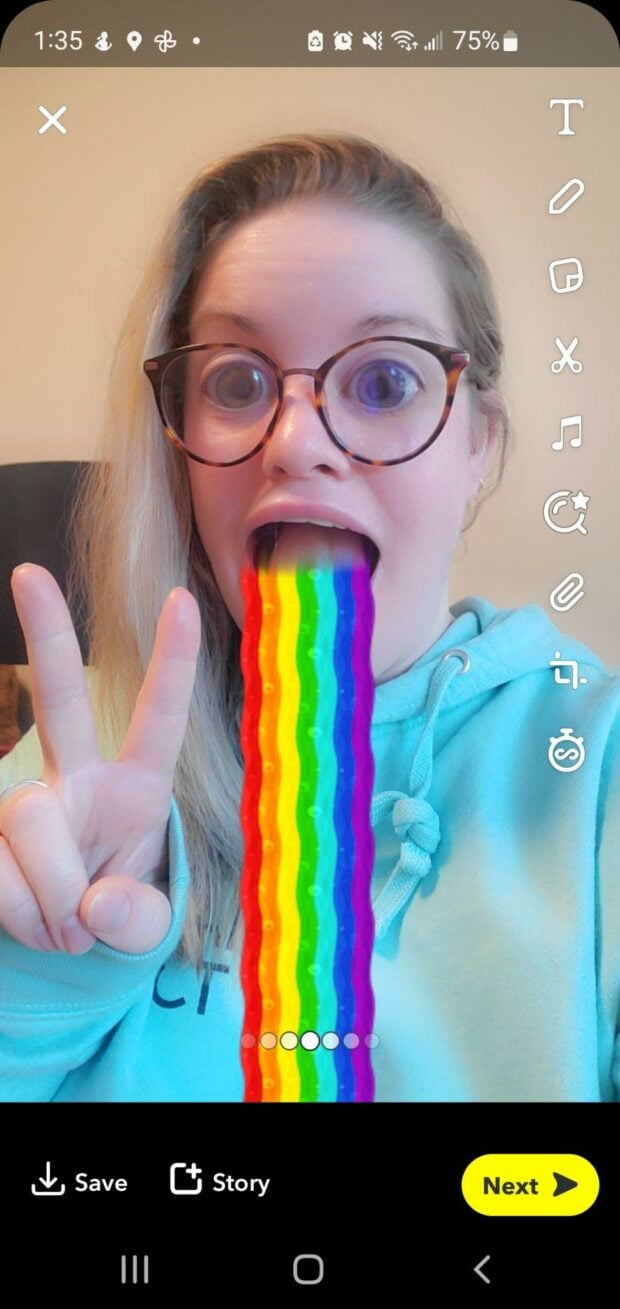
Almost exactly a year after Instagram, "Picaboo," soon rebranded as Snapchat, launched. It innovated with ephemeral content, allowing users to post photos and videos that vanished after 24 hours, appealing strongly to a younger demographic seeking a more private, transient space away from their families on Facebook. Snapchat’s iconic filters became a cultural phenomenon, further cementing its unique appeal.
Facebook’s dominance continued to expand, reaching a monumental milestone in 2012 when its user base surpassed one billion. Mark Zuckerberg famously remarked, "Helping a billion people connect is amazing, humbling and by far the thing I am most proud of in my life." This year also marked Facebook’s strategic acquisition of Instagram for a staggering one billion dollars, a prescient move that consolidated its position in the visual social media landscape.
The rise of video content intensified with the launch of Vine in 2013, acquired by Twitter pre-launch. Its simple premise of six-second looping videos spawned a distinct genre of humor and creativity. Despite rapid success, Vine eventually faded as competitors like Snapchat and Instagram integrated their own video-sharing capabilities. Concurrently, Twitch, a dedicated live video game streaming site, spun out of Justin.tv and amassed 45 million unique viewers by 2013 before its acquisition by Amazon, signaling the immense potential of live content. The mobile live-streaming craze was further ignited by Meerkat, with Twitter’s Periscope briefly winning the "streaming wars," even earning iOS app of the year in 2015. Today, live-streaming is a standard feature across major platforms like TikTok, Instagram, and Facebook.
The visual culture of this era culminated in the "Year of the Selfie" in 2014, declared by Twitter after Ellen DeGeneres’s Oscar selfie garnered millions of retweets, highlighting the pervasive integration of self-expression into daily digital life. Two years later, Instagram strategically adopted Snapchat’s innovation by introducing Stories, allowing users to post disappearing photo and video sequences, a move that proved crucial in maintaining its competitive edge.
The Algorithmic Age: Short-Form Video, Creator Economy, and Platform Shifts (2016-2022)
The subsequent era was characterized by the explosive growth of short-form video, the maturation of the creator economy, and a series of disruptive events that fundamentally reshaped the ownership and operation of major platforms, marking an accelerated pace in social media’s evolution.
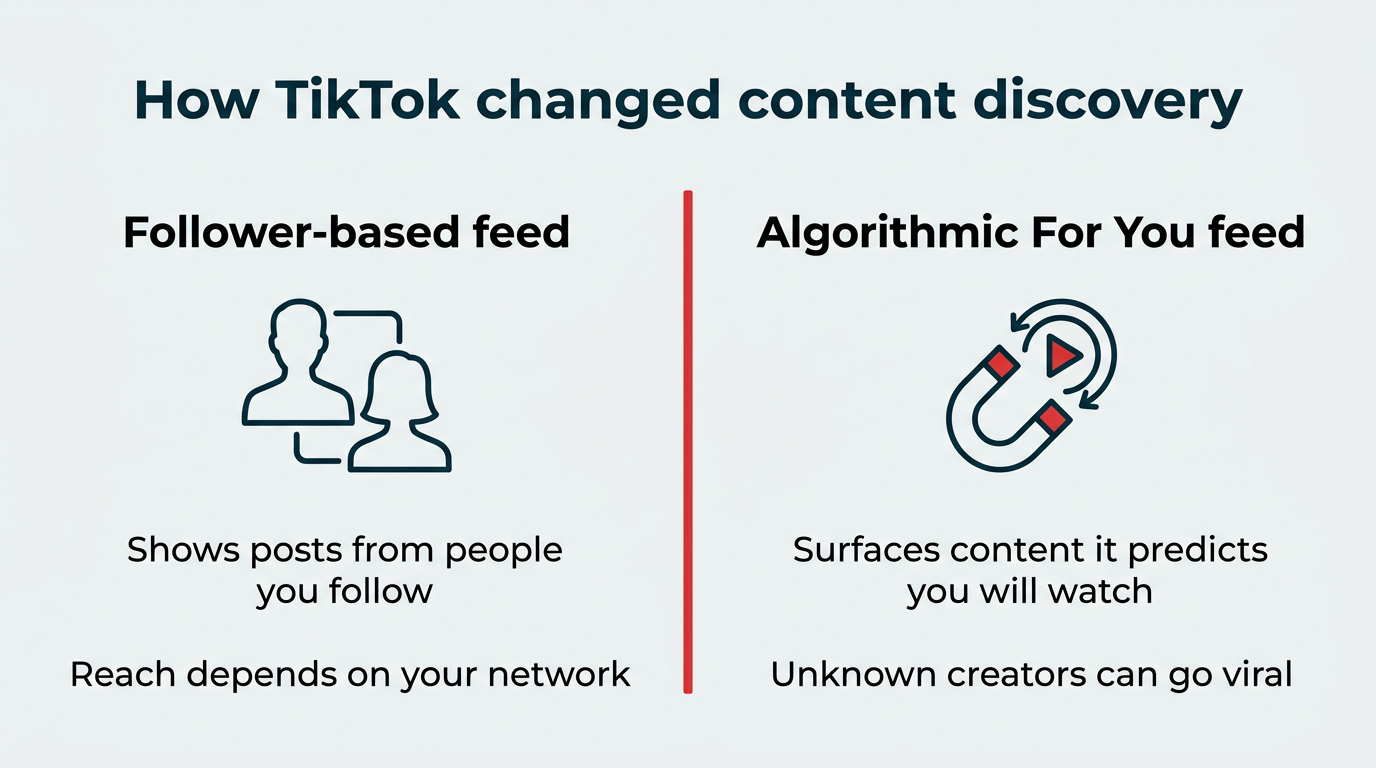
The most significant disruptor was Douyin, an app by ByteDance, released globally in 2017 as TikTok. It revolutionized content discovery by introducing an algorithm-driven "For You" page that curated content based on predicted user interest, rather than solely relying on a follower-based model. This fundamental shift made content viral based on merit and engagement, not just network size, profoundly influencing music, fashion, language, and news consumption, establishing TikTok as one of the most culturally significant platforms of its time.
During this period, the creator economy found more robust monetization avenues. Patreon, founded by Sam Yam and Jack Conte, allowed creators to receive direct financial support from their audience through subscriptions or exclusive content, diversifying revenue streams beyond advertising. Platforms also expanded their video capabilities, with Instagram launching IGTV for long-form video in 2018 and Reels for short-form video in 2020. Twitter doubled its character limit from 140 to 280 and introduced "threads," encouraging more detailed discourse.
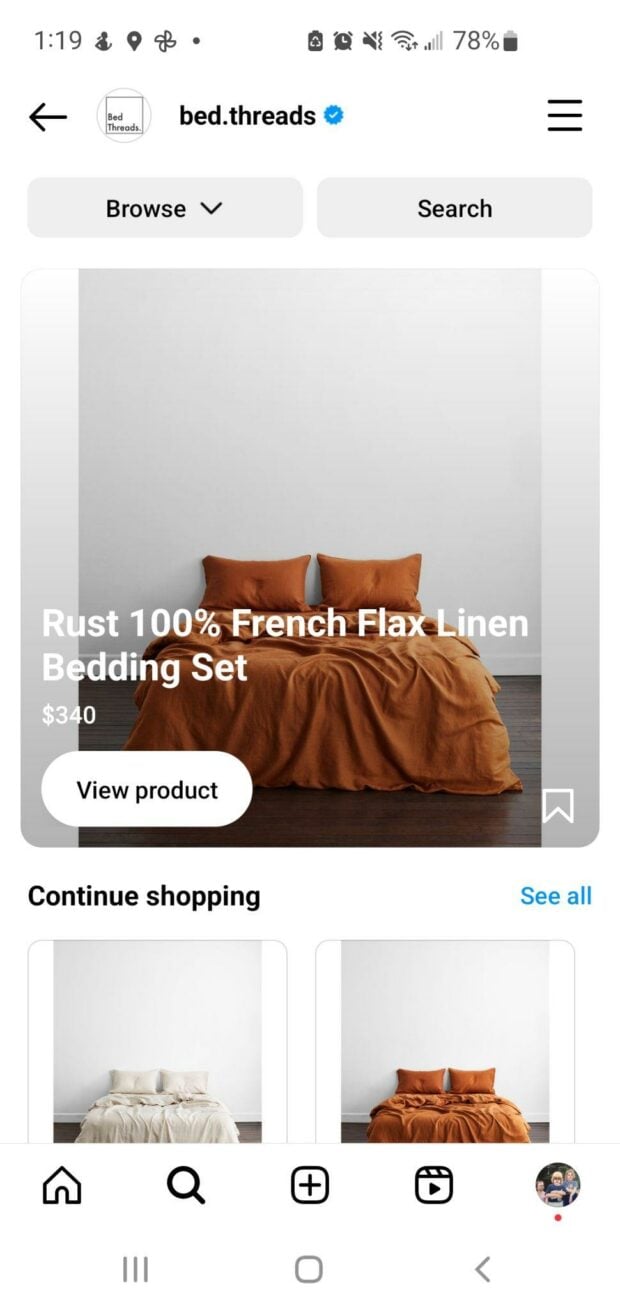
The global pandemic in 2020 significantly accelerated social commerce. Facebook and Instagram introduced "Shops," enabling in-app purchases and marking a major leap in integrating retail directly into social experiences. TikTok Shop soon followed, seamlessly blending short-form video entertainment with live shopping, transforming content consumption into a direct checkout experience.
However, this era also brought forth profound questions regarding trust and accountability. The Cambridge Analytica scandal in 2018 revealed that data from up to 87 million Facebook users had been harvested without consent, leading to Mark Zuckerberg testifying before the U.S. Congress on data privacy. Furthermore, Facebook disclosed that 126 million Americans were exposed to content from foreign agents during the 2016 U.S. election, prompting further Congressional scrutiny. These events propelled data privacy, content integrity, and the fight against disinformation to the forefront of the global social media conversation, leading to increased regulatory pressure worldwide.
The landscape was further fragmented by Elon Musk’s acquisition of Twitter in 2022. The ownership change triggered a cascade of updates, including paid verification, visible view counts, and a rare glimpse into the platform’s recommendation algorithm. In 2023, the platform rebranded to X, a move that, coupled with advertiser caution and user dissatisfaction, opened doors for competitors. Meta launched Threads in 2023 as a text-based rival to X, rapidly attracting millions of users within days. Concurrently, the decentralized platform Bluesky experienced significant growth as users sought alternatives, resulting in a more fragmented environment where audiences and creators diversified across multiple text-based platforms.
The Future Frontier: AI, Decentralization, and Regulation (2023-2026 and Beyond)
The most recent chapter in social media’s ongoing history is being defined by the pervasive integration of artificial intelligence, increasing regulatory scrutiny, and a growing user appetite for alternatives to dominant platforms. Several key developments are shaping this evolving landscape:
- AI-Driven Personalization: Advanced AI algorithms are enhancing content discovery, feed curation, and user experience, making platforms more engaging but also raising concerns about filter bubbles and algorithmic bias.
- Decentralized Social Networks: Platforms like Bluesky and Mastodon are gaining traction, offering users greater control over their data and community guidelines, challenging the centralized models of legacy platforms.
- Regulatory Scrutiny: Governments worldwide are intensifying efforts to regulate content moderation, data privacy, and antitrust issues, particularly concerning platforms’ influence on public discourse and mental health.
- The Metaverse’s Promise: While still nascent, the development of immersive virtual worlds promises new forms of social interaction, blending digital and physical realities, potentially creating new social frontiers.
- Persistent Short-Form Video Dominance: TikTok’s success has solidified short-form video as a primary content format, with other platforms continuing to adapt and integrate similar features.
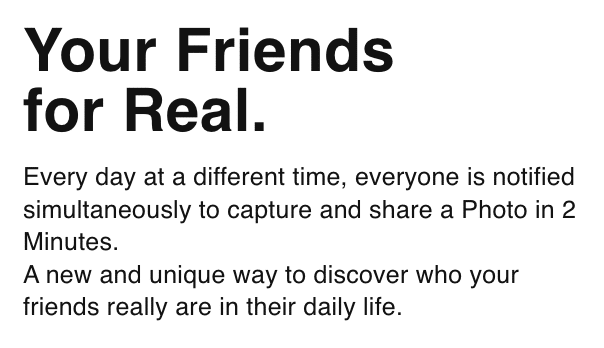
- Ephemeral Content’s Decline: While initially popular, platforms built solely on ephemeral content, such as Clubhouse (which surged during 2020 lockdowns but struggled to maintain relevance) and BeReal (which saw its viral buzz fade despite briefly topping app store charts), serve as reminders that novelty rarely guarantees lasting scale without sustained utility. BeReal, for instance, was acquired by mobile game maker Voodoo after its initial hype waned.
- Geopolitical and Economic Pressures: The potential regulation or outright banning of platforms like TikTok in various countries highlights the geopolitical tensions influencing the global social media landscape.
The Enduring Impact: Social Media’s Transformation of Society and Business
Social media has fundamentally rewired global communication, transitioning from a one-to-many broadcast model to a dynamic many-to-many conversation. Instead of a select few publishers addressing a passive audience, billions of individuals now possess the power to create, share, and respond in real-time, marking one of the most defining features of its evolution.
This profound shift has irrevocably altered how societies consume news, discover products, and form communities. It has given rise to the "attention economy," where platforms relentlessly compete for every spare second of user engagement, and has fueled the phenomenon of influencer culture, where individual creators can wield influence over audiences that often surpass those of traditional media outlets. Moreover, it has blurred the once-clear lines between personal and public life, as a single post can instantaneously reach a global audience.
For businesses, social media has transitioned from a peripheral marketing channel to a core strategic function. Marketing campaigns, customer service interactions, employee advocacy programs, and employer branding initiatives are now inextricably linked to social channels. Enterprise teams require sophisticated tools to manage this scale, like Hootsuite, which enables them to plan, schedule, publish, measure content, manage comments, and track trends. In essence, social media has transformed communication into an omnipresent, two-way channel that profoundly shapes both culture and commerce globally.
The history of social media unequivocally suggests that its next era will continue to be shaped by the same fundamental forces that have driven its past: the emergence of innovative formats, the evolution of business models, and an ongoing, dynamic tug-of-war over trust and integrity. For marketing leaders and businesses alike, the critical takeaway is the imperative for a flexible and adaptive social strategy, rather than a singular reliance on any given platform. Teams that demonstrate agility in embracing new formats, respecting evolving regulatory frameworks, and meeting audiences wherever they converge will be optimally positioned to navigate the complexities and capitalize on the opportunities of social media’s unfolding future.
When did social media start?
Social media’s origins trace back to the early 1970s, when systems like Community Memory (1973) and the university-built PLATO platform allowed users to post messages and interact online. The platforms most people recognize today, built around personal profiles and connections, began appearing in the late 1990s.
What was the first social media platform?
The first widely recognized social media platform was SixDegrees.com, launched in 1997, which let users create profiles, list their connections, and send messages within networks. Earlier systems like Usenet had social features, but SixDegrees is usually credited as the first true social network.
Who created social media and why?
Social media was not created by a single person. Tom Truscott and Jim Ellis created Usenet in 1979-1980 as one of the first open social platforms, and the concept then evolved through the work of many developers and companies who wanted to connect people online.
What came before Myspace?
Before Myspace launched in 2003, platforms like SixDegrees (1997), LiveJournal (1999), and Friendster (2002) pioneered the social networking model with user profiles and online connections. These earlier sites established the profile-plus-connections format that Myspace later popularized.
How has social media evolved over time?
Social media has evolved from text-based bulletin boards in the 1970s and 1980s, through profile-based networks in the late 1990s and 2000s, to the mobile-first, algorithm-driven, short-form video platforms that dominate in 2026. Each era added new formats, from text to photos to video to live and AI-generated content.
How many people use social media today?
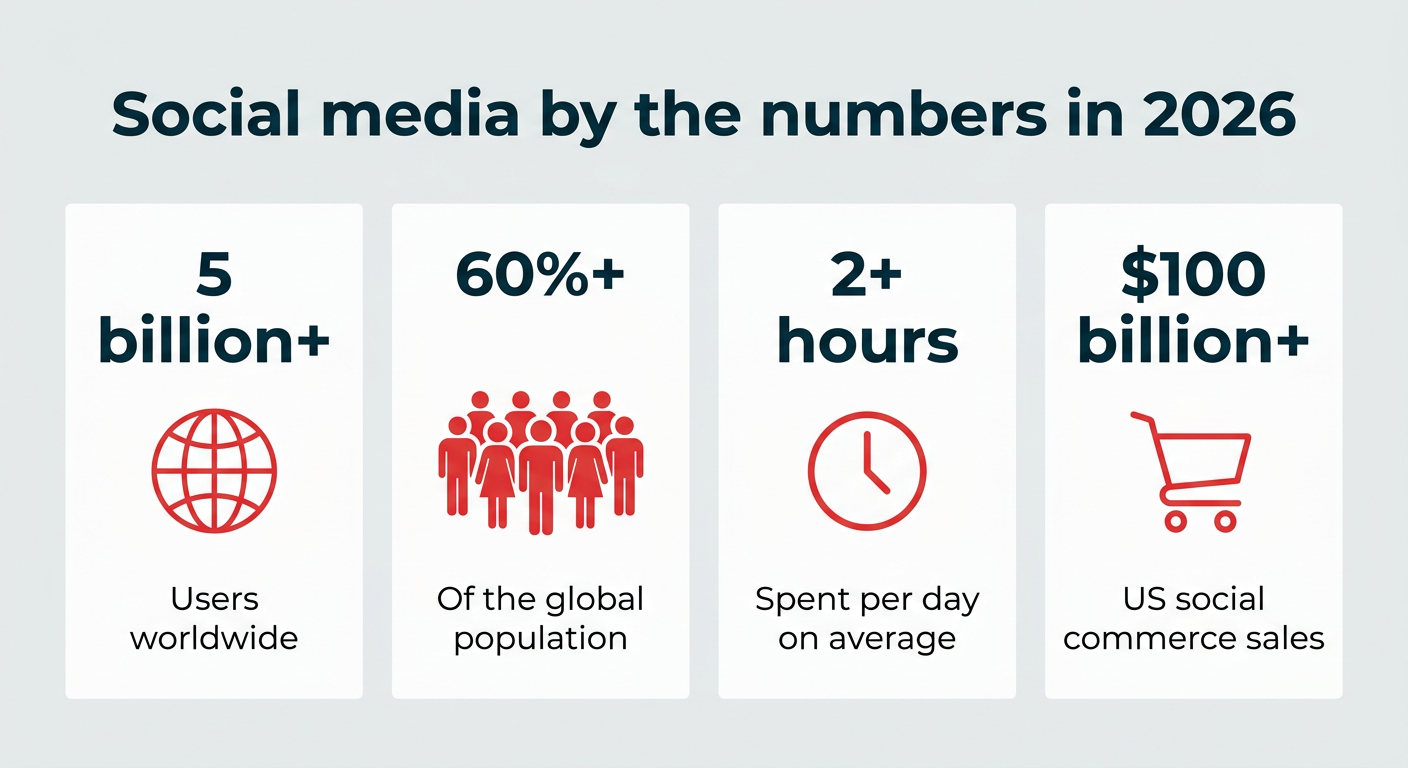
As of 2026, more than 5 billion people worldwide use social media, representing over 60% of the global population. That reach makes social platforms one of the most significant communication channels in human history.
Why is Gen Z ditching social media?
Some Gen Z users are reducing their social media use because of concerns about mental health, screen time, and a preference for smaller, more private group communication over public broadcasting. Rather than leaving entirely, many are shifting toward messaging and close-friend features instead of public feeds.
What is a social graph?
A social graph is a digital map of the connections between people on a social media platform, showing who is connected to whom and how they interact. Platforms use the social graph to power friend suggestions, feeds, and recommendations.

How did social media change marketing?
Social media transformed marketing by letting brands reach audiences directly, engage in two-way conversations, and measure campaign performance in real time. That shifted the industry from one-way broadcast advertising toward interactive, data-driven strategies.
What will social media look like in the future?
The future of social media is likely to be shaped by AI-driven personalization, decentralized platforms, tighter regulation, and deeper integration of commerce and creator tools directly into social experiences. Marketers who stay agile across formats and platforms will be best positioned for these shifts.
Save time managing your social media marketing strategy with Hootsuite. Publish and schedule posts, find relevant conversions, measure results, and more — all from one dashboard. Try it free today.
The #1 social media tool
Create. Schedule. Publish. Engage. Measure. Win.