The Post-Click Paradox: Marketers Overlook Conversion Drivers Amidst Budget Squeeze

Nine out of ten marketers are grappling with budget constraints that are significantly impacting their paid media programs. However, a critical oversight persists: the crucial element of what happens after the click. New research from Unbounce and Ascend2 reveals a pronounced imbalance, with marketers dedicating more time and financial resources to audience targeting, creative development, and artificial intelligence than to the landing pages and post-click experiences that are ultimately responsible for converting paid traffic. This phenomenon, dubbed the "post-click paradox," suggests that budget pressures are not merely leading to reduced spending but are actively diverting resources away from high-impact conversion optimization towards more readily manageable, upstream campaign elements.
The comprehensive survey, which polled 304 U.S. paid media professionals, highlighted a stark disconnect between marketers’ perceived drivers of return on investment (ROI) and their actual investment patterns. While a substantial 40% of respondents acknowledged that optimizing destination pages is one of the most effective strategies for maximizing paid media expenditure, a mere 31% reported investing in landing pages within the preceding six months. In contrast, significant portions of budgets were allocated to audience research (40%), AI tools (39%), and ad creative (38%). This trend indicates a strategic shift, where operational ease and immediate platform-based optimizations are being prioritized over the more resource-intensive, yet potentially more rewarding, post-click optimization efforts.
Budgetary Pressures Drive Spending "Upstream"
The reality of budget limitations has become a near-universal challenge for marketers. The Unbounce and Ascend2 study found that 90% of marketers are experiencing constraints on their paid media budgets or resources. The areas most acutely affected by these limitations include testing and experimentation, audience targeting, ad creative, and reporting. Alarmingly, nearly half of the surveyed marketers indicated that landing page creation and message matching suffered when resources were tightened. This pattern suggests a reactive approach to budget constraints, where less visible but vital components of the customer journey are the first to be deprioritized.
The consequences of this resource reallocation are evident in investment decisions. Audience research, the adoption of AI tools, and the development of ad creative emerged as the primary recipients of new investment. Landing pages, despite being recognized for their importance by marketers, consistently lagged behind. The report further illuminated that marketers who successfully exceeded their ROI targets adopted a more balanced investment strategy. These high-performing teams distributed their resources more evenly across audience research, AI integration, attribution modeling, robust testing frameworks, and crucially, landing page optimization. This contrasts sharply with those who concentrated resources in a few highly visible areas, suggesting that a holistic approach to paid media ROI yields superior results.
The AI Advantage: Underutilized Potential in Post-Click Experiences
Artificial intelligence, a rapidly evolving frontier in marketing, followed a similar pattern of underutilization in the post-click environment. Eighty-six percent of marketers reported integrating AI into their paid media strategies, with nearly three-quarters asserting that it had a positive impact on ROI. However, the application of AI was predominantly concentrated in areas such as reporting, audience targeting, leveraging platform tools, and generating ad copy. A mere 19% of marketers indicated using AI for landing page creation or optimization. This is particularly noteworthy given that marketers who surpassed their ROI goals were approximately twice as likely to employ AI in these critical post-click functions. This presents a significant untapped opportunity for marketers to leverage AI for personalized and high-converting landing page experiences.
The Click is Not the Problem: The Post-Click Experience Deficit
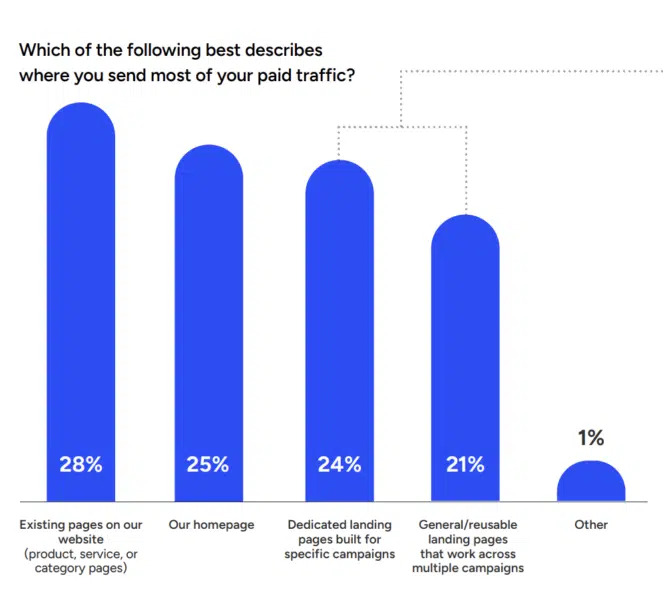
A significant portion of marketing efforts, even after successfully driving a click, are undermined by suboptimal post-click experiences. The survey revealed that more than half of the respondents direct paid traffic to general website pages rather than to campaign-specific landing pages. Specifically, 28% primarily route visitors to existing product or category pages, while another 25% direct them to the homepage. Only a modest 24% of marketers predominantly utilize dedicated landing pages tailored for individual campaigns.
This strategic misstep becomes even more pronounced when campaign objectives are considered. Forty percent of marketers focused on direct sales are sending traffic to generic product or category pages, bypassing the opportunity for a tailored conversion path. Furthermore, over a quarter of marketers running lead-generation campaigns are still directing potential leads to their homepage, a location often not optimized for immediate lead capture.
The financial implications of this approach are substantial. Nearly two-thirds of marketers who primarily direct paid traffic to their homepage reported not exceeding their ROI goals. Conversely, those who outperformed their targets were less likely to rely on homepages and demonstrated a greater propensity for using reusable or campaign-specific landing pages. This data strongly suggests that a generic post-click experience is a significant impediment to achieving desired campaign outcomes.

Marketers Understand Value, But Priorities Diverge
The research unequivocally indicates that marketers are aware of the importance of post-click optimization. When asked about the most effective ways to optimize paid media spend, audience targeting ranked highest, followed closely by destination page optimization. These were rated higher than strategies such as cutting underperforming channels, shifting platforms, or implementing spending caps.
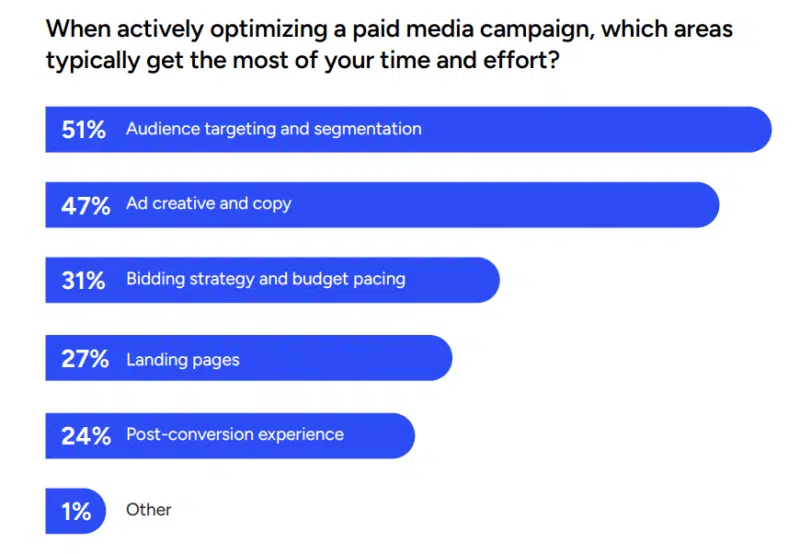
However, this understanding does not consistently translate into day-to-day priorities. More than half of the respondents indicated that audience targeting receives the majority of their optimization effort, with ad creative and bidding strategies following. Landing pages and the post-conversion experience, despite being widely recognized as significant contributors to ROI, languished at the bottom of the optimization priority list.
Operational Bottlenecks as the Primary Barrier
The divergence between knowing what works and prioritizing it appears to stem from operational constraints rather than a lack of strategic alignment. The study identified team capacity, design and development resources, available expertise, ongoing maintenance requirements, and software budgets as the principal obstacles hindering the more extensive use of landing pages. In essence, while marketers generally acknowledge the critical role of the post-click experience, they frequently lack the necessary personnel, time, or resources to effectively enhance it.
The findings suggest that the highest-performing marketing teams address this challenge by adopting an end-to-end perspective of paid media. Instead of viewing it as a series of discrete optimizations, they treat it as an integrated system. Marketers who consistently exceeded their ROI targets demonstrated a pattern of investing more significantly in landing pages, attribution modeling, rigorous testing protocols, and post-conversion enhancements. This investment was made in conjunction with, rather than at the expense of, efforts in audience targeting, creative development, and AI integration. This collective approach indicates that the most substantial gains in paid media performance are achieved by strengthening the entire customer journey, from initial ad impression to final conversion and beyond, rather than solely focusing on generating more clicks.
The full report, "The State of Paid Media ROI 2026," by Unbounce and Ascend2, is available for download, though registration is required. The findings offer a critical lens through which marketers can re-evaluate their resource allocation and strategic priorities to unlock greater efficiency and effectiveness in their paid media investments. By bridging the gap between acknowledging the importance of post-click experiences and dedicating the necessary resources to optimize them, marketers can move beyond the "post-click paradox" and achieve more robust and sustainable ROI.