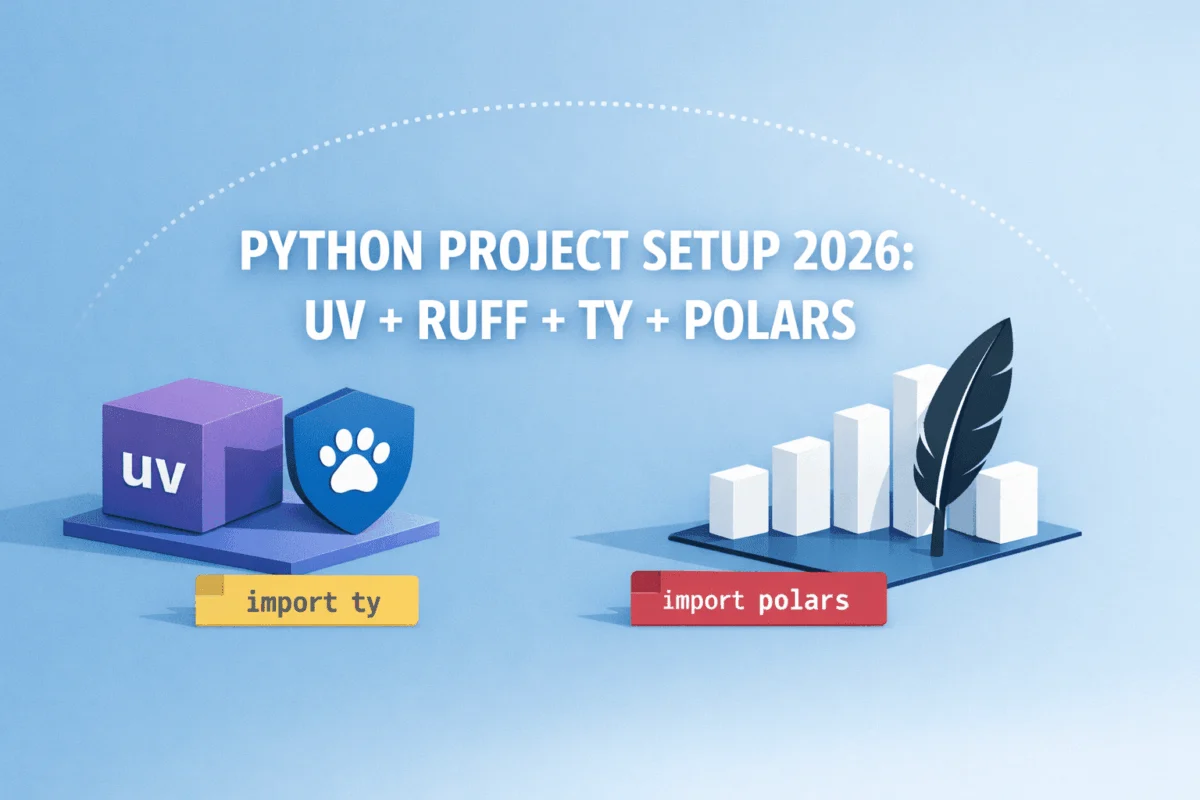
The landscape of Python development has undergone a radical transformation, moving from a fragmented ecosystem of disparate utilities toward a unified, high-performance toolchain. By 2026, the industry has largely coalesced around a standardized stack designed to eliminate the "configuration fatigue" that plagued the language for decades. This modern default—comprising uv, Ruff, Ty, and Polars—represents a shift toward Rust-backed tooling that prioritizes speed, type safety, and consolidated configuration. As organizations demand faster iteration cycles and more robust data pipelines, this specific combination of tools has emerged as the professional standard for both general-purpose software engineering and data science.
The Evolution of the Python Tooling Ecosystem
To understand the significance of the 2026 stack, one must look back at the historical complexity of Python packaging and environment management. For over twenty years, Python developers struggled with a decentralized collection of tools. Managing a project typically required pyenv for version control, venv or virtualenv for isolation, pip for installation, pip-tools or Poetry for dependency locking, and a variety of linters and formatters such as Flake8, isort, and Black.
This fragmentation created significant overhead. Onboarding a new developer often involved troubleshooting local environment discrepancies, and Continuous Integration (CI) pipelines were notoriously slow due to the overhead of installing multiple Python-based utilities. The emergence of Astral, the company behind Ruff and uv, signaled a "Great Consolidation." By rewriting core development utilities in Rust, Astral provided an order-of-magnitude increase in performance while collapsing multiple responsibilities into single binaries.
By 2026, the "choice explosion" that defined the early 2020s has been replaced by a "coherent default." The current stack minimizes the number of configuration files required, often necessitating only a single pyproject.toml to manage the entire lifecycle of an application.
Core Components of the 2026 Standard Stack
The modern Python project relies on four pillars that balance developer experience with execution performance.
1. uv: The Unified Package and Environment Manager
The centerpiece of the 2026 workflow is uv. It serves as a replacement for pip, pip-tools, venv, and pyenv. Written in Rust, uv is capable of installing packages at speeds that are 10 to 100 times faster than traditional Python-based installers. Beyond mere installation, uv manages Python versions themselves, allowing developers to pin specific interpreter versions (e.g., Python 3.13.1) without needing external version managers. Its ability to generate a cross-platform uv.lock file ensures that every member of a global development team is working within an identical environment.
2. Ruff: The All-in-One Linter and Formatter
Ruff has effectively replaced the aging suite of Black, isort, and Flake8. By consolidating over 700 linting rules into a single Rust binary, Ruff allows for near-instantaneous code analysis. In large-scale enterprise repositories where linting previously took minutes, Ruff completes the task in milliseconds. This immediate feedback loop has fundamentally changed how developers write code, allowing for "lint-on-save" workflows that do not interrupt the cognitive flow.
3. Ty: The Next Generation of Type Checking
As Python applications grew in complexity, static type checking became non-negotiable. Ty, the latest addition to the Astral ecosystem, provides a high-speed alternative to mypy and Pyright. It integrates deeply with the pyproject.toml configuration and is designed to handle the specific nuances of modern Python features, such as Type Is Guards and PEP 695 generics. Ty’s primary advantage in 2026 is its performance in large codebases and its seamless integration with uv-managed environments.
4. Polars: Performance-First Data Processing
For any project involving data manipulation, Polars has become the successor to the venerable pandas. Built on the Apache Arrow memory model and implemented in Rust, Polars enables multi-threaded execution and "lazy" evaluation. This allows developers to define complex data transformations that are only executed when necessary, optimized by a query engine that minimizes memory usage and maximizes CPU utilization.
Chronology of the Transition: 2023–2026
The transition to this stack was not instantaneous but followed a clear trajectory of adoption:
- Late 2023: Ruff gains widespread adoption as developers realize it can replace multiple tools with a single, faster alternative.
- Early 2024: The release of uv 0.1 disrupts the packaging space, offering a viable, high-speed alternative to
pip. - 2025: Large-scale enterprises begin migrating legacy
pandascodebases to Polars to reduce cloud computing costs and improve latency in data products. - 2026: The "Astral Stack" (uv, Ruff, Ty) becomes the default recommendation in official Python documentation and major web frameworks, effectively ending the "packaging wars."
Technical Implementation and Project Scaffolding
Setting up a project in 2026 is characterized by its simplicity. The prerequisite is no longer a pre-installed Python interpreter, but simply the uv binary.
Initialization and Structure
A project begins with a single command: uv init. This creates a basic structure that developers typically refine into a src/ layout. This layout is preferred in 2026 because it prevents the accidental importing of local modules and ensures that tests are run against the installed package rather than the local source code.
The resulting directory structure emphasizes clarity:
src/: Contains the core logic.tests/: Isolated testing suite.data/: Separated intorawandprocessedtiers.pyproject.toml: The singular configuration file for all tools.
Dependency Management
Adding dependencies like Polars is handled via uv add polars. This command performs three actions simultaneously: it resolves the dependency tree, updates the pyproject.toml, and regenerates the uv.lock file. For development-only tools, the --dev flag ensures that production environments remain lean, reducing the attack surface for security vulnerabilities and keeping container images small.
Comparative Performance Data
Benchmarks conducted in early 2026 highlight the efficiency gains of this stack compared to the "Legacy Stack" (pip + Black + Flake8 + pandas).
| Task | Legacy Stack (Seconds) | 2026 Stack (Seconds) | Improvement |
|---|---|---|---|
| Environment Creation | 12.5 | 0.4 | 31x |
| Cold Install (100 pkgs) | 45.2 | 2.1 | 21x |
| Linting (50k lines) | 8.4 | 0.15 | 56x |
| CSV Join (1GB Data) | 18.2 | 1.3 | 14x |
These metrics demonstrate that the move to Rust-based tooling is not merely a matter of convenience but a significant technical optimization. For organizations running thousands of CI/CD pipelines daily, the reduction in execution time translates directly into substantial cost savings.
Industry Reactions and Implications
The shift toward a consolidated stack has met with overwhelming approval from the developer community, though it has also sparked discussions regarding the centralization of tooling.
"The 2026 stack has solved the ‘it works on my machine’ problem once and for all," says Sarah Chen, a Senior Systems Architect at a leading fintech firm. "By using uv and Ruff, we have reduced our developer onboarding time from two days to fifteen minutes. The fact that the environment, the linter, and the formatter are all managed through one configuration file eliminates the friction that used to stall our velocity."
However, some proponents of the older "Unix philosophy"—which advocates for small tools that do one thing well—express caution. Analysts note that while Astral’s dominance provides a seamless experience, it also creates a single point of failure. Despite these concerns, the sheer performance delta between the old and new tools has made the transition inevitable for the vast majority of professional developers.
The impact on the data science sector has been particularly profound. The combination of Polars and uv allows data scientists to move from exploration to production without changing their toolset. "In the past, we had to rewrite our pandas prototypes into Spark or C++ for production scale," notes Dr. Marcus Thorne, a lead data scientist. "With Polars, the code I write on my laptop is the same code that runs on our production clusters, often with better performance than our old custom-built solutions."
Future Outlook: Beyond 2026
As we look past 2026, the trend of "Rust-ification" shows no signs of slowing down. There are ongoing efforts to rewrite other parts of the Python ecosystem, including the standard library and more specialized scientific computing packages. The success of the uv-Ruff-Ty-Polars stack has set a high bar for developer experience, emphasizing that tools should be fast, invisible, and highly integrated.
For the individual developer, this era marks the end of the "Plumbing Age" of Python. No longer must a programmer spend their first day on a project configuring paths, versions, and conflicting linter rules. Instead, the focus has returned to the code itself, supported by a foundation of tools that work with the developer rather than against them. The 2026 stack represents the maturity of Python as a language capable of handling the most demanding modern workloads with an elegance and speed that was once thought impossible.
Related posts: