The Ideal Instagram Reel Length in 2026: What 2.7 Million Posts Reveal About Reach and Engagement

The debate over the optimal length for short-form video content has entered a new phase as comprehensive empirical data sheds light on how algorithms reward video duration. While platforms continually expand technical thresholds to accommodate feature films, vlogs, and episodic content, user behavior and distribution mechanics dictate a far more nuanced reality for creators and brands aiming to maximize their footprint.
Recent data compiled by social media management platform Buffer offers an empirical look at this dynamic. By analyzing more than 2.7 million Instagram Reels published between January 1 and August 15, 2026, researchers have mapped out precisely how video duration correlates with content distribution, audience reach, and user engagement. The findings challenge long-held assumptions regarding short-form video consumption, providing creators with a data-driven framework to align video length with specific strategic goals.
Technical Limits Versus Algorithmic Realities
To understand the current landscape of Instagram Reels, creators must first distinguish between technical platform capabilities and algorithmic distribution rules. Instagram currently permits users to upload or record Reels up to 20 minutes in length, a ceiling that rolled out gradually across accounts globally, replacing older three-minute and 90-second caps.
However, technical capacity does not equate to algorithmic favor. Instagram maintains a strict threshold at the three-minute (180-second) mark regarding discoverability. When a creator publishes a Reel exceeding 180 seconds, the application issues an automated notification stating that videos over three minutes will not be recommended to new audiences. Consequently, while followers of the account can still view the content, these longer videos are largely barred from appearing in the main Reels tab, the Explore page, or as recommendations in the home feeds of non-followers.
This architectural decision underscores a fundamental platform philosophy. Head of Instagram Adam Mosseri has repeatedly emphasized that Instagram does not seek to emulate YouTube’s long-form video model. The platform’s discovery engine remains engineered primarily for snackable, fast-paced content, making the three-minute boundary a critical inflection point for anyone pursuing organic growth and audience acquisition.
The Sweet Spot for Maximum Reach
Buffer’s extensive analysis provides clear quantitative insight into how various length brackets perform relative to an account’s baseline performance. Rather than comparing raw view counts—which are inherently skewed by mega-influencers and viral anomalies—the study evaluated each account against its own historical average. This methodology ensures that performance metrics reflect the true impact of duration rather than existing audience size.
The data reveals that Instagram Reels ranging from 90 seconds to three minutes deliver the highest return on reach. Videos falling into this 90-to-179-second window achieved an average increase in unique account reach of 7.4 percent compared to the publisher’s baseline. Across the broader dataset, this bracket consistently outperformed both ultra-short clips and long-form uploads in acquiring new eyeballs.
Interestingly, for durations beneath the 90-second threshold, length plays a surprisingly minimal role in determining reach. Reels lasting under 15 seconds underperformed baseline reach by a modest 1.5 percent, while clips between 30 and 59 seconds exceeded baseline metrics by 2.7 percent. Because these fluctuations remain within a narrow single-digit band, digital strategists note that variables such as hook quality, topic relevance, editing cadence, and keyword optimization far outweigh the minute differences between a 30-second and a 60-second edit.
The Engagement Trade-Off of Long-Form Content
While clips under three minutes dominate metrics related to audience acquisition and top-of-funnel reach, the data uncovers a fascinating counter-trend regarding community interaction. For creators prioritizing deep engagement with an existing follower base rather than broad discovery, longer formats present a compelling opportunity.
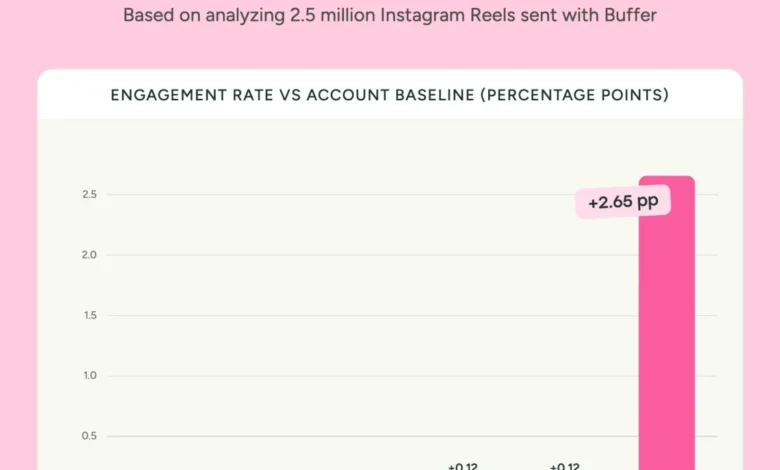
Reels extending beyond the 180-second mark—despite suffering a steep 49.3 percent drop in unique reach due to algorithmic restrictions—demonstrated the highest engagement rates in the study. Videos exceeding three minutes achieved an engagement rate 2.65 percentage points above their respective account baselines.
This inverse relationship highlights a classic content marketing trade-off: breadth versus depth. When a creator publishes a tutorial, a narrative story, or an in-depth community update that surpasses three minutes, the content is filtered away from casual scrollers and delivered primarily to dedicated loyalists. Those who choose to sit through an extended video have already self-selected into a higher-intent segment of the audience. Although the total volume of viewers is smaller, the resulting interactions—including saves, shares, comments, and meaningful discussions—occur at a significantly higher frequency.
This phenomenon mirrors established patterns observed in other media formats, such as Instagram carousels, where content requiring more time to consume reliably attracts a more dedicated subset of users.
Comparative Industry Benchmarks
As creators increasingly practice multi-platform distribution, understanding how Instagram’s constraints compare to rival networks is essential for workflow efficiency. Cross-posting identical assets without modification can lead to suboptimal performance if platform-specific parameters are ignored.

Platform Feature Comparison:
- Instagram Reels: Permits recordings up to 20 minutes, but strictly restricts algorithmic recommendations to content under 3 minutes.
- TikTok: Allows videos up to 10 minutes when recorded natively within the application, and up to 60 minutes for files uploaded from external camera rolls.
- YouTube Shorts: Imposes a strict 3-minute maximum limit, automatically classifying any uploaded video exceeding this duration as standard long-form content.
The alignment of the three-minute ceiling across Instagram and YouTube Shorts provides a standardized framework for cross-platform short-form strategy, simplifying production pipelines for digital creators.
Strategic Implications for Content Creators
The empirical insights drawn from millions of published posts suggest that content strategy must be dictated by specific campaign objectives rather than rigid adherence to a single format.
For creators whose primary key performance indicator (KPI) is audience growth and brand discovery, adhering strictly to the 90-second to three-minute window is vital. Staying within this zone ensures eligibility for algorithmic push into the feeds of non-followers, maximizing top-of-funnel visibility.
Conversely, legacy brands, educators, and community builders focusing on retention and relationship-building should not shy away from long-form Reels simply because raw reach metrics decline. By utilizing long-form formats for complex tutorials, storytelling, and behind-the-scenes deep dives, creators can effectively nurture their most valuable advocates.
For those hesitant to commit fully to longer durations, experimentation tools such as Instagram trial reels offer a low-risk environment. By publishing identical edits to non-followers first and analyzing performance over a 24-hour window, creators can empirically test audience appetite for extended narratives before committing them to permanent grid real estate. Ultimately, while duration acts as a powerful structural lever, the foundational pillars of compelling hooks, clear value propositions, and resonant storytelling remain the ultimate determinants of digital success.