On Charts Ambitious Three-Year Growth Strategy Led by Soccer Expansion While Wall Street Analysts Urge Caution

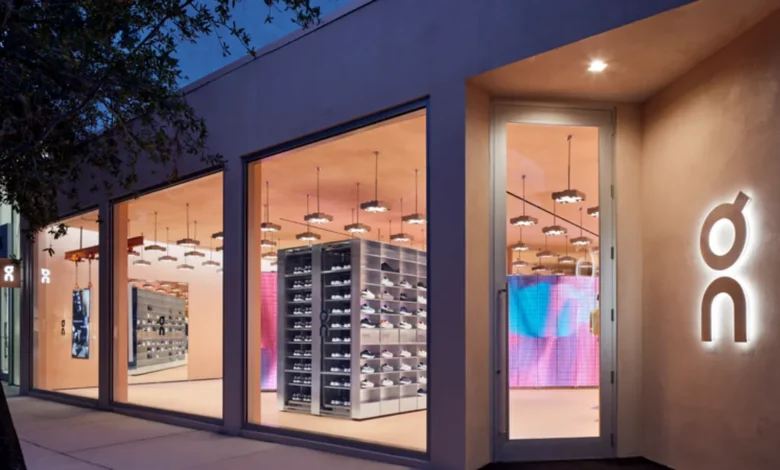
Athletic footwear and apparel brand On is betting big on high-teens revenue growth over the next three years, anchoring its aggressive expansion plans on a major push into the global soccer market and high-profile celebrity partnerships. However, financial markets and Wall Street analysts are responding with skepticism, pointing to a recent deceleration in the company’s sales velocity and broader macroeconomic challenges facing the athletic retail sector.
During a high-stakes investor day event, company executives outlined a sweeping roadmap that includes a massive $1 billion share buyback program and projections that net sales will surge to 5.6 billion Swiss francs, equivalent to approximately $6.8 billion, by 2029. Central to this aggressive forecast is On’s strategic entry into soccer—a massive global market dominated by legacy sportswear giants—highlighted by the high-profile recruitment of superstar athlete Kylian Mbappé away from longtime rival Nike. Yet, despite the brand’s bold vision, skeptical analysts argue that these long-term targets may be out of reach amid a cooling consumer environment and softening momentum.
Decelerating Growth Sparks Wall Street Skepticism
The disconnect between On’s internal optimism and Wall Street’s cautious outlook centers on recent financial performance trajectories. Analysts from Jefferies, led by Randal Konik, released a note highlighting that On’s year-over-year revenue growth has steadily decelerated from a blistering 36% down to 13% over the course of the previous six quarters. Furthermore, the company’s anticipated third-quarter constant currency growth is tracking at approximately 17%.
Konik and his team argued that issuing lofty, long-term targets against a backdrop of slowing base growth raises the execution hurdle rather than lowering it. In the view of Jefferies analysts, today’s market environment tests management’s guidance credibility far more than its overarching corporate vision.
Jefferies’ internal models project a much more conservative growth path for On, estimating an annual expansion rate of roughly 3% between 2026 and 2027. Their forecasts also place the company’s 2027 EBITDA margin at 14.8%—a full 700 basis points shy of the ambitious profitability goals management established for 2029. According to Konik, closing that significant performance gap would require the company’s financial algorithm to inflect almost immediately within a highly promotional United States retail market, and to do so without relying heavily on heavy markdowns or expensive paid digital traffic acquisition.
Echoing similar sentiments, Needham analyst Tom Nikic noted ahead of the investor presentations that On was likely to target a compound annual growth rate in the low teens for the upcoming three-year cycle. Nikic cautioned investors against buying into overly bullish projections, citing an increasingly difficult external operating environment.
"The external environment has become far more challenging, which is impacting athletic industry fundamentals and hurting investor sentiment to an even greater degree," Nikic wrote. Nevertheless, Nikic commended On for maintaining disciplined inventory controls, noting that the brand has smartly reined in wholesale sell-in and successfully avoided the widespread, margin-eroding discounting that has plagued many of its competitors in the athletic retail space, thereby safeguarding the long-term health of its brand equity.
The Strategic Pivot to Soccer and High-Profile Collaborations

To reignite top-line momentum and justify its ambitious valuation, On is aggressively diversifying its product ecosystem and elevating its marketing firepower. During the investor briefing, leadership emphasized the company’s foundational reliance on science-backed innovation, proprietary cushioning technologies, and close creative collaborations with high-profile brand partners.
The most prominent of these partnerships include multifaceted collaborations with global pop culture icon and actress Zendaya, as well as elite long-distance runner Hellen Obiri. However, the crown jewel of On’s current expansion strategy is its formal entry into the lucrative soccer category.
By successfully poaching French superstar Kylian Mbappé from Nike, On has signaled its intent to compete directly with entrenched industry heavyweights on the global stage. The company is not developing these products in a vacuum; it has enlisted legendary French footballer Thierry Henry and rising soccer talent Sydney Schertenleib to collaborate directly with its design and engineering teams. The objective is to engineer soccer cleats and footwear that deliver elite-tier athletic performance while maintaining a distinct, recognizable aesthetic identity.
On’s Chief Design Officer, Thilo Brunner, revealed that the internet has already been buzzing with speculative, artificial intelligence-generated concepts predicting what On’s upcoming soccer cleats might look like. According to Brunner, public renderings have gotten the design direction "pretty much right," which he interprets as proof that On has successfully established a distinct, highly recognizable design language that resonates with consumers even before products hit store shelves.
Beyond pure performance utility on the pitch, On’s Chief Marketing Officer, Alex Griffin, highlighted the anticipated halo effect that entering soccer will generate for the brand. Leadership expects that high visibility in the global soccer arena will naturally drive consumer awareness and cross-purchasing into other adjacent categories, particularly the brand’s lifestyle and everyday wear collections.

Balancing Brand Prestige with Market Realities
The friction between On’s aggressive growth blueprint and the conservative forecasts of financial analysts underscores a broader strategic dilemma facing premium athletic brands in the mid-2020s. As consumer discretionary spending tightens globally and inflationary pressures shift shopping behaviors, retail investors are increasingly prioritizing earnings visibility and margin stability over unchecked top-line expansion.
On’s decision to commit to a $1 billion share buyback program alongside its 5.6 billion Swiss franc net sales target demonstrates immense confidence from the executive board. Management is banking on the hypothesis that continuous product innovation, high-integrity distribution models, and aspirational cultural partnerships—epitomized by the Kylian Mbappé signing—will insulate the brand from broader market commoditization.
Conversely, Wall Street remains hyper-focused on near-term execution risks. Analysts warn that transitioning from a high-growth disruptor to a multi-category global powerhouse requires flawless navigation of supply chains, wholesale relationships, and promotional discounting pressures. For On, proving the skeptics wrong will depend entirely on whether its new soccer offerings and lifestyle expansions can achieve rapid market penetration without sacrificing the premium pricing power and brand scarcity that fueled its initial meteoric rise.