Microsoft Azure Databricks Delivers 331 Percent ROI and Significant Economic Value Through Strategic Co-Engineering and First-Party Integration

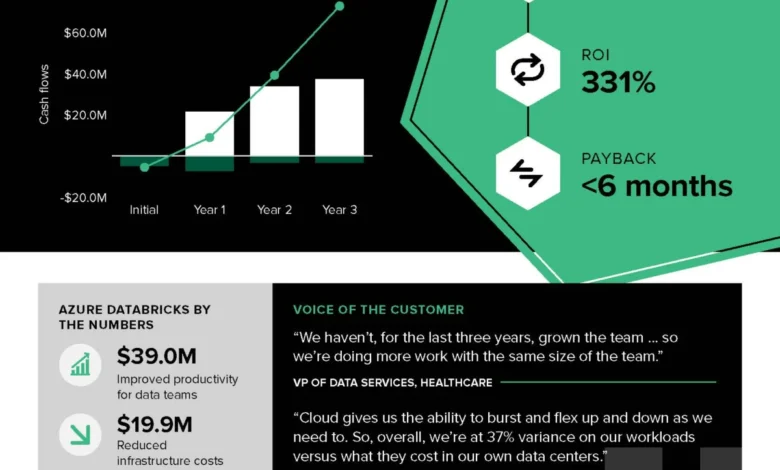
The strategic alliance between Microsoft and Databricks has reached a new milestone in quantifiable business impact, as a recent independent study reveals that organizations utilizing Azure Databricks achieve a 331 percent return on investment (ROI) over a three-year period. This first-party integration, which distinguishes Azure’s offering from other cloud providers, has demonstrated an ability to generate approximately $58.1 million in net present value (NPV) for a composite organization, with the initial investment typically recovered in less than six months. These findings, detailed in a Forrester Total Economic Impact (TEI) study commissioned by Microsoft, underscore the shifting landscape of data management and artificial intelligence, where the integration of platform and infrastructure is becoming a primary driver of corporate profitability.
The Evolution of the First-Party Advantage
The partnership between Microsoft and Databricks is unique in the hyperscale cloud market. Unlike many third-party software-as-a-service (SaaS) offerings that are simply hosted on a cloud provider’s infrastructure, Azure Databricks is co-engineered. This means that the product is a native Azure service, appearing in the Azure portal with the same level of integration as core services like Azure SQL or Azure Virtual Machines.
This co-engineering effort ensures that technical roadmaps are aligned between the two companies. For the enterprise customer, this translates into a unified experience where billing, support, and identity management are consolidated. The "first-party advantage" eliminates the friction often associated with multi-vendor environments, such as disparate security protocols or fragmented support paths. By treating Databricks as a native component of the Azure ecosystem, Microsoft allows organizations to leverage their existing investments in Azure Active Directory (now Microsoft Entra ID), Azure Monitor, and Azure Key Vault seamlessly.
Quantifying the Economic Impact: The Forrester Methodology
To assess the true value of the platform, Forrester Consulting interviewed several long-term Azure Databricks customers to create a composite organization for financial modeling. This representative entity is characterized as a $6 billion global corporation operating in a regulated industry, managing a massive data estate of approximately 10 petabytes.
Prior to adopting Azure Databricks, the composite organization struggled with a fragmented data landscape. Disparate data silos, inconsistent governance, and the high cost of maintaining legacy on-premises or disparate cloud systems led to significant operational inefficiencies. The Forrester study found that after the transition, the organization realized $75.6 million in total benefits against a three-year cost of $17.5 million.
The value derived from the platform was categorized into four primary pillars:
- Infrastructure Cost Reduction: By moving to a managed, auto-scaling cloud environment, the organization eliminated the need for expensive on-premises hardware and reduced the overhead associated with managing complex Spark clusters manually.
- Operational Efficiency for Data Teams: Data engineers and scientists reported significant productivity gains. The native integration with Azure services meant less time spent on "plumbing"—the manual work of connecting data sources—and more time spent on high-value analysis and model development.
- Accelerated Time-to-Market: The ability to deploy data-driven insights and AI models faster allowed the business to react to market changes with greater agility, leading to increased revenue opportunities.
- Risk Mitigation and Governance: Centralized governance through tools like Unity Catalog reduced the risk of data breaches and ensured compliance with industry regulations, avoiding potential fines and reputational damage.
Strategic Synergies with Microsoft Copilot and AI Innovations
As the corporate world pivots toward generative AI (GenAI), the integration between Azure Databricks and the broader Microsoft AI stack has become a critical differentiator. A centerpiece of this integration is Azure Databricks Genie, which has recently been integrated with Microsoft Copilot Cowork.
Genie allows non-technical business users to query the "lakehouse"—a unified data architecture that combines the best features of data lakes and data warehouses—using natural language. By integrating this capability into Microsoft Teams and Microsoft 365 Copilot, organizations can democratize data access. For example, a marketing executive can ask a simple question in a Teams chat about quarterly performance trends, and Genie, powered by the underlying Databricks engine, provides a response grounded in the company’s trusted data.
This process is governed by the Unity Catalog, ensuring that every answer provided by the AI is scoped to the specific permissions of the user. This "intelligence in the flow of work" ensures that data-driven decision-making is not confined to the IT department but is available across the entire enterprise without compromising security or governance standards.
Technical Benchmarks and Performance Superiority
The economic value of Azure Databricks is not solely derived from its integration features but also from its raw performance. Speed in data processing directly impacts costs; faster queries mean less compute time and lower bills. To validate these performance claims, Principled Technologies, an independent research firm, conducted a series of industry-standard TPC-DS-like decision-support benchmarks.
The testing involved a 10-terabyte dataset and compared Azure Databricks against Databricks on Amazon Web Services (AWS). The results indicated that Azure Databricks completed a single query stream up to 21.1 percent faster than its counterpart on AWS when autoscaling was disabled for a controlled comparison. Furthermore, in scenarios involving four concurrent query streams—simulating a busy enterprise environment with multiple users—Azure Databricks completed the tasks more than nine minutes faster than the competition.
These performance gains are attributed to the deep optimizations made at the hypervisor and networking levels within the Azure infrastructure, specifically tailored for Databricks workloads. For large-scale enterprises, these minutes saved per query translate into thousands of dollars in monthly savings and significantly higher throughput for data science teams.
A Chronology of Strategic Growth
The partnership between Microsoft and Databricks has evolved through several key phases:
- 2017: The initial launch of Azure Databricks was announced, marking the first time a major cloud provider offered Databricks as a first-party service.
- 2019-2021: The introduction of the Lakehouse architecture redefined how organizations handled structured and unstructured data, leading to a surge in adoption as companies looked to simplify their data stacks.
- 2022-2023: The launch of Unity Catalog provided a unified governance layer for data and AI, addressing the growing concerns over data privacy and regulatory compliance.
- 2024-2026: The current era focuses on "Generative AI for the Enterprise," characterized by the deep integration of Databricks Genie with Microsoft Copilot and the optimization of Azure infrastructure for large language model (LLM) training and inference.
Market Implications and the Future of the Data Estate
The findings of the Forrester study arrive at a time when enterprise IT budgets are under intense scrutiny. The mandate for Chief Information Officers (CIOs) has shifted from pure innovation to demonstrating clear ROI and operational efficiency. The 331 percent ROI figure provides a compelling economic argument for the consolidation of data services onto a unified, co-engineered platform.
Industry analysts suggest that the "first-party" model adopted by Microsoft may set a new standard for cloud partnerships. By sharing a roadmap and support path, Microsoft and Databricks have effectively lowered the "barrier to entry" for complex data engineering projects. This is particularly relevant for companies in regulated industries—such as finance, healthcare, and energy—where the risks of data fragmentation and poor governance are highest.
Furthermore, the rise of the "Lakehouse" as the dominant data architecture suggests a decline in the traditional separation between data warehousing for BI and data lakes for AI. Azure Databricks sits at the center of this convergence, providing a single platform that serves both needs. This consolidation is a primary driver of the $58.1 million net present value identified in the study, as it allows companies to decommission redundant legacy systems.
Conclusion: The Strategic Imperative for Data Leaders
For organizations navigating the complexities of the modern data economy, the choice of a platform is a long-term strategic decision. The evidence presented in the Forrester TEI study and the Principled Technologies benchmarks suggests that the native integration of Azure Databricks provides a measurable advantage in terms of cost, speed, and risk management.
As AI continues to move from experimental pilots to core business functions, the underlying data foundation becomes the most critical asset. The co-engineering efforts between Microsoft and Databricks ensure that this foundation is not only high-performing but also deeply integrated into the tools that employees use daily. With a payback period of less than six months, the transition to a unified lakehouse on Azure represents one of the most efficient paths to digital transformation available to the modern enterprise.
The value of the partnership is ultimately found in the synergy between the two entities: Databricks provides the industry-leading data processing engine, while Microsoft provides the global scale, security, and integrated productivity ecosystem. Together, they offer a platform that does not just store data, but actively converts it into economic value.