Bankruptcy Court Confirms Francesca’s Chapter 11 Wind-Down Plan, Capping Second Insolvency in Six Years

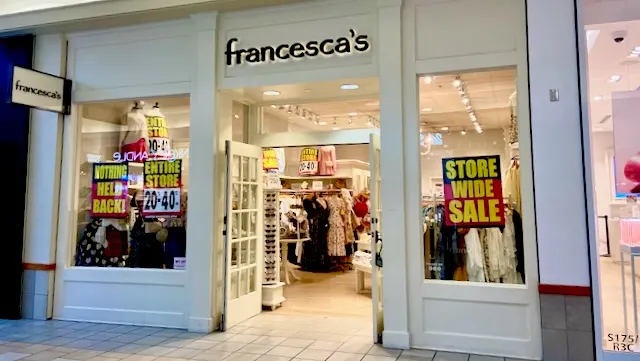
The winding down of boutique women’s apparel and accessories retailer Francesca’s reached a definitive legal milestone on Tuesday, as a U.S. bankruptcy court judge officially confirmed the company’s Chapter 11 liquidation plan. The approval follows months of arduous negotiations, legal maneuvering, and operational downsizing, bringing formal closure to a protracted restructuring effort that ultimately failed to preserve the brick-and-mortar footprint of the once-ubiquitous mall brand.
The newly sanctioned disclosure statement and joint plan of liquidation incorporates pivotal asset dispositions, most notably the sale of the retailer’s intellectual property to Stand Out For Good, the parent company of lifestyle brand Altar’d State. Valued at approximately $7 million, the transaction transfers ownership of Francesca’s core digital and brand equity—including its trademarks, proprietary customer databases, branding assets, and active social media channels—to a new corporate home.
With the judicial stamp of approval now secured, the operational framework is set to transition Francesca’s from an active, albeit distressed, commercial enterprise into a fully executed corporate dissolution.
The Anatomy of the Final Wind-Down Plan
The amended liquidation plan approved by the court highlights the company’s success over the preceding months in resolving complex, high-stakes objections lodged by landlords, vendors, and various unsecured creditors. These disputes primarily centered around the terms and execution of the retailer’s store-closing sales, which were initiated earlier this year to monetize remaining inventory and generate immediate liquidity.
Under the terms of the confirmed asset purchase agreement, Stand Out For Good secured the intellectual property via a stalking-horse process. Court documents indicate that while 28 prospective buyers and interested parties accessed the electronic data room to review the debtors’ financial disclosures, historical performance metrics, and asset holdings during the marketing window, not a single competing qualified bid materialized. Consequently, Stand Out For Good’s $7 million offer stood uncontested, clearing the path for the court’s final approval without the need for an auction.
For customers and industry watchers, the acquisition by Stand Out For Good signals that the Francesca’s brand name may yet survive in some digital or retail capacity under new ownership, even as its physical storefronts vanish from shopping centers nationwide. Altar’d State, known for its experiential retail model and strong community-focused branding, represents a strategic custodian for Francesca’s digital footprint and customer lists.
A Chronology of Decline: The Road to Bankruptcy
The operating company for Francesca’s formally sought Chapter 11 bankruptcy protection in February at the U.S. Bankruptcy Court for the District of New Jersey. The filing marked a grim corporate milestone: the second time in approximately six years that the women’s apparel retailer was forced to seek court-supervised debt relief.
The timeline of Francesca’s modern distress reveals a compounding series of structural and financial headwinds:
- December 2020 (First Bankruptcy): Hit hard by pandemic-era mall traffic declines and structural shifts in retail, Francesca’s Holdings Corporation filed for Chapter 11 protection for the first time. That proceeding resulted in a swift sale to financial sponsors TerraMar Capital and Tiger Capital for $18 million, transitioning the company from a publicly traded entity to private ownership with a restructured, trimmed-down footprint.
- Throughout 2023: Despite hopes of a post-pandemic turnaround, the newly private company encountered severe headwinds. Management pointed to a disruptive data breach in 2023 that compromised internal systems and consumer trust, alongside costly, underperforming investments in non-core brand expansions that drained vital operating capital.
- Late 2023 to Early 2024: E-commerce pressures intensified, squeezing profit margins as digital-native competitors captured younger demographics. Concurrently, broader macroeconomic pressures—including stubborn inflation and rising commercial real estate costs—further constrained liquidity remaining from prior restructuring efforts.
- February 2025: Facing insurmountable liquidity constraints and unable to secure out-of-court refinancing or strategic rescue capital, the company filed its second Chapter 11 petition in New Jersey. The filing immediately confirmed the company’s intention to shutter its remaining retail footprint through a phased, orderly store-closing liquidation.
Financial Pressures and Structural Catalysts
In court declarations and restructuring filings, executives detailed the precise combination of operational missteps and macroeconomic shifts that rendered the business model unviable. Beyond the disruptive 2023 data breach—which necessitated immediate, unexpected expenditures in cybersecurity remediation and damaged consumer confidence—Francesca’s struggled to adapt to a fundamentally altered retail landscape.
The traditional specialty apparel sector has faced intense margin compression as consumer spending habits permanently migrate toward online marketplaces and fast-fashion giants. While Francesca’s historically thrived on its agility, curating boutique-style trends with low inventory depth to encourage frequent store visits, the prolonged decline in traditional indoor shopping mall traffic severely impaired this model.
Furthermore, previous restructuring efforts had left the company with limited cash reserves. Attempts to diversify revenue streams by investing in non-core brands failed to yield expected returns, diverting capital away from core merchandising and digital infrastructure upgrades. When liquidity dried up entirely in early 2025, leadership and its financial advisors concluded that a complete corporate wind-down and intellectual property sale was the only path to maximize recovery for creditors.
Stakeholder Impact and Legal Proceedings
The confirmation of the Chapter 11 plan represents a crucial legal closure for the myriad stakeholders caught in the retailer’s insolvency. Over the course of the spring and summer, the debtors’ legal counsel engaged in intensive negotiations with commercial landlords—representing dozens of retail spaces across major U.S. malls—as well as merchandise vendors and service providers.
Objections initially filed by landlords concerning lease rejections, make-good provisions, and the conduct of going-out-of-business sales were systematically resolved and incorporated into the amended plan. While unsecured creditors will see minimal recovery given the priority claims of secured lenders and administrative expenses, the resolution of these disputes avoids prolonged and costly litigation that would have further depleted the estate’s remaining assets.
For the thousands of retail employees affected by the phased closures, the wind-down plan brings finality to a turbulent transition period, marking the end of operations for a brand that once operated hundreds of boutiques across the United States.
Broader Implications for the Specialty Retail Sector
The definitive demise of Francesca’s physical operations underscores the ongoing vulnerability of mid-market mall-based specialty apparel chains. As commercial real estate landlords continue to grapple with shifting consumer dynamics, the space left vacant by legacy brands is increasingly being backfilled by entertainment concepts, fitness centers, or omnichannel brands with radically different unit economics.
At the same time, the successful carve-out and monetization of Francesca’s intellectual property highlights the enduring value of brand equity in the digital age. Even as physical stores are liquidated and fixtures sold off, established brand names retain residual value for alternative operators seeking to capture existing customer segments through e-commerce or shop-in-shop strategies.
As the case moves from judicial confirmation to final administrative closure, the liquidation of Francesca’s will be studied by restructuring professionals as a textbook example of the limits of serial restructurings in an unforgiving retail environment, where shifting consumer habits and digital disruption continue to separate resilient enterprises from those unable to permanently adapt.
Related posts: