Active Exploitation of Critical GeoServer Vulnerabilities Prompts Urgent Patching Advisory

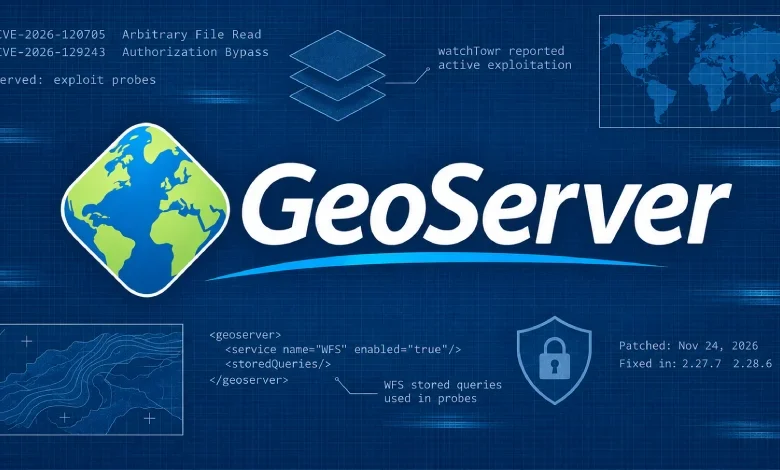
Cybersecurity researchers have confirmed that malicious actors are actively weaponizing two newly identified and patched security vulnerabilities within GeoServer, a widely used open-source server for sharing geospatial data. The discovery, reported by the preemptive exposure management firm watchTowr, highlights a severe risk to organizations relying on the platform for mapping and spatial data infrastructure. These flaws, designated as CVE-2026-120705 and CVE-2026-129243, allow unauthorized attackers to bypass security protocols, gain administrative access, and execute arbitrary code on vulnerable systems. Given the active exploitation observed in the wild, security professionals are urging administrators to apply the latest security updates immediately to mitigate the risk of full system compromise.
Technical Breakdown of the Vulnerabilities
The security flaws in GeoServer have been described as highly sophisticated, particularly when chained together. CVE-2026-120705, which was initially identified and reported by Eye Security, functions as a gateway to broader system exploitation. When combined with other vulnerabilities in the software’s architecture, it facilitates unauthenticated remote code execution (RCE).
According to technical analysis, attackers are currently leveraging error-based exploit probes to verify whether a server is susceptible to attack. By creating and invoking specially crafted stored queries, these actors can determine if they can bypass existing security filters. The exploit mechanism involves a multi-stage process where attackers manipulate the Web Feature Service (WFS) name. By prefixing the service name—for example, using a format such as "x/WFS"—attackers can bypass the administrative restrictions typically enforced on stored queries. Once inside, the software inadvertently processes the input, transforming escaped text into live "xi:include" elements. This action forces the server to leak sensitive files, including those containing administrative password digests and "remember-me" authentication keys.

Once the attacker secures the administrative password digest and the authentication key, they can effectively forge an administrative session cookie. This allows them to bypass the need for traditional password cracking entirely. With full administrative privileges, the attacker gains the ability to point the GeoServer JDBC (Java Database Connectivity) user service toward an uploaded HSQLDB database. Because the system utilizes a bundled driver that deserializes stored values, the attacker can then trigger the execution of arbitrary commands, granting them complete control over the host server.
Chronology and Disclosure Timeline
The path to discovery and remediation for these vulnerabilities has unfolded over several months, reflecting the complexity of identifying deep-seated flaws in large-scale geospatial software.
- August 2, 2026: Jonah Burgess, a Senior Security Researcher at Rapid7—known in the cybersecurity community as "CryptoCat"—independently discovered and reported a comprehensive five-step unauthenticated remote command execution chain. This report served as a cornerstone for understanding the severity of the flaws.
- October 2026: Initial patches for several GeoServer vulnerabilities were released by project maintainers, though the full extent of the exploitation risk was not immediately publicized to the general user base.
- November 24, 2026: Formal advisories for CVE-2026-120705 and CVE-2026-129243 were published, providing the necessary documentation for organizations to secure their environments.
- November 25, 2026: The cybersecurity firm watchTowr issued a public warning on the X (formerly Twitter) platform, confirming that they had observed active exploitation attempts in the wild. This shifted the incident from a potential threat to an active, ongoing security crisis.
The Broader Impact on Spatial Data Infrastructure
GeoServer is a critical component for many government, academic, and private sector entities. It is frequently used to serve complex maps and geospatial data for web applications. Because it often sits at the edge of a network to provide public-facing services, a remote code execution vulnerability is particularly dangerous.
The ease with which these vulnerabilities can be chained to gain full administrative control presents a systemic risk. If an attacker gains access to a GeoServer instance, they do not just compromise the mapping data; they effectively gain a foothold in the internal network where the server resides. From there, lateral movement becomes significantly easier, potentially leading to the compromise of internal databases, private files, and other sensitive enterprise infrastructure.

The situation is compounded by the fact that this is not an isolated incident. Only three months prior, in August 2026, GeoServer was the subject of another high-profile security crisis involving CVE-2026-76904, a critical flaw with a CVSS score of 9.8. That vulnerability also saw active exploitation as a zero-day, suggesting that threat actors have identified the platform as a lucrative target for reconnaissance and long-term persistence.
Official Responses and Mitigation Strategy
In response to the active exploitation reports, the GeoServer project maintainers have been explicit in their guidance: patching is the only viable defense. The maintainers have specifically noted that attempting to circumvent the issue by manually changing security configurations—such as modifying the "security/config.xml" file—is ineffective if the attacker has already obtained the necessary files through the aforementioned disclosure vulnerabilities.
Users are strongly advised to update their systems to the following versions immediately:
- GeoServer 2.27.7
- GeoServer 2.28.6
- GeoServer 3.0.2
These versions include the critical patches that address the underlying logic errors allowing for the unauthorized command execution. Organizations that are unable to update immediately are advised to isolate their GeoServer instances from the public internet or place them behind a robust Web Application Firewall (WAF) configured to block suspicious WFS requests.

Analysis of Implications for Cybersecurity Practices
The exploitation of these GeoServer vulnerabilities serves as a stark reminder of the risks inherent in complex, modular software architectures. The ability of attackers to chain seemingly disparate vulnerabilities—moving from a simple file disclosure to full remote command execution—illustrates the "Swiss cheese" model of security failure. Each flaw, while perhaps minor in isolation, creates a hole that, when aligned with others, provides a direct path to total system compromise.
For organizations, the primary takeaway is the necessity of a proactive "exposure management" strategy. As noted by watchTowr, the ability to preemptively identify these weaknesses is as important as the reactive patching process. The reliance on legacy code or bundled drivers, such as the HSQLDB driver that facilitated the command execution in this scenario, underscores the need for regular supply chain security audits. As software components continue to become more interconnected, the attack surface for enterprise applications like GeoServer will only continue to expand, requiring more rigorous testing and a faster cadence for vulnerability disclosure and remediation.
Security researchers and maintainers remain on high alert. The rapid transition from disclosure to active exploitation indicates that threat actors are monitoring security advisories closely. In this environment, the window between the publication of a patch and the onset of automated, large-scale attacks is shrinking. For IT departments, the lesson is clear: in the modern threat landscape, the interval between the release of a security update and its installation must be measured in hours, not days.