RansomwareHelp CTO and Co-Founder Charged with Wire Fraud Following FBI Sting Operation

The digital landscape of ransomware remediation has long been a murky, high-stakes environment where desperate businesses—often facing the existential threat of total data loss—turn to self-proclaimed experts for salvation. However, a recent indictment unsealed in Rhode Island has exposed a predatory scheme operating behind the facade of professional cybersecurity. Juan Ricardo Palacio Escobar, the 52-year-old co-founder and CTO of the Florida-based firm RansomwareHelp, has been formally charged with wire fraud. Federal investigators allege that rather than deploying the "advanced cryptographic tools" promised to clients, Palacio was merely acting as a middleman, secretly paying cybercriminals to release decryption keys and then billing victims at a significant markup for services that were never rendered.
The Anatomy of the Deception
RansomwareHelp marketed itself as a beacon of integrity in the cybersecurity industry. Its public-facing messaging was explicitly designed to discourage victims from capitulating to criminal demands. The company’s website featured bold declarations such as "Do not pay the ransom!" and touted a proprietary infrastructure capable of achieving 100 percent data recovery. To bolster its credibility, the firm claimed to employ 80 experts in fields ranging from forensic analysis to reverse engineering, backed by a purported 28 years of experience.
Despite these grand claims, the reality was a starkly different, simpler, and more fraudulent operation. According to court documents, Palacio would receive a cry for help from a victimized business, perform a nominal "diagnostic," and then—unknown to the client—contact the threat actors directly to purchase a decryption key. He would then present the key to the victim, claiming it was the result of proprietary decryption algorithms, while charging an exorbitant fee that far exceeded the actual cost of the ransom.
The Federal Sting: A Case Study in Manipulation
The downfall of RansomwareHelp began with an elaborate FBI sting operation. Federal agents established a dual-layered undercover operation: they acted simultaneously as a corporate entity suffering from a ransomware attack and as a fictitious ransomware group.

When the "victim" company contacted RansomwareHelp, the firm’s representatives adhered to their standard script, denouncing the practice of paying ransoms. However, shortly after this interaction, Palacio reached out to the FBI’s "criminal" persona. He inquired about the lowest possible price for a decryption key. The agents quoted 0.2 bitcoin—roughly $13,000 at the time. Within 48 hours, Palacio informed his "victim" client that the diagnostic was successful and demanded $13,260 for the recovery.
The deception became even more brazen the following day. Palacio contacted the FBI-run ransomware group again, this time successfully negotiating the price down to $4,000. Ultimately, he secured the key for approximately $6,000 in bitcoin. He then billed the "victim" company a total of $16,010, which included an initial $2,750 diagnostic fee on top of the inflated recovery cost. This transaction provided the federal government with concrete evidence of a deliberate, profit-driven scheme designed to defraud vulnerable businesses.
Industry Scrutiny and Technical Inconsistencies
The fraudulent nature of RansomwareHelp’s business model did not go entirely unnoticed by legitimate cybersecurity professionals. Paul Ihme, co-founder of the security firm Soteria, encountered the firm in 2024 while assisting a small accounting firm that had been hit by Lockbit ransomware.
Ihme noted that the proposal RansomwareHelp sent to the accounting firm was a masterclass in technical obfuscation. The document promised the use of "510 preconfigured forensic servers" and "eight (6-hour processing cycles" to brute-force encryption. These claims, Ihme asserted, were patently absurd. The proposal referenced irrelevant cryptographic concepts, such as SHA-256 hashing algorithms, which are not used for encrypting files in the manner described.
Perhaps more telling was the firm’s insistence on obtaining unrestricted remote access to the victim’s network via Anydesk software. Ihme discovered that this access was likely used to delete the ransomware notes left by the attackers on various machines. By purging these notes, RansomwareHelp ensured that the victim could not contact the hackers directly, thereby maintaining their monopoly on the "negotiation" process and preventing the client from discovering the true, lower cost of the ransom.

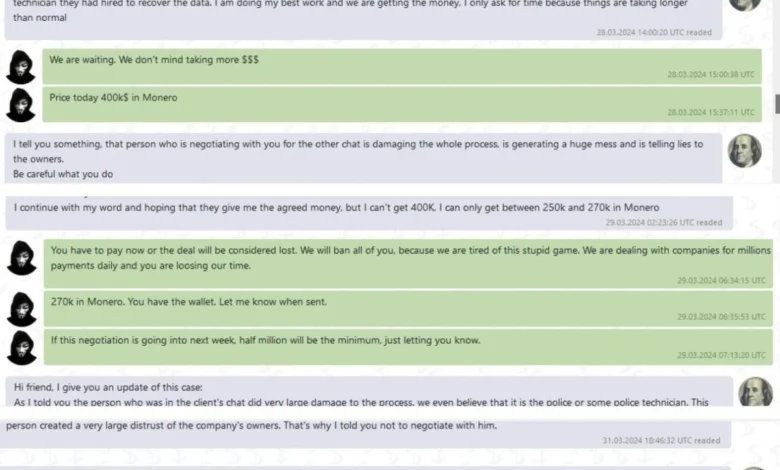
In the case of the accounting firm, the strategy backfired. The victim discovered that someone had already been communicating with the Lockbit group, and the hackers were becoming increasingly frustrated by the conflicting negotiations. By the time the firm engaged Soteria, the ransom demand had escalated significantly due to the stalled and chaotic communication initiated by RansomwareHelp.
A Pattern of Malfeasance in Cybersecurity
The indictment of Palacio is not an isolated incident; it represents a growing trend of federal intervention against firms that exploit the fear and desperation of ransomware victims. The Department of Justice has been aggressively pursuing a string of similar cases throughout 2026.
In early October, Edward Dubrovsky, an executive at the Canadian firm Cybersteward, was charged with cyber extortion and conspiracy. Similarly, the CEO of MonsterCloud, Zohar Pinhasi, faced charges of wire fraud and conspiracy after allegedly paying hackers $8 million while billing clients $19 million for remediation services he claimed were "proprietary."
These cases follow the July sentencing of Angelo Martino, a Florida-based negotiator who was sentenced to 70 months in federal prison. Martino’s case was particularly egregious, as he was found to have conspired directly with the Blackcat/ALPHV ransomware gang, providing them with confidential insights into his own clients’ negotiation strategies to ensure the hackers could maximize their payouts.
Implications for the Cybersecurity Industry
The prosecution of these firms sends a chilling message to the cybersecurity sector: the "gray market" of ransomware negotiation is under intense federal scrutiny. For businesses, these cases highlight the critical importance of due diligence when selecting a third-party incident response partner.

The prevalence of these scams suggests that there is a significant gap in the market for transparent, regulated, and ethical ransomware negotiation. When victims are at their most vulnerable, the lack of standardized pricing and clear, legal protocols creates a vacuum that bad actors are eager to fill. Industry experts suggest that organizations should prioritize firms that maintain clear communication, provide transparent billing, and, crucially, do not demand exclusive, unrestricted access to the victim’s environment without a clear, documented, and professional justification.
As the Department of Justice continues to crack down on these fraudulent entities, the hope is that the cybersecurity industry will move toward greater accountability. The era of the "black-box" recovery expert appears to be waning, replaced by a mandate for total transparency in how companies respond to the growing threat of digital extortion. For victims, the lesson is clear: if an offer to restore data seems too good to be true, or if the "expert" is more interested in controlling communication than in explaining the technical process, it is time to seek a second opinion.