Dolphin X Malware Uses AI Profiler to Rank and Prioritize High-Value Cybercrime Targets


The landscape of cyber warfare has entered a new phase of automation with the discovery of Dolphin X, a sophisticated remote access trojan (RAT) that integrates artificial intelligence to streamline the exploitation of victims. Discovered and analyzed by Varonis Threat Labs, this malware represents a significant shift in the operational efficiency of cybercriminals. By utilizing an "AI Profiler," the malware builders have addressed one of the most significant bottlenecks in modern cybercrime: the overwhelming volume of stolen data that requires manual triage. This development suggests that the era of "spray and pray" malware is being augmented by intelligent, data-driven targeting systems that allow threat actors to focus their resources on the most lucrative targets with surgical precision.
The Discovery and Origin of Dolphin X
The malware first surfaced on clandestine cybercrime forums, where it was marketed by an individual or group operating under the alias "Kontraktnik." Advertised as an all-in-one solution for remote access and data exfiltration, Dolphin X was positioned as a premium tool for sophisticated threat actors. Daniel Kelley, a researcher at Varonis Threat Labs, identified the advertisement and began a deep-dive analysis into the malware’s architecture.
Unlike many low-level infostealers that simply dump data into a text file, Dolphin X was built with a robust infrastructure. The Varonis team managed to obtain the operator panel and the malware builder, allowing them to examine the tool’s inner workings within a controlled, isolated laboratory environment. While the researchers opted not to execute a live agent on a production machine to avoid potential risks, their analysis of the network traffic and the command-and-control (C2) interface revealed a highly organized and feature-rich platform.
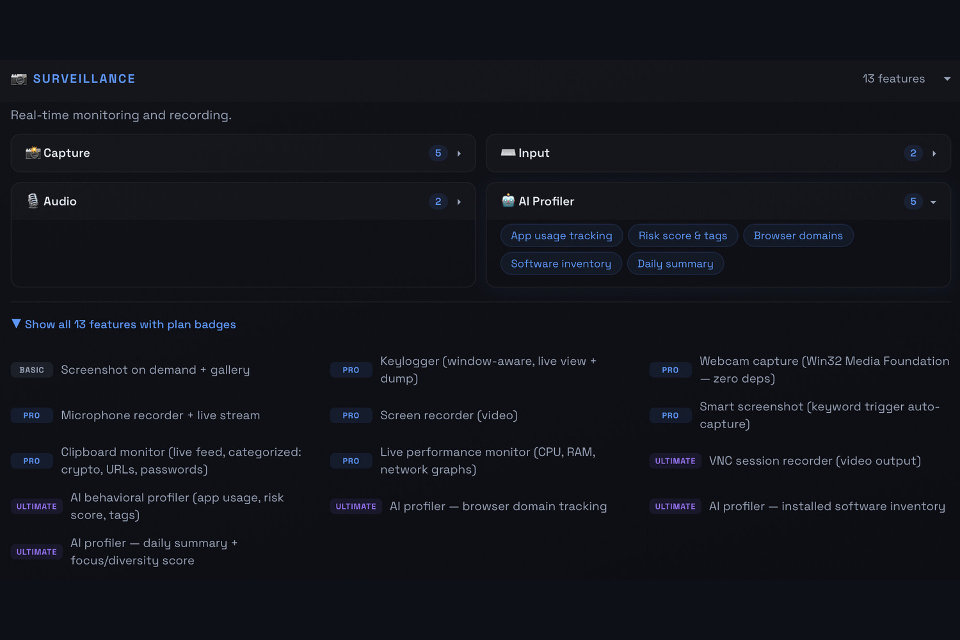
The operator panel itself is a testament to the industrialization of cybercrime. It boasts 329 distinct features organized into ten functional categories. These range from traditional surveillance tools to advanced credential harvesters. However, it is the surveillance tab—specifically the AI Profiler—that has drawn the most attention from the cybersecurity community.

The Mechanics of the AI Profiler
In the traditional cybercrime lifecycle, an attacker might infect thousands of computers through phishing or malicious downloads. This results in a massive influx of credentials, browser cookies, and system logs. For a lone attacker or even a small group, manually searching through this data to find a "whale"—such as a high-ranking corporate executive or a cryptocurrency developer—is time-consuming and inefficient.
The Dolphin X AI Profiler claims to solve this problem by acting as an automated intelligence officer. According to the marketing materials provided by Kontraktnik and the technical strings found in the panel, the profiler tracks application usage, calculates risk scores, and generates daily summaries. The system analyzes specific data points, including:
- Application Usage Tracking: Identifying if the victim uses professional software, development tools, or financial applications.
- Browser Domain Analysis: Monitoring which websites the victim frequents, such as corporate portals, cloud service providers, or cryptocurrency exchanges.
- Software Inventory: Scanning for installed software that might indicate a high-value target, such as VPNs, SSH clients, or password managers.
- Risk Scoring: Assigning a numerical value to each victim based on the perceived value of their digital assets.
Technical strings identified by Daniel Kelley, such as Auto-Start AI Profiler, ProfilerStart, ProfilerGetData, risk_score, and categoryusage, confirm that the profiling workflow is integrated into the malware’s backend. While the specific AI engine or Large Language Model (LLM) used to generate these rankings remains unconfirmed due to the limitations of static analysis, the intent is clear: the automation of victim prioritization.
A Comprehensive Suite of Malicious Tools
Beyond its AI capabilities, Dolphin X functions as a highly effective credential stealer and remote access tool. The Varonis analysis highlighted the sheer scale of the malware’s reach, targeting over 300 different applications. This includes:
- Web Browsers: Full support for nine major Chromium and Gecko-based browsers, allowing for the theft of saved passwords, autofill data, and session cookies.
- Cryptocurrency Assets: The malware targets 100 cryptocurrency wallet extensions and 65 desktop-based wallets, making it a potent threat to digital asset holders.
- Development and Cloud Tools: In a move that highlights its focus on corporate and infrastructure targets, Dolphin X targets more than 30 cloud command-line interface (CLI) tools, SSH keys, and
.envfiles. - Credential Managers: The tool is designed to extract data from 10 popular password managers, potentially giving attackers the "keys to the kingdom."
The targeting of .env files is particularly concerning for organizations. These files often contain plaintext secrets, API keys, and database credentials used in software development and cloud deployment. By automating the collection and ranking of these files, Dolphin X enables attackers to move laterally from a single infected workstation into a company’s entire cloud infrastructure.

The Shift from Quantity to Quality in Cybercrime
The introduction of AI into the malware ecosystem marks a pivotal evolution in threat actor tactics. For years, the industry has focused on the volume of attacks. However, as security measures like Multi-Factor Authentication (MFA) and Endpoint Detection and Response (EDR) have become more prevalent, the "cost" of an attack has increased. Attackers can no longer afford to waste time on low-value targets.
The AI Profiler in Dolphin X represents a move toward "Quality over Quantity." By using machine learning or sophisticated heuristics to rank victims, attackers can ensure they are spending their time on infections that yield the highest return on investment (ROI). This is particularly useful for Initial Access Brokers (IABs)—cybercriminals who specialize in gaining entry to networks and then selling that access to ransomware groups. An IAB using Dolphin X can quickly identify which of their thousands of "bots" have access to a Fortune 500 company or a high-cap crypto firm, allowing them to demand a higher price for the access.
Chronology of the Threat Landscape Evolution
The emergence of Dolphin X is not an isolated incident but part of a broader trend of AI adoption by malicious actors.
- Late 2023: The cybersecurity community observed the rise of "WormGPT" and "FraudGPT," specialized LLMs designed to help attackers write convincing phishing emails and develop malicious code.
- Early 2024: Reports surfaced of "SpamGPT," an AI-driven tool for automating large-scale spam and social engineering campaigns.
- Mid-2024: Researchers identified autonomous AI agents capable of conducting basic vulnerability scans and exploitation without human intervention.
- July 2024: Varonis Threat Labs releases its analysis of Dolphin X, identifying the first significant use of AI for post-infection victim profiling and triage.
This timeline demonstrates a rapid progression from using AI for "front-end" tasks like phishing to "back-end" operational tasks like data processing and strategic planning.
Industry Implications and Defensive Recommendations
The arrival of AI-powered RATs like Dolphin X necessitates a shift in defensive strategies. Traditional signature-based antivirus solutions are increasingly ineffective against malware that can be easily obfuscated or modified by its builders. Organizations must prioritize behavioral analysis and zero-trust architectures to mitigate the risk.
Industry experts suggest several key defensive measures:
- Enhanced Endpoint Monitoring: Utilizing EDR tools that can detect the specific behaviors associated with Dolphin X, such as unauthorized access to browser data folders or the scanning of
.envfiles. - Strict Credential Management: Since Dolphin X targets developer tools and cloud tokens, companies should implement short-lived credentials and robust secrets management solutions to ensure that stolen
.envfiles have a limited shelf life. - Data Loss Prevention (DLP): Implementing DLP rules that flag the exfiltration of sensitive configuration files and SSH keys can provide an early warning of a Dolphin X infection.
- Network Segmentation: By segmenting networks, organizations can prevent an attacker from using a ranked "high-value" workstation to move laterally into production environments.
Final Analysis: The Future of AI in Malware
The Varonis report on Dolphin X serves as a wake-up call for the cybersecurity industry. While the "AI" label is often used as a marketing gimmick, the technical evidence suggests that Dolphin X’s profiling feature is a functional tool designed to solve a real-world problem for cybercriminals. As these tools become more accessible on the dark web, the barrier to entry for conducting sophisticated, targeted attacks will continue to drop.
The integration of AI into the malware lifecycle—from initial delivery to final data monetization—is no longer a theoretical threat. It is a present reality. Security teams must now assume that attackers are not just faster than before, but also "smarter" in how they choose their victims. The battle for digital security is increasingly becoming a contest of AI versus AI, where the speed of detection must match the speed of automated exploitation.
Related posts: