Google Ads Unveils "Missed Growth Opportunity" Insights in Main Recommendations Tab to Illuminate Untapped Revenue Potential

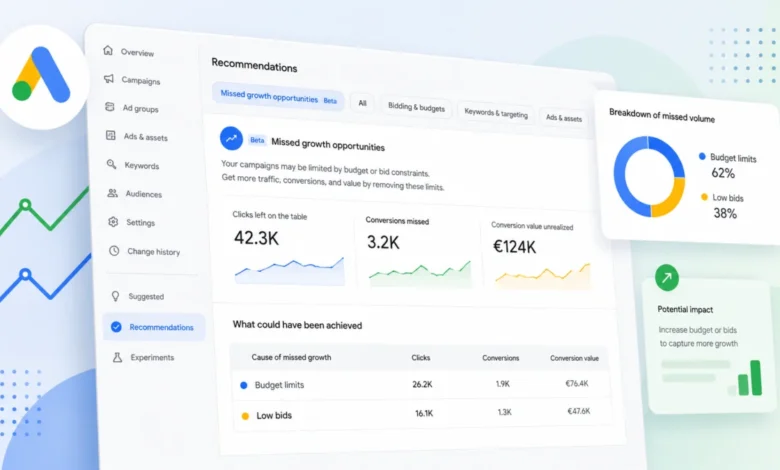
Google Ads is making a significant enhancement to its Recommendations tab with the beta launch of "Missed Growth Opportunity" insights, providing advertisers with a more direct and actionable view of potential revenue and conversions lost due to budgetary constraints or suboptimal bidding strategies. This integration aims to demystify the impact of these critical campaign management levers, empowering advertisers to make more informed decisions for enhanced performance. Previously residing in the more experimental Google Ads Labs, these valuable estimates are now positioned front and center, appearing alongside existing optimization suggestions, thereby increasing their visibility and potential for immediate adoption.
The newly introduced beta feature offers a quantitative assessment of the potential gains advertisers could achieve by strategically increasing their budgets or adjusting their bids upward. This move signifies a shift towards making complex performance estimations more accessible within the core Google Ads interface. Advertisers will now be able to see these insights directly within the Recommendations tab, often accompanied by illustrative screenshots or data visualizations that highlight the unrealized traffic, conversions, and revenue. This proactive approach by Google Ads acknowledges that for many advertisers, budget allocation and bid management represent the most impactful levers for driving campaign growth and achieving their business objectives. By quantifying the potential impact of these constraints, Google is furnishing advertisers with a crucial data point to identify and prioritize areas where additional investment is likely to yield the greatest return on investment.
Evolution of Opportunity Insights
The "Missed Growth Opportunity" feature is not entirely new; it represents a rebranding and strategic integration of a tool that was previously accessible within Google Ads Labs. This move from a more experimental section to the primary Recommendations tab suggests Google’s confidence in the utility and reliability of these insights. PPC expert Thomas Eccel was among the first to notice and highlight this integration, describing it as essentially a rebranded iteration of the former "Missed Growth Opportunity" tool. The migration indicates Google’s commitment to refining and mainstreaming these predictive analytics for a broader advertiser base.
Historically, Google Ads Labs has served as a testing ground for new features and advanced functionalities. While these labs offer cutting-edge tools, they often require a more proactive engagement from advertisers willing to explore and experiment. Bringing the "Missed Growth Opportunity" insights into the main Recommendations tab democratizes access, ensuring that a larger segment of Google Ads users can benefit from this valuable diagnostic information without needing to navigate to a separate, less prominent section of the platform. This strategic decision reflects a broader trend in digital advertising platforms to simplify complex data and make actionable insights more readily available.
Quantifying Lost Potential: A Deeper Dive
The core value proposition of this new beta lies in its ability to quantify the economic impact of under-optimizing budgets and bids. Advertisers can now expect to see estimated missed performance broken down by its root cause: insufficient budget or low bids. This granular breakdown allows for a more precise understanding of where campaign limitations are hindering growth. For instance, an advertiser might see a recommendation that suggests an additional $500 per month in budget could lead to an estimated 15% increase in conversions, or that raising bids on specific high-performing keywords could unlock an additional $2,000 in monthly revenue.

This level of detail is crucial for strategic planning. It moves beyond generic advice and provides concrete figures that can be directly factored into marketing budgets and forecasting models. The ability to differentiate between budget-related shortfalls and bid-related limitations also enables advertisers to tailor their optimization strategies accordingly. If the issue is primarily budget, the focus might be on securing additional funding or reallocating existing resources. If it’s bid-related, the attention would shift to competitive analysis, bid strategy refinement, and understanding the value of specific keyword auctions.
Supporting Data and Industry Context
The integration of these insights comes at a time when the digital advertising landscape is increasingly competitive and data-driven. Advertisers are constantly seeking ways to maximize their return on ad spend (ROAS) and gain a competitive edge. According to industry reports, the global digital advertising market is projected to continue its robust growth, with significant portions allocated to platforms like Google Ads. For example, eMarketer has consistently reported substantial year-over-year growth in digital ad spending, with search advertising remaining a cornerstone of many marketing strategies.
In this environment, every percentage point of conversion or revenue gain can translate into significant financial impact. The "Missed Growth Opportunity" insights provide a tangible representation of the untapped potential that exists within existing campaigns. This is particularly relevant for small to medium-sized businesses (SMBs) that may have tighter budgets and fewer resources for in-depth campaign analysis. By surfacing these opportunities directly, Google Ads is effectively offering a powerful, data-backed consultation to help these businesses optimize their spend and compete more effectively.
The underlying algorithms that power these estimations likely draw upon vast amounts of anonymized data from across the Google Ads network. This data includes information on auction dynamics, historical campaign performance, conversion rates across various industries and geographies, and the projected impact of bid and budget adjustments. While Google does not disclose the proprietary details of these algorithms, their continuous refinement is essential for providing accurate and actionable recommendations. The beta phase allows Google to gather feedback and further calibrate these models based on real-world advertiser results.
Implications for Advertisers: A Data-Driven Approach to Growth
The broader implications of this feature are significant. It democratizes access to advanced performance forecasting, previously a domain that might have required specialized tools or external consultants. By bringing these estimates into the main Recommendations tab, Google Ads is empowering a wider range of advertisers to:
- Prioritize Spend: Identify which campaigns or ad groups have the most potential for growth if additional budget or strategic bid adjustments are made. This allows for more strategic allocation of marketing resources.
- Justify Budget Increases: Provide concrete, data-backed justifications for requesting increased advertising budgets from stakeholders. The projected revenue or conversion uplift can be a powerful argument for investment.
- Refine Bidding Strategies: Understand the direct impact of current bidding levels and identify opportunities to optimize for higher conversion volumes or revenue.
- Identify Campaign Limitations: Gain a clearer understanding of whether performance is being held back by budget caps or insufficient bids, allowing for targeted problem-solving.
However, it is crucial for advertisers to approach these insights with a critical and analytical mindset. As Google itself emphasizes, these are modeled estimates, not guaranteed outcomes. The digital advertising ecosystem is dynamic, influenced by seasonality, competitor activity, economic factors, and evolving consumer behavior. Therefore, advertisers should treat these recommendations as directional guidance.

Best Practices for Utilizing "Missed Growth Opportunity" Insights
To effectively leverage the "Missed Growth Opportunity" beta, advertisers should consider the following best practices:
- Validate the Estimates: Before making significant budget increases or bid adjustments based solely on these recommendations, advertisers should cross-reference the projected impact with their own historical performance data and market benchmarks. This involves analyzing recent trends, conversion rates, and cost per acquisition (CPA) for similar campaigns.
- Implement Gradually: For significant changes, consider implementing budget increases or bid adjustments incrementally. This allows for close monitoring of performance and the ability to roll back changes if they do not yield the expected results.
- Monitor Performance Closely: After implementing changes based on the recommendations, diligent monitoring of key performance indicators (KPIs) is essential. Track metrics such as click-through rates (CTR), conversion rates, CPA, ROAS, and overall revenue to assess the actual impact of the adjustments.
- Contextualize with Business Goals: Ensure that the recommended actions align with overarching business objectives. An increase in conversions might be desirable, but if it comes at an unsustainable CPA or detracts from other strategic goals, it may not be the right move.
- Combine with Other Optimization Efforts: These insights should be used in conjunction with a comprehensive optimization strategy that includes keyword research, ad copy testing, landing page optimization, and audience segmentation.
Official Statements and Industry Reactions
While official statements from Google Ads directly elaborating on this specific beta are typically minimal, the integration into the Recommendations tab itself signifies a strategic priority. The platform’s ongoing development consistently focuses on providing advertisers with tools that simplify complex decision-making and drive measurable results.
Industry reactions, as exemplified by PPC expert Thomas Eccel, have been generally positive, acknowledging the value of making these insights more accessible. The consensus among many in the paid media community is that enhanced visibility into potential growth is always beneficial, provided the data is sound. The key concern, as always with automated recommendations, is the underlying accuracy and the potential for over-reliance without critical evaluation.
Looking Ahead: The Future of Predictive Analytics in Ad Platforms
The introduction of "Missed Growth Opportunity" insights in the main Recommendations tab is a clear indication of Google Ads’ commitment to leveraging predictive analytics to empower its users. As AI and machine learning capabilities continue to advance, advertisers can expect to see even more sophisticated tools that anticipate market trends, forecast campaign performance, and offer proactive recommendations.
This move by Google Ads aligns with a broader industry trend across advertising platforms. Companies like Meta (Facebook/Instagram Ads), Microsoft Advertising, and others are continually investing in AI-driven features to help advertisers navigate increasingly complex digital landscapes. The goal is to move beyond simply reporting past performance to actively guiding advertisers toward future success.
Ultimately, the "Missed Growth Opportunity" beta represents a valuable enhancement to the Google Ads platform. By bringing estimated unrealized performance to the forefront, Google is providing advertisers with a powerful new data point to inform their budget and bidding strategies. When used judiciously and in conjunction with rigorous performance analysis, these insights have the potential to unlock significant untapped growth and drive greater ROI for businesses advertising on Google. The success of this beta will likely pave the way for further integration of predictive and prescriptive analytics within the core Google Ads experience.