The rapid integration of artificial intelligence into software development lifecycles has exposed a significant infrastructure gap in traditional version control workflows. As AI coding agents such as Claude Code, Cursor, and OpenAI’s specialized models become ubiquitous in professional environments, developers are increasingly encountering friction when attempting to manage multiple concurrent tasks. While 51% of professional developers now utilize AI tools on a daily basis, a recent industry survey indicates that only 17% believe these tools have substantially improved team collaboration. This discrepancy suggests that while individual productivity may be rising, the underlying infrastructure used to manage code changes has not yet fully adapted to the high-velocity, multi-threaded nature of AI-driven development.
Central to this challenge is the limitation of the standard Git working directory. In a traditional workflow, a developer working on a feature branch must often pause their progress to address urgent hotfixes or review peer code. This typically involves stashing changes and switching branches, a process that inherently disrupts the context of an active AI agent. When an agent has spent significant time indexing a codebase and building internal context for a complex rewrite, a branch switch can lead to corrupted state, lost progress, or the need for expensive re-indexing. The emergence of Git worktrees, a feature introduced in Git version 2.5 in 2015, is now being recognized as the essential architectural solution to these modern bottlenecks.
The Technical Architecture of Git Worktrees
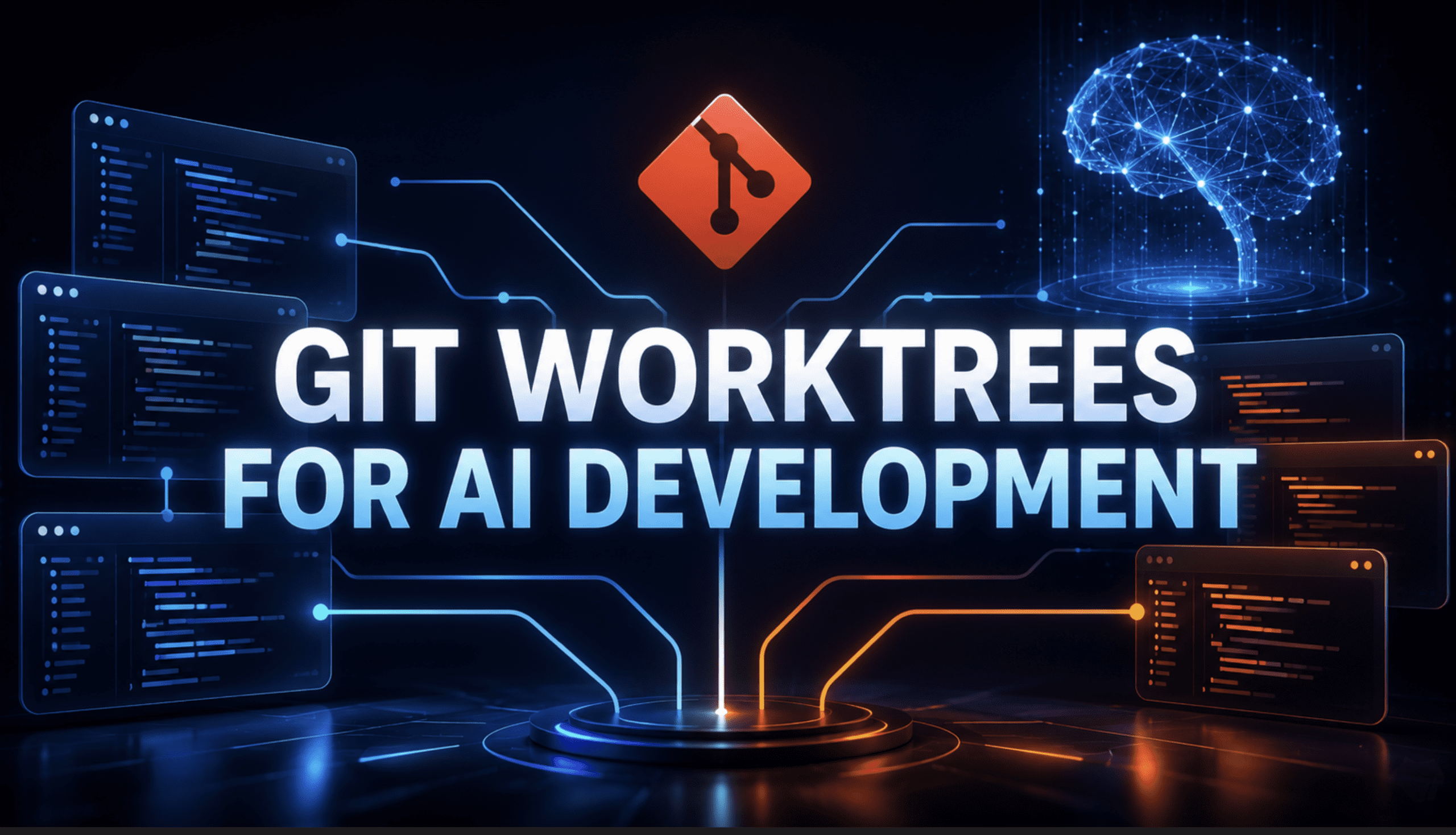
A Git worktree allows a single repository to support multiple working directories simultaneously. Unlike the traditional model where one .git folder corresponds to one set of checked-out files, worktrees enable a developer to have multiple branches checked out in separate physical folders on the filesystem, all linked to a single Git backend. This configuration ensures that history, objects, and commits are shared across all workspaces without the disk-space overhead of multiple full repository clones.
From a technical standpoint, each worktree maintains its own index and its own HEAD pointer. This isolation is critical for AI agents. When an agent is assigned to a specific directory—for instance, project-feat-auth/—it operates entirely within that environment. If a production emergency requires a hotfix, the developer can navigate to the project-main/ directory or create a project-hotfix/ worktree without interrupting the agent’s session in the feature directory. This physical separation prevents the silent overwriting of files, such as package.json or configuration manifests, which frequently occurs when multiple processes attempt to modify the same working directory.
The Shift Toward Multi-Agent Orchestration
The practical utility of this approach was highlighted during the Microsoft Global Hackathon in late 2025. Engineering leads, including Tamir Dresher, documented a paradigm shift where the developer’s role evolved from a primary coder to a technical orchestrator of multiple AI agents. By utilizing Git worktrees, the team was able to bypass the "context-switching tax" that typically limits human productivity.
During the event, a single engineer could manage three or four distinct feature developments simultaneously. Each feature was assigned a dedicated worktree and a corresponding AI agent. This "virtual AI team" model allowed for parallel execution of OAuth2 implementations, API endpoint construction, and bug resolution. The results suggested a significant compression of the development timeline, provided that the underlying Git architecture remained robust.
The workflow adopted during this period established a new best practice: the use of a coordination window. In this model, the main worktree remains a "clean" environment used for code reviews, final testing, and merging, while linked worktrees serve as isolated "laboratories" for AI agents. This separation ensures that the main branch is never contaminated by experimental or incomplete AI-generated code until it has passed human inspection.
Implementing the AI-Worktree Workflow
For organizations seeking to bridge the gap between AI adoption and collaborative efficiency, the implementation of a worktree-centric workflow involves several key stages. The process begins with the standardization of worktree creation through automation scripts. Because each worktree is a fresh directory, it does not automatically inherit untracked files, such as .env configurations or local dependency folders like node_modules.
Expert practitioners recommend a scripted approach to ensure environment parity. A standardized setup script typically handles the creation of the branch, the allocation of the directory, the copying of necessary gitignored environment files, and the installation of dependencies. This automation ensures that an AI agent begins its task in a fully functional environment, reducing the likelihood of errors stemming from missing configuration files.
Furthermore, the introduction of specialized context files, such as AGENTS.md or CLAUDE.md, has become a cornerstone of high-performing AI teams. Peer-reviewed research presented at the International Conference on Software Engineering (ICSE) in 2026 demonstrated that agents provided with structured architectural documentation and clear task scoping show measurable gains in functional correctness and code modularity. By placing a task-specific AGENTS.md file within a worktree, developers can provide the agent with a precise roadmap, acceptance criteria, and prohibited zones, effectively "fencing" the AI’s activity to prevent architectural drift.
Managing Branch Drift and Synchronization
A significant risk in parallel development is branch drift. When multiple worktrees exist for several days, the divergence from the main branch can lead to complex merge conflicts. To mitigate this, the emerging industry standard favors a "rebase-early, rebase-often" strategy.

By rebasing a worktree branch onto the latest version of the main branch at regular intervals, developers ensure that the AI agent is always working against the most current codebase. This practice keeps the project history linear and simplifies the final pull request (PR) process. Journalistic analysis of team performance suggests that teams who sync their worktrees daily reduce the time spent on merge conflict resolution by approximately 40% compared to those who rely on late-stage merging.
Broader Implications for the Software Industry
The transition to worktree-based AI development carries profound implications for the structure of software engineering teams. As the "orchestrator" model gains traction, the value of senior engineers will increasingly lie in their ability to scope tasks, define architectural boundaries, and perform high-level synthesis of code produced by parallel agents.
This shift also places a renewed emphasis on Git mastery. While Git has been a foundational tool for decades, the nuances of worktree management, reference repair, and pruning have moved from "advanced" topics to "essential" daily skills. Educational institutions and corporate training programs are beginning to update their curricula to reflect this change, moving away from simple "commit and push" instruction toward complex multi-worktree orchestration.
Moreover, the environmental impact and resource management of local development are being reconsidered. While worktrees are more disk-efficient than full clones, running multiple AI agents and their associated language servers, compilers, and test runners requires significant local computational resources. This is driving a trend toward high-spec developer workstations and the increased use of cloud-based development environments that can scale dynamically to support multiple parallel worktrees.
Conclusion and Future Outlook
Git worktrees, once an overlooked feature of the version control system, have emerged as a critical infrastructure component in the age of AI-assisted coding. By providing the physical and logical isolation necessary for parallel AI agents to operate without interference, worktrees solve the primary friction point of modern software development: the context-switching tax.
As the industry moves toward 2026 and beyond, the integration of worktree management into IDEs and AI agent interfaces is expected to become more seamless. Tools like Claude Code are already introducing native flags for worktree creation, signaling a future where the distinction between a branch and a working directory becomes increasingly transparent to the user. For now, the adoption of the worktree workflow remains a competitive advantage for teams looking to maximize the output of their AI tools while maintaining the integrity and collaborative health of their codebases. The model is clear: one task, one branch, one worktree, and one agent—a formula that promises to turn the potential of AI coding into a scalable, industrial reality.