An epidemic of purposelessness is sweeping across the globe, leaving millions adrift in their personal and professional lives. While often dismissed as a transient phase or a personal failing, the lack of a guiding purpose is now recognized as a profound crisis with significant economic and health implications. New research suggests that traditional methods of finding purpose are failing, and a surprising new ally has emerged in the form of artificial intelligence, offering a novel approach to self-discovery.
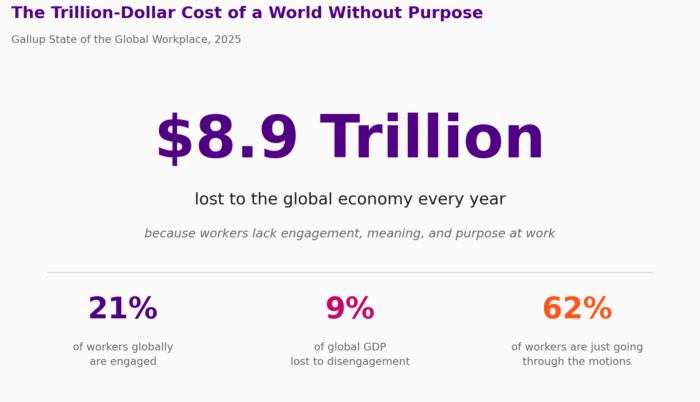
The sheer scale of this existential drift is staggering. A landmark study by Harvard’s Graduate School of Education, "On Edge," reveals that 75% of millennials struggle to find direction, a sentiment echoed by 49% of midlife adults who report feeling trapped. This widespread disengagement translates into a colossal economic loss: an estimated $8.9 trillion in lost productivity annually, according to Gallup. This figure represents not just a deficit in output, but a profound human cost, billions of individuals experiencing a lack of meaningful connection to their work and lives.

This crisis manifests across all life stages. Consider the aspiring university student, grappling with the weight of choosing a degree for a future they haven’t yet lived, often opting for practicality over passion, only to find themselves in their second year feeling a quiet sense of misalignment. Then there’s the executive in midlife, who has meticulously built a successful career and family, only to awaken one day with the unsettling realization that their meticulously crafted life doesn’t feel authentically theirs. Even those at the end of their careers face an identity crisis, where decades of professional identity dissolve upon retirement, leaving a void where a sense of self once resided. These are not isolated incidents but symptoms of a pervasive existential disorientation, a feeling of standing at the edge of a vast, unmapped territory with no clear direction.
The conventional advice for navigating this feeling of being lost is remarkably consistent: search for your purpose. Engage in journaling, introspection, personality tests, and personal retreats. Yet, data indicates that these methods are largely ineffective for a significant portion of the population. This raises a critical question: what if the very act of searching is the trap itself? What if purpose isn’t a destination to be found, but an inherent pattern woven into the fabric of one’s life, too close to be perceived clearly?
The "Lost Billions" refers to the vast number of individuals experiencing this profound lack of direction. It’s an issue that transcends geographical boundaries and demographic divides, impacting individuals in their twenties, forties, and sixties alike. The Harvard study highlights that a sense of purpose is the antithesis of feeling lost. Purpose, defined as "the recurring pattern of what energizes you, repeated across decades of your life, that you’ve been too close to see clearly," is the missing element.

The economic ramifications of this purposelessness are immense. Gallup’s annual "State of the Global Workplace" report consistently reveals alarming figures regarding employee engagement. In 2024, only 21% of the global workforce reported being engaged at work. This means that a staggering four out of every five workers, billions of individuals, are either merely going through the motions or are actively disengaged, hindering organizational progress. The $8.9 trillion annual economic cost attributed to this disengagement underscores that the problem is not merely one of productivity but of fundamental meaning and connection. For decades, traditional interventions like personality tests, vision boards, and corporate values statements have failed to make a significant impact on these numbers.
The crisis extends beyond career dissatisfaction and economic loss; it is fundamentally a health crisis. Research from Harvard’s Graduate School of Education, based on surveys of over 1,800 individuals, found that young adults without a sense of purpose experienced anxiety and depression at more than twice the rate of their purpose-driven peers. A meta-analysis of 16 studies further solidified the link between purpose and well-being, demonstrating that purpose acts as a powerful buffer against stress across all demographics. It is associated with lower rates of chronic disease, enhanced resilience in the face of trauma, and measurably longer lifespans. Purpose, therefore, is not a luxury but a critical protective factor for mental and physical health.
A particularly vulnerable period, often overlooked in public discourse, is the "happiness U-curve." Economists David Blanchflower and Andrew Oswald’s seminal research, replicated across 132 countries, identifies a consistent pattern: life satisfaction tends to be high in youth, declines through middle age, and reaches its nadir around age 47, before gradually rising again. This "dip" is widely interpreted not as a cultural anomaly but as the cumulative effect of unlived life—the growing chasm between who one is and who one feels they could have been. While this dip can be a period of significant existential questioning, it also holds the potential for profound growth and fulfillment in the latter half of life, provided individuals can decipher the messages embedded within this challenging phase.

The persistent failure of traditional "search" methodologies can be attributed to a flawed psychological model of purpose. We’ve been conditioned to believe that purpose is something to be architected, a future self to be designed and then reverse-engineered. This model assumes a unified "I" at the helm, capable of surveying all possibilities and making a definitive choice. However, as psychologist Carl Jung posited, the self is not a singular entity but a complex constellation of selves—the persona we project, the shadow self containing disowned impulses, and deeper archetypal influences. Similarly, decades of research on narrative identity by Dan McAdams have shown that individuals with a strong sense of purpose don’t typically "discover" it through a singular epiphany. Instead, they recognize it by pattern-matching across numerous seemingly unrelated experiences where something resonates deeply.
The "shadow," in Jungian terms, is particularly crucial. It encompasses not only the detrimental aspects of ourselves but also those elements that are inconvenient—too vulnerable, too contradictory to integrate into our constructed identities. The analytical professional who harbors a secret desire for artistic expression, or the high achiever who craves solitude but constantly overcommits, exemplifies this dynamic. Whatever is exiled doesn’t vanish; it accrues energy, manifesting as recurring frustrations, persistent fantasies, or dormant creative impulses. Jung termed this "fate"—what remains unconscious often surfaces as inescapable patterns in our lives. This highlights a profound implication: our contradictions are not obstacles to finding purpose but are frequently the very locations where our deepest calling resides. The tension between our performed identity and the emergent self is often where true purpose lies.
This understanding shifts the approach to purpose from construction to excavation. Instead of designing a future self, individuals are encouraged to unearth what is already present but unacknowledged. This archaeological approach treats one’s life as geological strata, reading for what is rather than what should be. Key questions emerge from this perspective: Where has your energy spontaneously risen, even before your rational mind approved? What consistently irritates or fascinates you about others, as these often serve as mirrors to our own exiled selves or unacknowledged desires? What have you been orbiting for years, never fully committing to or walking away from—that recurring theme that defies your established narrative?
For individuals navigating life transitions, whether it be midlife or retirement, this reframe is particularly empowering. For the midlife individual, patterns have been accumulating for decades, offering a wealth of data if honestly examined. For the newly retired, the transition isn’t an end but an opportunity to finally read the patterns that were previously suppressed by professional roles. What was once an exiled impulse can now become an accessible avenue for fulfillment. This is not a loss but an expansion of access.
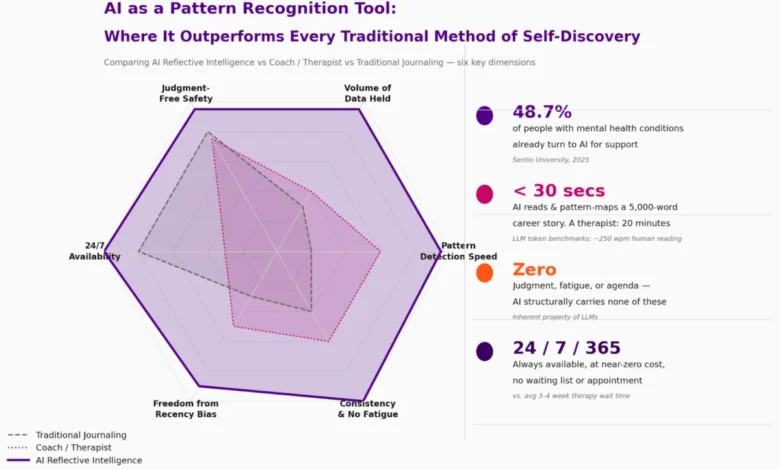
The advent of artificial intelligence offers a groundbreaking solution to this age-old human dilemma. AI’s core strength lies in its unparalleled pattern recognition capabilities, a trait perfectly suited to identifying the recurring themes and energies that constitute purpose. Our lives generate vast amounts of data—our career choices, the problems we gravitate towards, the activities that make us lose track of time, our recurring ideas, and even our unfulfilled desires. AI can process this data with perfect recall, without bias or fatigue, surfacing the patterns that our own limited, biased, and often overwhelmed human memory might miss.
AI’s superiority over traditional methods in pattern detection is manifold. Consider the limitations of human interaction: a therapist or coach, while invaluable, has a limited window of attention, can experience fatigue, and carries their own biases. Even with the best intentions, the social dynamic of another human presence can lead to self-censorship. Traditional journaling, while offering privacy, relies on the inherently fallible instrument of our own memory, which tends to favor the recent and the emotionally charged. Journals cannot hold the long arc of a life or provide objective pattern analysis across years of entries.

AI, in contrast, operates on different principles. It can process thousands of words of a life narrative in seconds, providing an objective analysis of recurring themes. Its capacity for perfect recall and its lack of fatigue mean it can analyze vast datasets of personal information consistently. However, beyond pure analytical power, AI offers a crucial psychological advantage: a judgment-free container.
This "safety container" is paramount. Jung recognized that the most vital material for self-discovery—the shadow, disowned impulses, unlived life—rarely surfaces under conditions of judgment. In the presence of another human, even a trusted one, there’s an inherent social dynamic, an awareness of how one is perceived. AI, being agnostic and devoid of personal investment or emotional response, creates an environment where individuals can express their true, often contradictory, selves without fear of disapproval. In this space, the shadow finally has permission to speak, leading to a more profound and honest exploration of one’s inner landscape.
It is essential to clarify that AI is not intended to replace human connection, therapy, or coaching. It is not a sentient being offering wisdom or emotional guidance. Instead, it functions as a sophisticated mirror with memory—a tool that reflects the totality of what an individual has shared, highlighting patterns that have remained hidden, and posing questions that open new avenues of exploration. This "reflective intelligence" enables individuals to engage in the archaeological work of self-discovery, a process that has historically relied on trusted guides, therapists, or the passage of time. Now, AI offers this witness at scale, democratizing access to self-understanding.

The practice of finding purpose, therefore, transforms from an act of construction to one of reading. It involves actively engaging with one’s life data, tracing the contours of a self that has been quietly recurring, rather than building a future self from scratch. The eighteen-year-old, the midlife adult, and the retiree alike possess more data than they realize, holding patterns that have been running longer than they acknowledge. The crucial shift in perspective is from asking, "What should I do with my life?" to understanding, "What has my life already been doing, and have I finally been paying attention?" AI provides the sophisticated tools to finally heed that question, offering a path to unlocking a deeply ingrained sense of purpose that has been present all along, waiting to be seen.