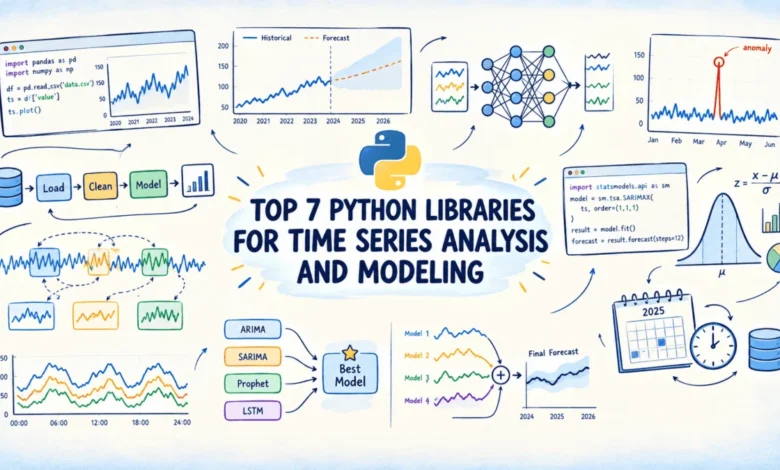
Time series analysis remains one of the most structurally fragmented domains within the Python data science ecosystem. Unlike tabular machine learning, which has largely converged around unified frameworks like scikit-learn, predicting time-dependent data requires navigating a complex web of specialized tools. Depending on whether an organization needs classical statistical forecasting, robust machine learning pipelines, deep learning architectures, or unsupervised anomaly detection, data scientists routinely switch between disparate libraries—each featuring its own distinct application programming interface (API), internal data format expectations, and underlying mathematical assumptions.
Addressing this fragmentation is critical for modern enterprises. Time-dependent data drives critical decision-making across global supply chains, financial markets, energy grids, and digital infrastructure monitoring. As data volumes expand exponentially and operational environments grow increasingly volatile, selecting the right analytical instrument can determine the accuracy, reliability, and ultimate business value of predictive systems. To navigate this landscape effectively, data engineering and data science teams must evaluate the specialized tools available in the Python ecosystem. This overview examines seven of the most prominent and powerful Python libraries designed to span the full spectrum of time series workflows.
The Evolution of Time Series Ecosystems in Python
Historically, Python lagged behind programming environments like R in classical time series modeling, relying heavily on isolated modules for basic econometric tasks. Over the past decade, however, the open-source community has rapidly matured. The emergence of robust foundational packages, combined with the integration of gradient-boosting frameworks and deep learning architectures, has transformed Python into a dominant ecosystem for predictive analytics.
Despite this progress, the diversity of methodologies—ranging from linear autoregressive models to complex neural networks—has kept the ecosystem decentralized. Industry analysts note that data architects frequently encounter friction when transitioning models from exploratory data analysis to production environments. Consequently, understanding the specific strengths and operational boundaries of each library is essential for building scalable, maintainable architectures.
1. Building Rigorous Statistical Forecasting Models with Statsmodels
When domain interpretability, statistical rigor, and mathematical transparency are paramount, statsmodels serves as the foundational cornerstone for classical time series analysis in Python. Heavily relied upon in economics, quantitative finance, and operations research, the library implements the classic workhorses of time series forecasting, including Autoregressive Integrated Moving Average (ARIMA), Seasonal ARIMA with exogenous variables (SARIMAX), and Exponential Smoothing (Holt-Winters) models.
Unlike black-box machine learning algorithms, statsmodels provides comprehensive diagnostic outputs for every fitted model. Practitioners gain immediate access to parameter confidence intervals, p-values, residual analyses, and goodness-of-fit metrics such as Akaike Information Criterion (AIC) and Bayesian Information Criterion (BIC). This deep statistical transparency makes statsmodels indispensable when forecasts must be audited, explained to non-technical stakeholders, or justified within highly regulated industries such as banking and healthcare.
2. Automating Classical Modeling Workflows with pmdarima
While classical models like ARIMA offer immense interpretability, manually identifying the optimal parameters—specifically the autoregressive order ($p$), differencing degree ($d$), and moving average order ($q$)—is notoriously tedious and computationally intensive. To alleviate this bottleneck, pmdarima bridges a historical gap by bringing R’s popular auto.arima functionality directly into the Python ecosystem.
Operating as a high-level wrapper around statsmodels, pmdarima automates the iterative search process for optimal model configurations. By leveraging grid search techniques alongside information criteria like AIC, the library rapidly scans a specified parameter space to identify the best-performing ARIMA structure. Furthermore, pmdarima supports cyclical feature handling, seasonal decomposition, and robust pipeline integration. While developers should monitor ongoing library maintenance and community contribution cycles before locking it into mission-critical, long-term production pipelines, it remains an efficient solution for generating rapid statistical baselines and executing automated forecasting at scale across multiple univariate series.
3. Unifying Machine Learning Workflows with sktime
One of the greatest historical challenges in Python time series development has been the lack of a standardized API across disparate tasks, such as forecasting, classification, regression, and clustering. sktime resolves this fragmentation by establishing a unified, scikit-learn-compatible interface designed specifically for time series machine learning.
sktime harmonizes classical statistical algorithms, traditional machine learning regression techniques, and advanced deep learning models under a single architectural umbrella. By treating time series transformations, reductions, and forecasting steps as composable pipeline objects, the library enables data scientists to build modular, reproducible, and easily comparable workflows. Whether an enterprise needs to forecast future values, classify incoming sensor streams, or cluster temporal customer behaviors, sktime provides the structural consistency required to streamline large-scale machine learning operations.
4. Scaling Global and Probabilistic Forecasting with Darts
As organizations transition from forecasting isolated time series to managing thousands of concurrent streams—such as global retail inventory or cloud infrastructure metrics—traditional single-series models often buckle under the computational weight. Darts addresses this challenge by adopting a holistic, multi-series-first approach to time series forecasting.
Developed by Unit8, Darts offers a unified Python library that natively supports both classical algorithms (like Exponential Smoothing and ARIMA) and modern techniques, including gradient-boosted regression trees and deep neural networks. A standout feature of Darts is its robust support for probabilistic forecasting, enabling organizations to quantify prediction uncertainty through confidence intervals rather than relying solely on deterministic point estimates. By facilitating global model training across multiple time series simultaneously, Darts empowers enterprises to capture cross-series patterns and scale their forecasting operations efficiently.
5. Unsupervised Pattern Discovery and Matrix Profiles with stumpy
The vast majority of time series libraries are engineered explicitly for predictive forecasting—estimating what will happen next. However, many operational use cases require answering a fundamentally different question: what hidden patterns, recurring motifs, or structural anomalies currently exist within historical data, without the benefit of pre-labeled training sets?
stumpy answers this need by computing the matrix profile, a powerful data structure that efficiently records the distances between every subsequence within a time series and its nearest neighbor. By leveraging highly optimized parallel processing and GPU acceleration, stumpy enables rapid motif discovery (identifying recurring shapes or behaviors) and discord detection (identifying structural anomalies or sudden deviations). In production monitoring environments, stumpy acts as an invaluable diagnostic complement to forecasting libraries, uncovering critical insights buried deep within continuous data streams.
6. Scaling Multimodal Anomaly Detection with PyOD
Detecting outliers in complex data streams is a critical requirement for fraud detection, cybersecurity threat monitoring, and industrial predictive maintenance. PyOD (Python Outlier Detection) stands out as the most comprehensive and widely adopted library for tabular and multivariate anomaly detection in the Python ecosystem.
Spanning over 60 distinct algorithms under a unified, intuitive API, PyOD covers everything from classic statistical techniques—such as Principal Component Analysis (PCA) and k-Nearest Neighbors (KNN)—to advanced deep learning models like Autoencoders. While historically focused on tabular feature matrices, recent versions of PyOD have expanded to support multimodal data architectures, encompassing time series, graph networks, text corpora, and image datasets. In practical production deployments, PyOD is frequently paired with engineered temporal features—such as rolling statistics, lag variables, and frequency transformations—to deliver scalable, high-performance anomaly detection.
7. Pushing Predictive Accuracy with Deep Learning via NeuralForecast
When traditional statistical techniques and classical machine learning models reach their performance plateau, deep learning architectures often provide the necessary capability to capture complex, non-linear temporal dynamics. Nixtla’s NeuralForecast brings a robust suite of state-of-the-art neural forecasting architectures into a production-friendly Python package.
Designed for seamless integration into modern data pipelines, NeuralForecast provides access to over 30 advanced neural architectures—including recurrent models, temporal convolutional networks, and transformer-based forecasters—optimized for rapid training and inference. Operating as part of the broader Nixtla ecosystem alongside StatsForecast (for ultra-fast classical modeling) and MLForecast (for gradient-boosted tabular workflows), NeuralForecast allows organizations to leverage deep learning capabilities without sacrificing operational efficiency or writing complex boilerplate code from scratch.
Comparative Overview of Python Time Series Libraries
| Library | Primary Category | Core Features | Best Suited For |
|---|---|---|---|
| statsmodels | Statistical Modeling | Full ARIMA/SARIMAX suite with comprehensive diagnostic statistics | Highly interpretable, stakeholder-ready financial and economic forecasting |
| pmdarima | Automated Model Selection | Automated auto_arima parameter search and seasonal decomposition |
Rapid generation of statistical baselines across univariate series |
| sktime | Unified Machine Learning | Standardized API spanning forecasting, classification, and clustering | Reproducible, modular machine learning workflows |
| Darts | End-to-End Forecasting | Probabilistic forecasting, multi-series scaling, and global models | Managing uncertainty across large collections of related time series |
| stumpy | Pattern Discovery | Matrix profile computation for motif and discord analysis | Unsupervised pattern recognition and anomaly detection without labels |
| PyOD | Anomaly Detection | 60+ integrated outlier detection algorithms with multimodal support | Scalable multivariate anomaly detection and industrial monitoring |
| NeuralForecast | Deep Learning | 30+ neural architectures optimized for fast global training | Maximizing predictive accuracy on massive, complex datasets |
Strategic Implications for Enterprise Data Architecture
The diversity of the Python time series ecosystem reflects the inherent complexity of temporal data itself. No single library serves as a universal panacea for every forecasting challenge. Instead, successful enterprise data architectures typically adopt a hybrid, layered approach.
For instance, an organization might utilize statsmodels or pmdarima to generate baseline economic indicators where regulatory auditability is mandatory. Simultaneously, the same enterprise might deploy Darts or NeuralForecast to manage millions of high-frequency Internet of Things (IoT) sensor readings, while employing stumpy and PyOD in the background to monitor infrastructure health and flag unexpected operational anomalies.
Ultimately, mastering these tools requires rigorous empirical validation. Data science teams achieve the greatest success by benchmarking multiple libraries against shared organizational datasets, evaluating models not merely on abstract accuracy metrics, but on computational efficiency, deployment complexity, and alignment with overarching business objectives.
Related posts: