Unmasking the Architect of Qilin: How Digital Footprints Led to a St. Petersburg Resident

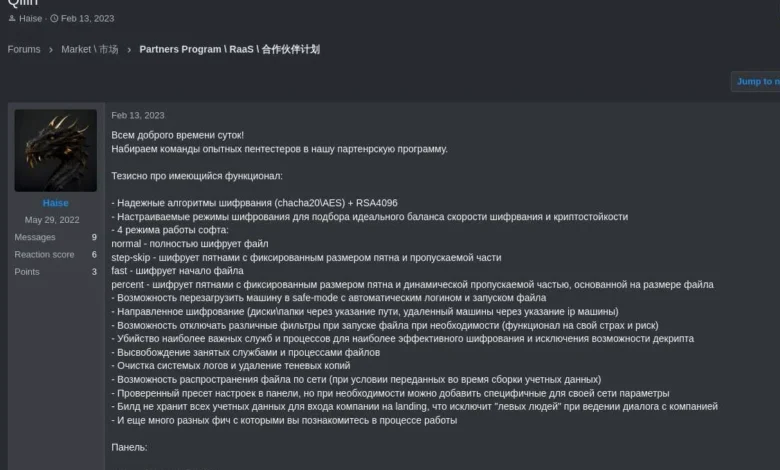
The cybercrime group Qilin has cemented its status as the world’s most prolific ransomware-as-a-service (RaaS) operation, yet the cloak of anonymity surrounding its leadership has finally begun to fray. Through a meticulous trail of operational security lapses, outdated digital aliases, and data points harvested from multiple high-profile leaks, investigators have linked the administrator of the group—operating under the pseudonym “Haise”—to a 36-year-old resident of St. Petersburg, Russia, identified as Aleksey Mikhailovich Yakovtsev.
The Rise of the Qilin Machine
Since its emergence in September 2022, Qilin has fundamentally altered the landscape of digital extortion. According to recent intelligence reports from the NCC Group, the organization has been staggeringly productive, claiming at least 365 victim organizations within the last quarter alone. Qilin operates on a "double extortion" model, a tactic that has become the gold standard for modern cyber-syndicates. Affiliates infiltrate corporate networks, exfiltrate sensitive data, and subsequently encrypt critical systems, threatening to leak the stolen information on a dedicated site if the ransom demands are not met.
Unlike many of its contemporaries in the Russian cyber-underground, which often restrict their recruitment to native Russian speakers, Qilin has actively courted English-speaking affiliates. This aggressive expansion strategy has facilitated partnerships with notorious threat actors, including the prolific Scattered Spider and the RansomHub group. By offering an industry-leading payout—frequently exceeding 80 percent of the extorted funds—Qilin has successfully incentivized a global network of cyber-criminals to execute attacks on their behalf.
Tracing the Digital Breadcrumbs: A Chronology of Failure
The de-anonymization of the individual behind Haise was not the result of a single catastrophic error, but rather the cumulative effect of a decade of digital activity. Cyber-criminals frequently rotate handles to compartmentalize their illicit activities, a process known as operational security (opsec). However, the necessity of building credibility on established cybercrime forums often forces individuals to reference their older, compromised identities.

The timeline of the investigation reveals a multi-year progression:
- 2013–2014: Early travel records indicate Aleksey Yakovtsev was flying between St. Petersburg and Murmansk, establishing a baseline for his physical location and identity.
- 2018–2019: The individual began engaging in lower-level cyber-activity, likely as an arbitrageur and participant in credit card fraud schemes. During this period, the handle "Rjun" began to emerge across various Russian-language forums.
- 2020: The alias "Rjun" began utilizing the Telegram handle "Alexbigboss44," a moniker that would eventually become synonymous with high-volume acquisition of compromised Facebook logs and Google Ads accounts.
- June 2022: The transition to major ransomware operations began in earnest when the user applied for membership at RAMP, a prestigious, invitation-only forum. It was here that the user officially adopted the handle "Haise."
- January 2026: The FBI’s seizure of the RAMP forum provided intelligence agencies and cybersecurity firms with a treasure trove of direct messages, linking Haise to the older Alexbigboss44 account.
The Intersection of Public Data and Illicit Activity
The pivot point in this investigation involved the email address [email protected]. Security researchers at Spycloud and Constella Intelligence discovered that this specific email was registered to several forums under the handle "Rjun." Critically, this address was also present in the massive 2025 data breach of gosuslugi.ru, the Russian Federation’s official government services portal. The leak, which exposed the personal information of over 20 million citizens, provided a verifiable link between the email address and Aleksey Mikhailovich Yakovtsev.
Further forensic analysis by IntelHawk, which utilizes stylometry and historical pattern matching, solidified the connection. The analysis traced the evolution of the actor’s technical proficiency, moving from basic botnet management in 2020 to the complex, multi-layered ransomware infrastructure of 2023. Additional evidence, including the reuse of a family member’s phone number (+79602347275) for account registration, confirmed the identity beyond a reasonable doubt.
Broader Implications for Ransomware-as-a-Service
The identification of Yakovtsev serves as a stark reminder of the limitations of anonymity for even the most sophisticated cyber-operators. While ransomware gangs often benefit from the perceived protection of the Russian legal system, their reliance on global, interconnected digital infrastructure makes them vulnerable to "doxing" by researchers and intelligence firms.
The implications of this exposure are threefold:

- Disruption of Command: The exposure of an administrator’s real-world identity often leads to the immediate retirement or rebranding of a ransomware group. As the pressure mounts, the internal trust within the affiliate network may collapse, potentially leading to a fragmentation of Qilin’s operations.
- Increased Scrutiny: With a face and name attached to the Qilin brand, international law enforcement agencies may escalate the tracking of Yakovtsev’s assets, travel, and financial movements, even if extradition remains politically difficult.
- The End of "Safe" Havens: The success of the de-anonymization effort underscores the efficacy of cross-referencing public breach data with illicit forum activity. As more state-run portals and databases are compromised, the ability for threat actors to maintain historical digital distance from their current personas diminishes significantly.
The Human Element and Future Outlook
Despite the technical depth of the evidence, the human element remains central to the narrative. The transition from a small-time fraudster managing social media logs to the lead architect of an international ransomware syndicate is a trajectory frequently observed in the evolving cyber-threat landscape. However, Yakovtsev’s inability to fully scrub his digital footprint—specifically his reuse of personal contact information and travel records—allowed researchers to bridge the gap between his online persona and his physical reality.
As of the latest reports, attempts to reach Yakovtsev for comment have been unsuccessful. The case continues to serve as a high-profile case study for the cybersecurity community, demonstrating that even the most "industrial" ransomware gangs are susceptible to the classic failures of operational security. For the victims of Qilin, the identification of Haise offers a degree of accountability, though it remains to be seen whether this revelation will translate into a decrease in the group’s malicious activity.
The success of this investigation was bolstered by the collaborative efforts of multiple intelligence platforms, including Intel 471, Flashpoint, and IntelHawk, alongside independent researchers like GangExposed. By synthesizing disparate data points—from Telegram user IDs and airline records to forum registration history—the cybersecurity community has effectively stripped away the veil of the "Haise" persona. As the digital net tightens, the future of the Qilin operation appears increasingly precarious, marking yet another victory for attribution in an era of persistent digital conflict.