How Python and the Olostep Batch API Enabled Developers to Scrape 10,000 Web Pages in Minutes

In the contemporary landscape of big data and artificial intelligence, the ability to rapidly aggregate, process, and ingest unstructured web content has transformed from a competitive advantage into a fundamental operational necessity. Enterprise applications, large-scale machine learning models, rigorous market research initiatives, and automated price-monitoring systems continuously demand vast ingestion pipelines. Yet, the engineering bottleneck has historically remained constant: scaling web scrapers to process tens of thousands of pages reliably without triggering rate limits, incurring catastrophic timeouts, or succumbing to network degradation.
Traditional single-request scraping architectures quickly bog down when tasked with harvesting thousands of distinct Uniform Resource Locators (URLs). Network latency, server-side throttling, asynchronous thread management overhead, and intermittent dropped connections turn what should be straightforward data collection tasks into multi-hour engineering hurdles. To address these systemic inefficiencies, developers have increasingly turned to specialized batch-processing interfaces designed to offload infrastructure burdens to managed web data platforms.
A recent empirical test utilizing Python 3.13.15, the Olostep SDK 1.2.2, and the Olostep Batch API sought to quantify the operational limits of high-throughput web scraping. By targeting 10,000 unique documentation pages hosted on the Mozilla Developer Network (MDN), engineers measured not merely the raw extraction velocity, but the end-to-end viability of managing massive data pipelines from initial sitemap ingestion to final file verification.
Main Facts and Architectural Overview
The core objective of the technical evaluation was to stress-test the Olostep Batch API’s capacity to handle a substantial payload of 10,000 discrete URLs in a single execution batch. Rather than sequentially dispatching thousands of individual Hypertext Transfer Protocol (HTTP) GET requests—a methodology prone to latency accumulation and IP blacklisting—the batch architecture abstracts the queuing, throttling, and execution layers.
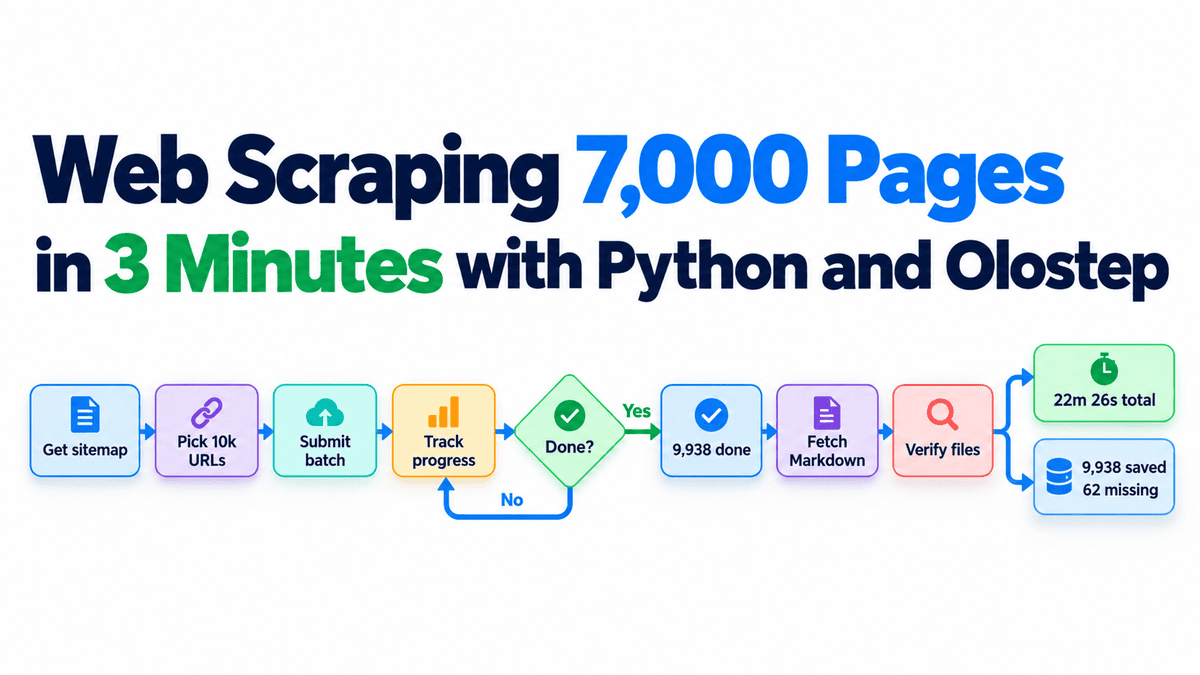
For the purposes of the experiment, researchers isolated MDN documentation as the benchmark domain due to its clean structural markup, predictable hierarchy, and high volume of technical articles. The complete workflow comprised six distinct phases:
- Environment configuration and SDK initialization.
- Sitemap acquisition, XML parsing, and randomized dataset generation of 10,000 unique documentation targets.
- Batch submission to the API endpoint coupled with real-time polling via asynchronous monitoring loops.
- Concurrent retrieval of completed markdown content utilizing localized concurrency caps.
- Systematic verification of saved files, identifying persistent gaps or downstream retrieval errors.
- Manifest generation and final statistical summary compilation.
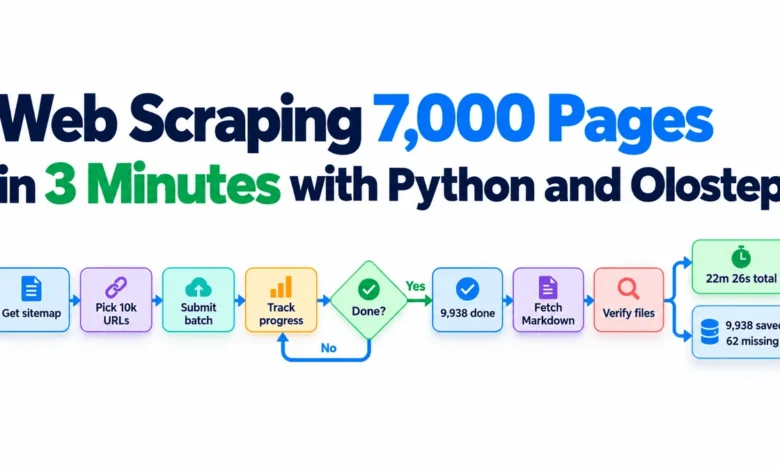
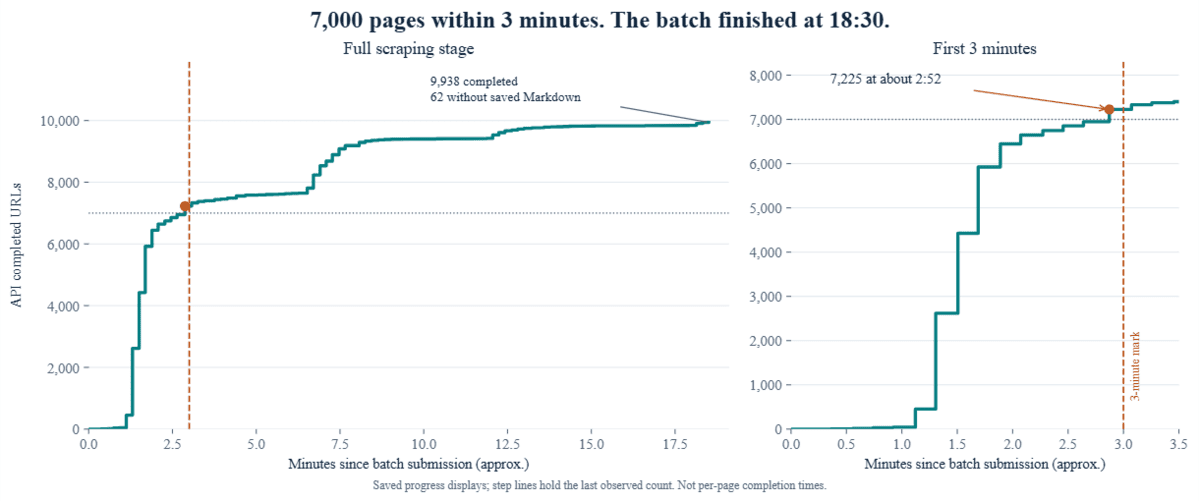
The experiment revealed a stark dichotomy between initial throughput and total pipeline completion time. While the infrastructure demonstrated blistering speeds during the opening minutes of execution—processing more than 7,000 pages in under three minutes—the total lifecycle of the operation, including post-processing, validation, and edge-case retries, spanned over 22 minutes.
Chronology and Operational Timeline
Understanding the temporal dynamics of large-scale web extraction requires examining the lifecycle of a batch job from conception to archival. The process initiated with the programmatic fetching of the official MDN XML sitemap, compressed via GNUzip, which housed hundreds of thousands of potential target links.
By applying a deterministic random seed to eliminate selection bias, engineers extracted a precise subset of 10,000 unique URLs conforming to the https://developer.mozilla.org/en-US/docs/ namespace. These targets were serialized into a local CSV manifest accompanied by a cryptographic SHA-256 fingerprint to ensure dataset integrity across subsequent runs.
Upon submission of the JSON payload containing the 10,000 endpoints, the Olostep client returned a unique batch identifier, allowing asynchronous tracking loops to query progress metrics at fixed intervals. The chronological breakdown of the execution unfolded as follows:
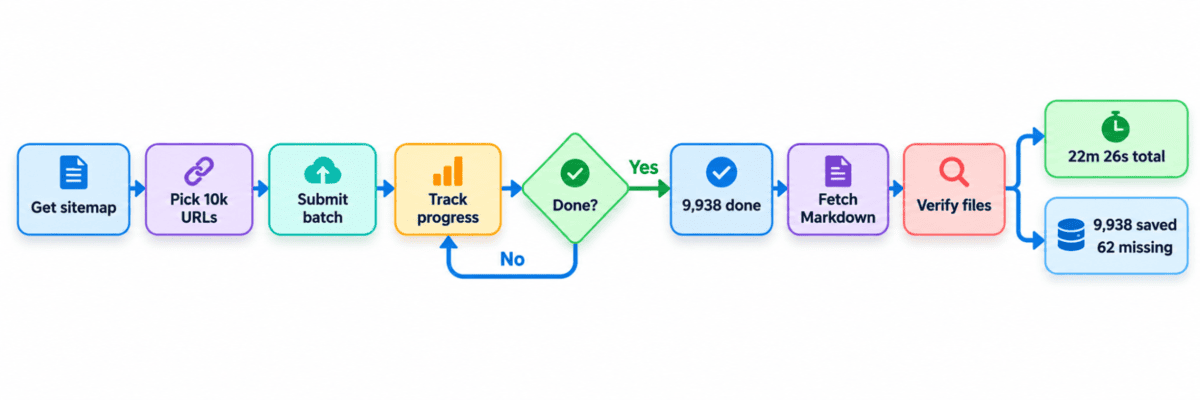
- T+00:00 (Initialization and Submission): The batch was successfully registered within the API ecosystem. Local progress monitors initiated polling protocols to track
completed_urlscounters against the target ceiling of 10,000. - T+02:52 (The Velocity Peak): Within approximately 172 seconds of initialization, the platform reported 7,225 successfully processed pages. This phase showcased the peak capability of parallelized cloud workers executing upstream extraction tasks concurrently.
- T+18:30 (Tail-End Latency and Completion): The rate of completion experienced a noticeable deceleration as the batch approached its final percentage points. The status flag transitioned to "completed" after roughly 18 minutes and 30 seconds, with 9,938 pages successfully processed by the remote infrastructure.
- T+22:26 (Download and Verification Finalization): Following the completion of remote scraping, local execution threads utilized a 96-semaphore concurrency limit to pull markdown payloads via retrieve endpoints. Accounting for file writing, network overhead, and checksum validations, the entire pipeline concluded at 22 minutes and 26 seconds.
Supporting Data and Performance Metrics
Quantitative analysis of the final output metrics provides vital insights for data engineers designing enterprise ingestion systems. Out of the 10,000 requested URLs, exactly 9,938 files were successfully compiled, formatted as clean markdown documents, and written to local storage. This yielded an overall success rate of 99.38%.
However, the remaining 62 URLs resulted in missing artifacts or unretrievable states, illustrating a critical tenet of distributed data engineering: a batch completion status reported by an API does not guarantee a 100% yield of valid local files. Network anomalies, transient HTTP 5xx server errors, rate-limiting interventions by target origins, or malformed source pages can cause localized attrition.
  "batch_id": "batch_sample_identifier_9938",
  "requested": 10000,
  "batch_status": "completed",
  "api_completed_urls": 9938,
  "saved_markdown": 9938,
  "missing_markdown": 62,
  "all_saved": false,
  "scrape_seconds": 1110.0,
  "download_seconds": 145.0,
  "total_seconds": 1346.0
The data underscores the necessity of robust manifest generation and automated error logging. By cross-referencing successful writes against the original dataset fingerprint, engineers can isolate failed nodes and re-queue them in subsequent micro-batches without invalidating the entire corpus. Furthermore, concurrency tuning played a pivotal role during the download phase; capping simultaneous retrieval requests at 96 prevented socket exhaustion while maximizing local bandwidth utilization.
Industry Background and Enterprise Implications
The evolution of web scraping from bespoke script-writing to enterprise-grade data infrastructure reflects the broader maturation of the artificial intelligence sector. As foundational large language models (LLMs), retrieval-augmented generation (RAG) systems, and specialized vertical search engines demand ever-larger corpora of clean, parseable text, the plumbing of data acquisition has come under intense scrutiny.
Historically, organizations relied on in-house scraping clusters built on frameworks like Scrapy or Selenium, deployed across fleets of virtual private servers equipped with rotating proxy pools. While highly customizable, these legacy architectures impose substantial maintenance overhead. Engineering teams must continuously update parsing logic to match modern JavaScript-heavy frontend frameworks, manage IP reputation scores to circumvent anti-bot firewalls, and manually scale infrastructure up or down based on data pipeline schedules.
Managed batch APIs represent a paradigm shift toward infrastructure-as-a-service models tailored specifically for web data extraction. By abstracting proxy management, headless browser rendering, and dynamic worker allocation, platforms like Olostep position themselves as foundational data pipelines for corporate intelligence. Industry observers note that enterprise workloads frequently require processing upwards of 100,000 pages within tight operational windows—benchmarks that modern batch infrastructures claim to achieve in under half an hour.
Analytical Implications for Data Pipelines
The findings from the 10,000-page MDN extraction test carry several immediate takeaways for software architects and data scientists designing production-grade ingestion frameworks:
- Beware the Mirage of Initial Throughput: Benchmarking web scraping performance solely on the speed of the first few thousand pages can lead to skewed capacity planning. Distributed cloud workers often encounter complex, heavy, or unresponsive target pages toward the tail end of a batch, causing execution curves to plateau.
- Idempotency and Checkpointing Are Non-Negotiable: Long-running asynchronous jobs are inherently vulnerable to network disruptions, local power failures, or script crashes. Implementing robust state-saving mechanisms—such as persisting batch IDs, URL SHA-256 fingerprints, and incremental write queues—ensures that pipelines can resume seamlessly without incurring redundant API credit consumption.
- Validation Outweighs Raw Speed: Collecting data is only half the battle; ensuring its structural integrity is paramount. Automated pipelines must incorporate post-processing verification checks that inspect file payloads for emptiness, validate character encodings, and generate exception manifests for failed endpoints.
- Credit Consumption Awareness: Managed batch APIs operate on transactional pricing models where submission equates to credit expenditure. Developers must institute rigorous pre-flight validation checks on input datasets to prevent wasting financial resources on malformed, duplicate, or dead URLs.
Ultimately, while high-level abstractions and managed APIs significantly lower the barrier to entry for large-scale web data extraction, engineering rigor remains essential. Success in enterprise data pipelines is measured not merely by how fast the first 7,000 pages can be gathered in three minutes, but by the reliability, completeness, and cleanliness of the final dataset delivered at the end of the run.