Critical Memory Corruption Flaw in Google Brotli Decoder Exposes Global Infrastructure to Potential Remote Code Execution

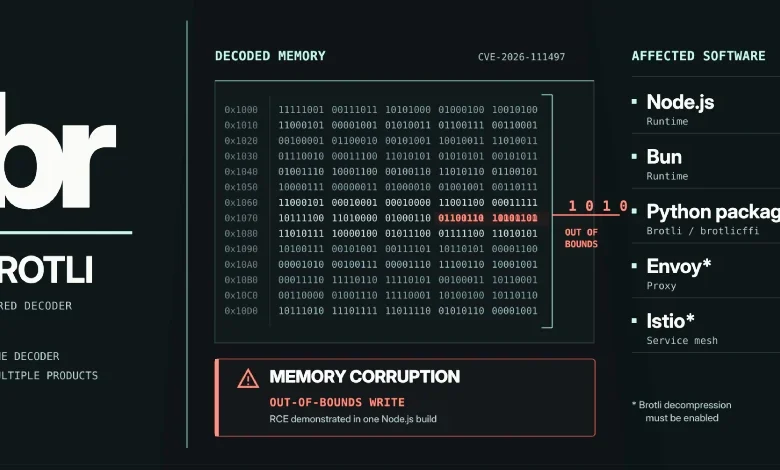
A severe memory-corruption vulnerability, cataloged as CVE-2026-111497, has emerged as a significant threat to the software supply chain, affecting a wide array of critical internet infrastructure components. The flaw resides within the widely used Google Brotli compression library—specifically within the C-based decoder—creating a ripple effect across modern web runtimes, proxies, and language-specific packages. Because the Brotli format is a cornerstone of modern web performance, utilized to reduce the size of data transmitted between servers and clients, the vulnerability is uniquely positioned to affect both the "client-side" of web communications and the "server-side" processing of incoming traffic.
The vulnerability stems from an improper handling of crafted, malicious compressed data streams. When a vulnerable decoder attempts to process these malformed streams, the logic error triggers a buffer overflow, allowing data to overwrite memory segments beyond designated boundaries. Depending on the complexity of the host application, this corruption can result in service crashes, memory leaks, or, most alarmingly, the execution of arbitrary, attacker-controlled code (RCE).
A Chronology of the Discovery and Remediation
The history of this vulnerability is characterized by an unusual disconnect between code maintenance and security disclosure. While the root cause of the flaw was addressed in the official Google Brotli source code on February 27, 2026, the fix was not packaged into a formal, versioned release until October 21, 2026. This delay meant that for several months, the security patch remained "dormant" in the source repository, unbeknownst to the thousands of downstream maintainers who rely on stable releases to build their own software.
The security implications were finally identified by researchers Khai Tran and Sylvie Mayer from OpenAI’s Codex Security team. Their discovery prompted a coordinated disclosure effort. On October 21, 2026, the vulnerability was officially brought to light. This triggered a frantic patching cycle across the ecosystem, as critical platforms like Node.js, Bun, and Envoy recognized the inherent risk to their users. Since that date, various vendors have released updates, but the fragmented nature of the Brotli library—where each product effectively bundles its own copy of the decoder—has turned the remediation process into a complex, multi-layered undertaking.
Scope of the Impact: From Runtimes to Proxies
The ubiquity of the Brotli algorithm means the impact is not confined to one specific domain. The vulnerability manifests differently depending on how the host software consumes compressed data.

In the context of language runtimes like Node.js and Bun, the risk is most acute when these runtimes are used to perform HTTP requests. When a server fetches a response from an untrusted source, or when a web application processes an incoming request body—such as a file upload handled by middleware like Express or body-parser—the decoder is triggered. If an attacker controls the compressed payload, they can potentially trigger the RCE vulnerability.
Infrastructure components like Envoy and Istio, which function as service meshes and API gateways, are also at risk. These tools are frequently tasked with decompressing traffic to inspect or modify headers and payloads. If a company has enabled Brotli decompression within these proxies, they become a prime target for attackers attempting to compromise the network perimeter.
Furthermore, the impact extends to the Python ecosystem. The Brotli and brotlicffi packages, which are commonly installed as dependencies, automatically handle decompression for popular HTTP libraries like requests, urllib3, and aiohttp. This means that even if a developer does not explicitly invoke a Brotli function in their code, simply having the library installed can introduce a silent, exploitable surface in their application.
Technical Analysis and Risk Assessment
The vulnerability is classified under the Common Vulnerabilities and Exposures (CVE) system as a critical security concern, though industry consensus on its severity varies. Google, the maintainer of the Brotli library, assigned the flaw a CVSS 4.0 score of 9.2, citing the high potential for remote exploitation. Conversely, Red Hat has evaluated the risk as "Important" with a score of 8.1, reflecting a more cautious interpretation of the difficulty required to weaponize the exploit in real-world scenarios.
Research conducted by the Imperva Red Team, which dubbed the exploit vector "Node2Shell," has demonstrated that it is possible to execute arbitrary code on a default Node.js 24.22.0 build. While their proof-of-concept was limited to a specific hardware environment (ARM64 Linux) and has not been publicly released, the demonstration confirms the theoretical viability of the attack.
The mechanism works in two directions. An unpatched server accepting compressed input can be compromised by a malicious client, while an unpatched client (such as a CLI tool performing a request) can be compromised by a malicious server. This bidirectional nature of the threat is particularly dangerous for automated CI/CD pipelines, which frequently pull dependencies or source code from external, potentially untrusted mirrors.

Official Responses and Mitigation Challenges
The remediation of CVE-2026-111497 is non-trivial. Because the vulnerable code is embedded within the binaries or libraries of disparate software products, a "one-size-fits-all" patch does not exist. Users must manually update each individual product to its latest, patched version.
For many organizations, this necessitates an audit of their entire software bill of materials (SBOM). For example, while Node.js users are directed to upgrade to versions 22.23.4, 24.22.1, or 26.12.1, Python developers must ensure that their environment uses the updated 1.2.1 versions of the Brotli or brotlicffi libraries. Simply updating the operating system’s global libraries may not be sufficient if an application uses statically linked versions or bundled dependencies within container images.
Security professionals have noted that Web Application Firewalls (WAFs) offer only limited protection. While some providers like Vercel have implemented perimeter rules to block suspicious traffic, these protections often fail to cover "internal" or "outbound" fetches where a function might retrieve data from a compromised upstream server. Consequently, patching the application layer remains the only definitive method to eliminate the risk.
Broader Implications for Software Supply Chain Security
The saga of CVE-2026-111497 serves as a stark reminder of the "brittleness" inherent in modern software ecosystems. When a single underlying library—in this case, the C code for Brotli—is reused across dozens of independent projects, a security flaw in that library effectively becomes a "force multiplier" for attackers. The fact that the vulnerability was known in the source code for months before being properly released as a patch highlights a systemic failure in how upstream-to-downstream communication is handled in open-source development.
The event has prompted calls for more rigorous dependency scanning and better communication protocols between foundational libraries and the platforms that consume them. As of late October 2026, while the Cybersecurity and Infrastructure Security Agency (CISA) has reported no evidence of active, in-the-wild exploitation, the technical community remains on high alert. The lack of a reliable, public exploit code has likely prevented widespread damage so far, but security analysts warn that the window of opportunity is closing as reverse engineers work to understand the fix and reconstruct the exploit.
For now, the mandate for IT administrators and developers is clear: identify any system utilizing the Brotli decoder, cross-reference the installed versions against the patched releases, and prioritize the deployment of these updates. Given the potential for remote code execution, this is not a task to be relegated to the next maintenance cycle. As the threat landscape continues to evolve, the resilience of the global web infrastructure will depend on the speed and precision of these manual interventions, underscoring the vital, yet often invisible, role that low-level library maintenance plays in the security of the internet.
Related posts: