The Evolving Landscape of Social Media in Government: Strategies, Challenges, and Future Directions

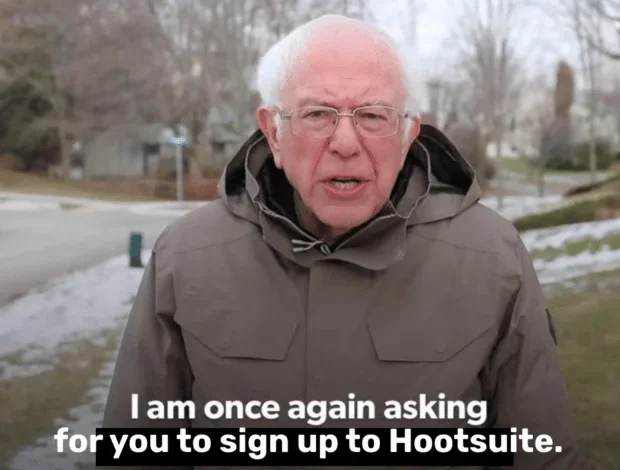
Governments worldwide are increasingly leveraging social media platforms to engage with citizens, disseminate critical information, and foster transparency in an era of rapid digital transformation. These digital channels offer a direct conduit between public institutions and their constituents, fundamentally reshaping traditional models of civic communication and public administration. The shift represents a significant evolution from the unidirectional broadcasts of traditional media to dynamic, interactive dialogues, offering both unprecedented opportunities and complex challenges for public entities.

Enhanced Public Engagement and Transparency
Social media platforms have become indispensable tools for governments to maintain an informed populace and rebuild trust. With over half of U.S. adults now relying on social media for news, platforms such as TikTok, X (formerly Twitter), and Facebook enable public entities to reach citizens where they are already active. This direct engagement is crucial in countering declining public trust in traditional institutions; for instance, a 2025 Pew Research Center study revealed that only 17% of Americans consistently trust the government to do what is right. By actively participating in online dialogues, governments can demystify complex policies, solicit public feedback, and respond to community concerns in real-time, thereby fostering a sense of accountability and trust.
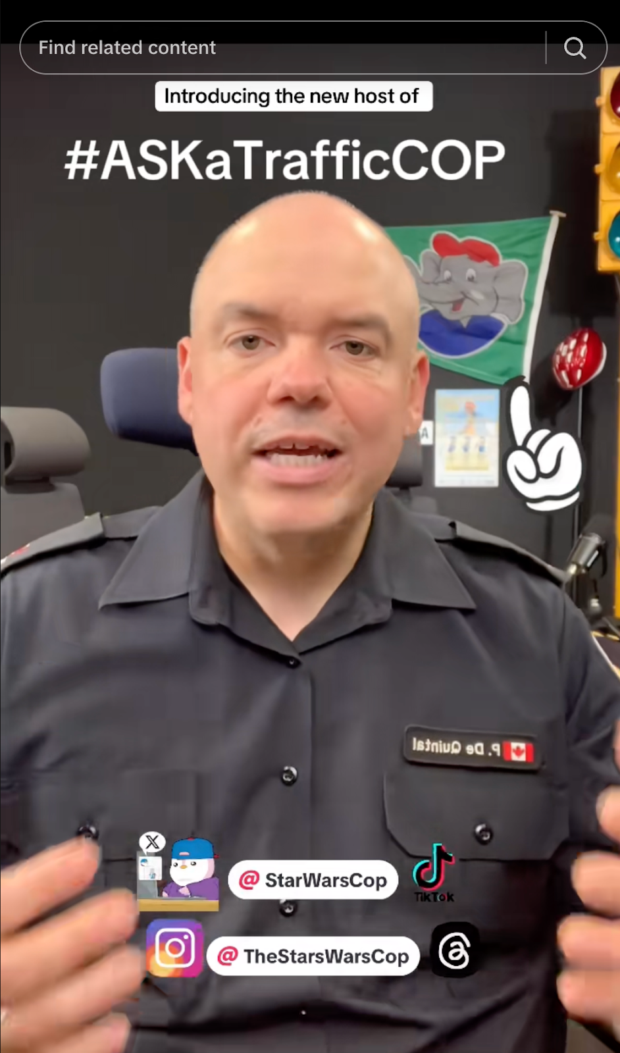
The Toronto Police Traffic Unit exemplifies this approach through regular "Ask Me Anything" (AMA) sessions on TikTok. A representative fields diverse questions, from "Can I drink coffee at a red light?" to "Are after-market steering wheels legal?", directly addressing everyday queries from citizens. This not only humanizes the police force but also clarifies traffic regulations in an accessible format. Similarly, platforms like Nextdoor facilitate hyperlocal engagement, enabling local governments to organize virtual town halls, educate residents on safety issues, and engage community groups directly at the neighborhood level. The key to success lies in genuine engagement, moving beyond mere broadcasting to foster two-way communication and responsive interaction.
Building Authentic Connections and Personal Branding
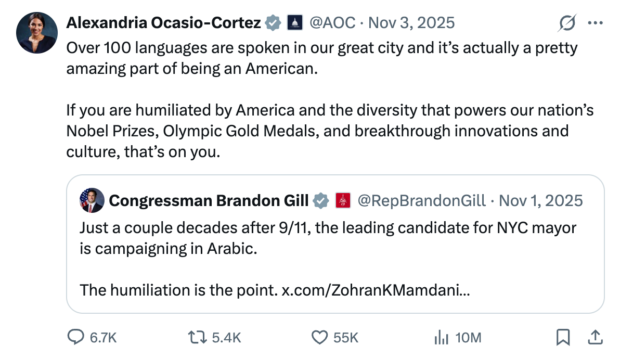
Beyond institutional communication, social media allows government officials to cultivate personal brands rooted in authenticity and transparency. This is particularly crucial in an environment where public figures are often perceived as distant or disingenuous. U.S. Representative Alexandria Ocasio-Cortez (AOC) is a prominent example, utilizing X (Twitter) to communicate directly with her constituents in an unvarnished, authentic voice, eschewing overly polished press releases or political jargon. Her approach has seen her X following grow from under 500,000 in 2018 to over 12 million by 2026, and she was notably the first person to reach 1 million followers on Bluesky, demonstrating the power of a genuine online presence. Such engagement not only makes politicians more accessible but also helps bridge the perceived gap between elected officials and the electorate, albeit with the inherent risk of public missteps. This personalization helps humanize governance, making abstract policies and decisions more relatable to the average citizen.
Critical Role in Crisis Communication
During times of crisis, social media platforms transform into vital conduits for rapid information dissemination and public reassurance. Citizens instinctively turn to these channels for immediate updates, guidance, and community support. Governments are consequently expected to serve as reliable sources of truth, countering the swift spread of misinformation. The COVID-19 pandemic starkly illustrated this challenge, with approximately 47% of surveyed U.S. adults reporting encounters with fabricated news about the crisis. The advent of sophisticated AI-generated content has only amplified this risk, making false narratives harder to detect and faster to propagate.
To mitigate this, government agencies are increasingly investing in social listening tools. These platforms enable monitoring of online conversations to identify emerging false narratives early and respond promptly with accurate information from official channels. While not every incorrect comment warrants a response, widespread misinformation necessitates clear, authoritative counter-messaging from official sources. The speed and reach of social media in these scenarios can be life-saving, but only if managed with precision and a commitment to factual accuracy.
Powering Political Campaigns and Policy Advocacy
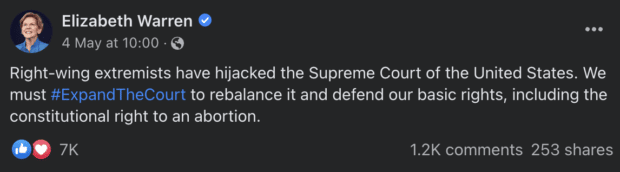
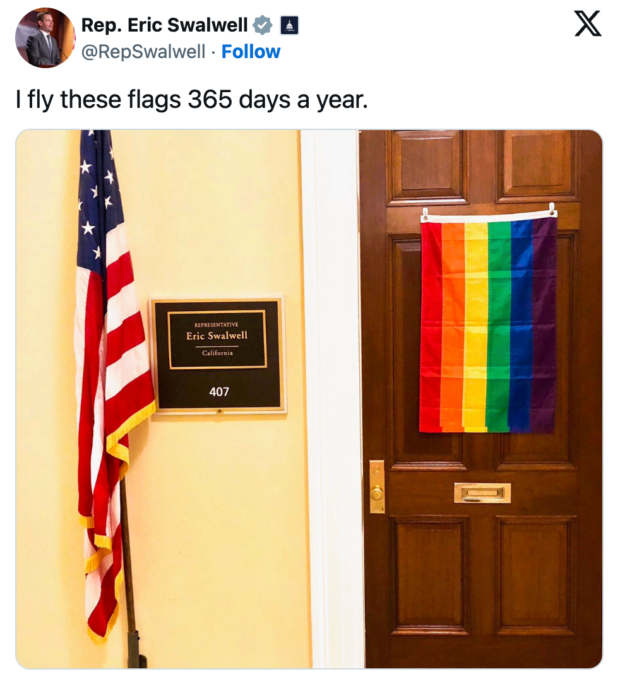
Social media has revolutionized political campaigning, offering a cost-effective and highly interactive "virtual town hall" for politicians to introduce initiatives, test messaging, and build public support. The immediate feedback loops and measurable engagement metrics on platforms allow campaigns to adapt their strategies in real-time, optimizing for maximum resonance with voters. Furthermore, these platforms enable politicians to align publicly with key issues and movements, such as Elizabeth Warren’s use of social media to reinforce her stance on the U.S. Roe v. Wade decision.
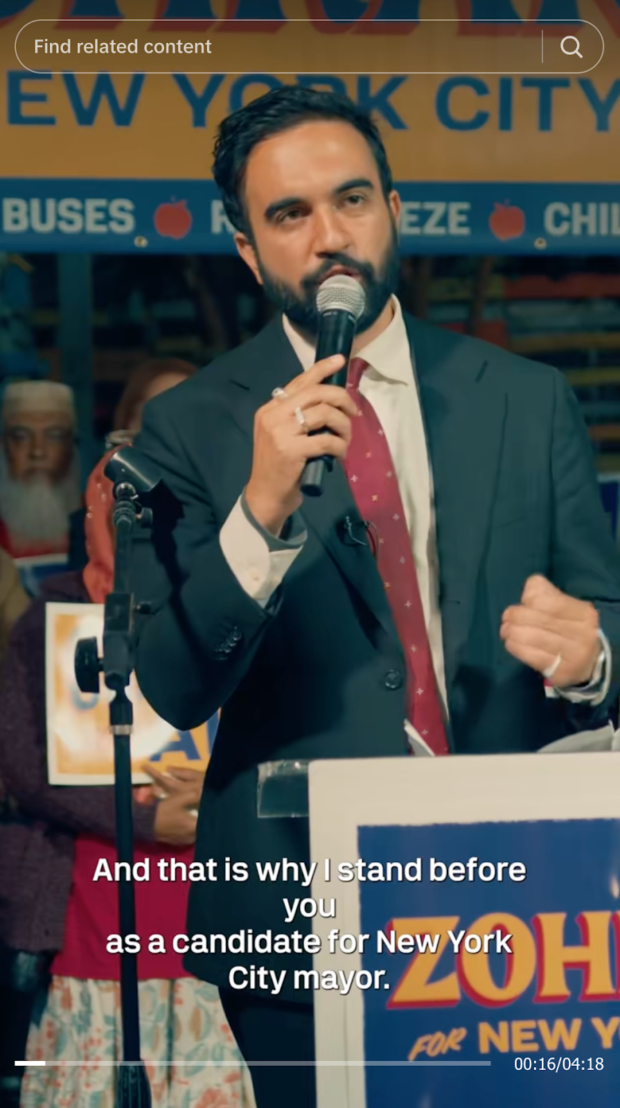
More recently, Zohran Mamdani’s 2025 New York City mayoral campaign showcased a highly successful TikTok-first strategy, demonstrating how platform-native content can translate online attention into significant real-world momentum, especially among younger demographics. This direct connection bypasses traditional media gatekeepers, allowing candidates to craft and control their narratives more effectively.
Cost-Effectiveness and Measurable Impact
The shift to digital communication has profoundly altered the economics of government outreach and political campaigning. Historically reliant on expensive traditional media like TV ads, newspaper placements, and door-to-door flyers, governments now benefit from social media’s comparatively low cost and unparalleled measurability. The 2024 U.S. election cycle saw political advertisers spend over $1.3 billion on digital advertising across Google and Meta alone, underscoring the channel’s dominance. This investment is driven by the ability to track performance meticulously, evaluate campaign efficacy, and demonstrate a tangible return on investment, allowing for more strategic allocation of public funds or campaign budgets. Performance metrics, such as engagement rates, reach, and conversion rates (e.g., voter registration, event attendance), provide clear data points for assessing campaign success and refining future strategies.
Organizational Framework: Who Manages Government Social Media?
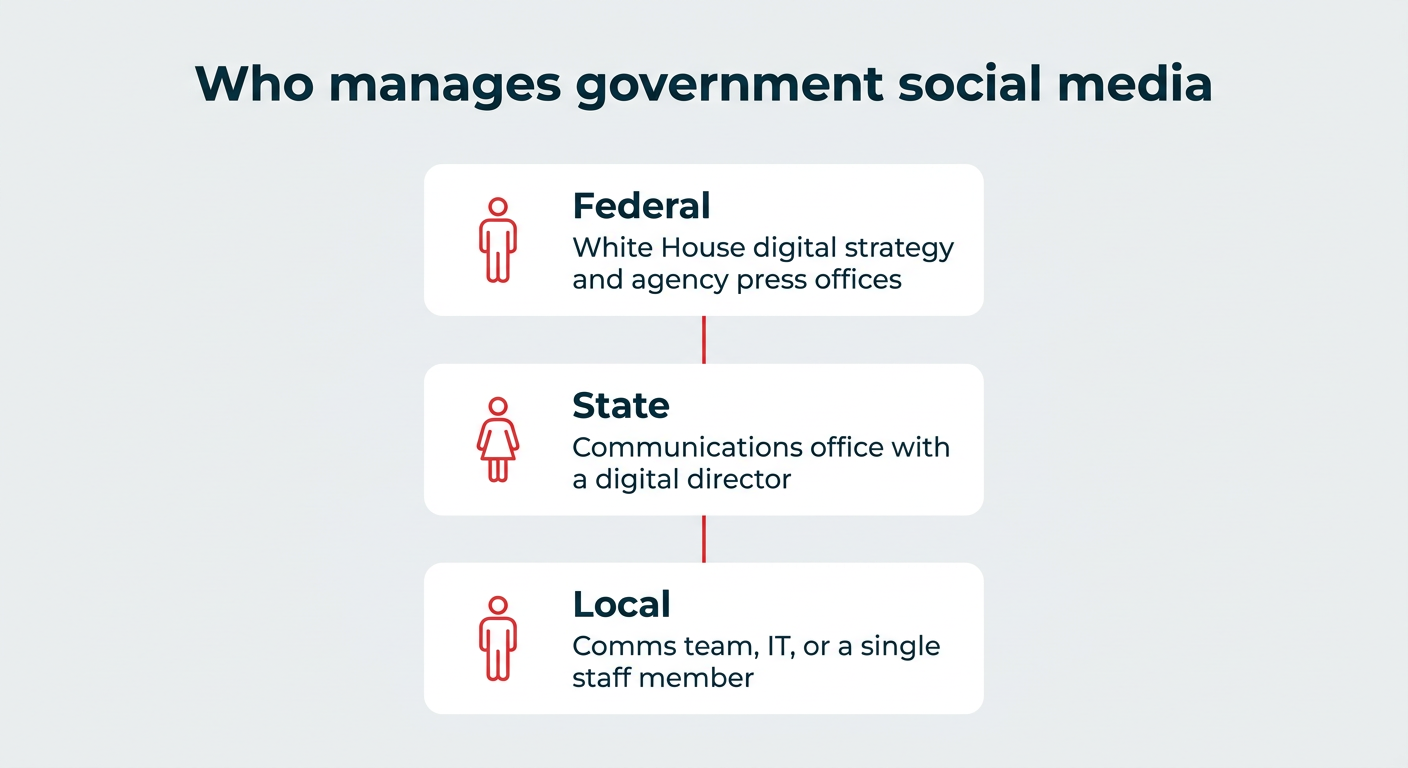
The management of government social media accounts typically falls under public affairs or communications teams, though the exact structure varies significantly based on the governmental level and agency size. It is rarely the work of a single individual posting freely; instead, it involves a small group of dedicated staff operating within stringent approval and compliance frameworks.
- Federal Level: Often overseen by offices such as the White House Office of Digital Strategy, coordinating communications across various federal departments and agencies. These teams manage high-profile accounts, ensuring message consistency and adherence to national policy, often involving layers of approval before publication.
- State Level: State governments usually have dedicated communications departments or press offices responsible for managing official social media presences, informing citizens about state-wide initiatives, laws, and services. They balance broad public messaging with localized information.
- Local Level: Municipal and county governments often integrate social media management into broader communications or IT departments, focusing on hyperlocal updates, community events, and emergency alerts. Staff members often wear multiple hats, necessitating clear guidelines and centralized tools.
Across all levels, there’s a clear trend towards professionalizing social media roles, acknowledging its central importance in modern public communication and crisis response, moving beyond treating it as an auxiliary function. This includes investing in specialized training and dedicated personnel.

The Multi-Platform Landscape: Strategic Choices in 2026
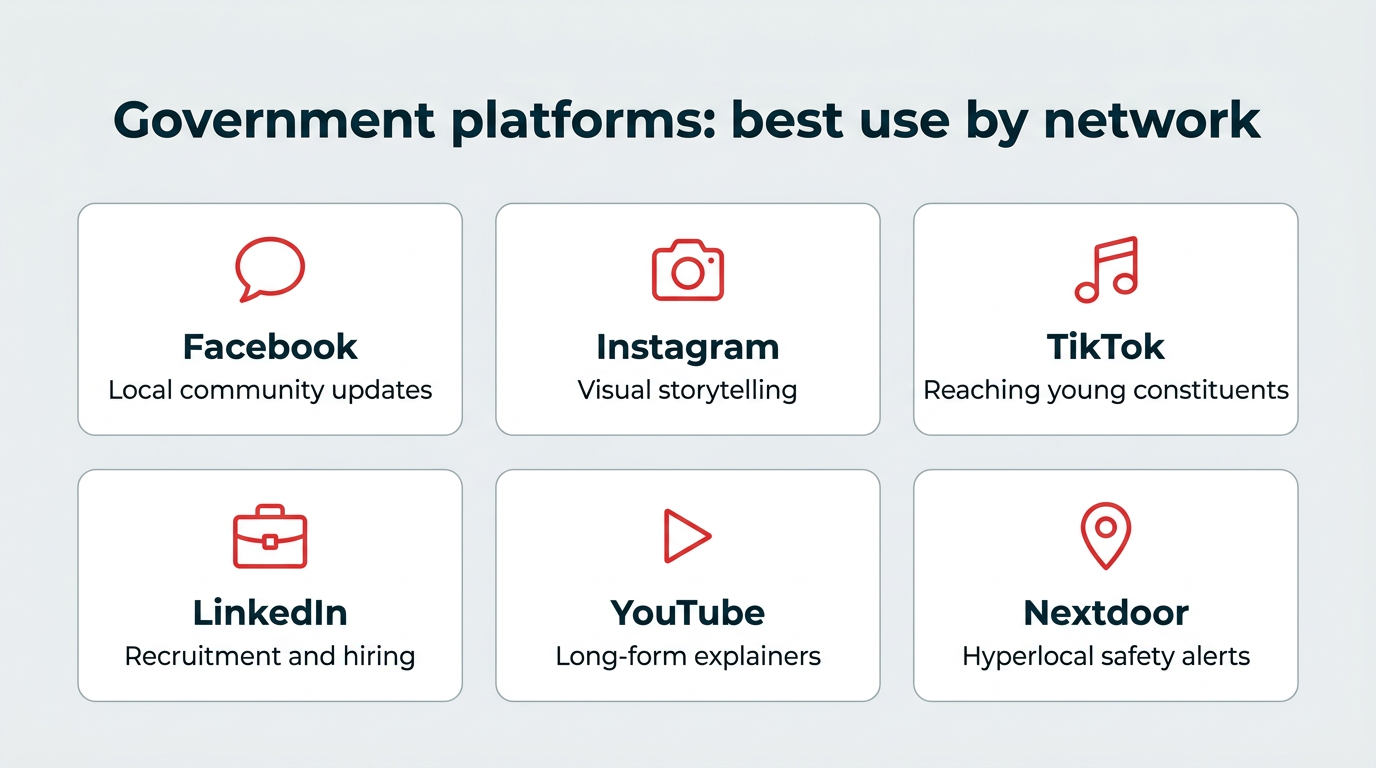
Government agencies in 2026 employ a diverse array of social platforms, with selection guided by target audience demographics and communication objectives. The landscape is dynamic, with established platforms retaining core functions while newer networks emerge as alternatives.
- Facebook: Remains the primary workhorse for municipal and local government, offering broad reach for community notices, event promotion, and general updates, largely catering to an older-skewing demographic.
- X (formerly Twitter): Historically crucial for real-time alerts and breaking news, its landscape has shifted significantly in terms of reach and content moderation, leading many agencies to explore alternatives for official announcements.
- Instagram: A vital platform for visual storytelling, showcasing government programs and campaigns, particularly effective with Millennials and Gen Z. Reels, short-form video content, currently drive the most reach and engagement.
- TikTok: Increasingly utilized for engaging younger constituents and raising awareness, particularly among Gen Z. Agencies must navigate evolving regulatory scrutiny regarding its use by government entities.
- LinkedIn: Essential for recruitment, workforce development initiatives, and establishing thought leadership within professional communities, targeting professionals and job seekers.
- Threads & Bluesky: These newer text-based platforms are gaining traction as alternatives to X, drawing agencies seeking more stable environments for community engagement and transparent updates, particularly among early adopters and journalists.
- YouTube: Indispensable for long-form video content, archiving public hearings, and detailed explanatory videos, serving a broad age demographic with searchable content.
- Nextdoor: A purpose-built platform for hyperlocal engagement, facilitating community safety alerts, town halls, and direct communication with local residents.
A