The AI Era Demands Permission: Stepping Through the Uncharted Door of Transformation

The advent of Artificial Intelligence has fundamentally altered the landscape of personal and professional development, erasing many traditional excuses for stagnation and presenting a unique opportunity for radical change. This seismic shift, akin to stepping through a newly opened door, offers unprecedented access to expertise, efficiency, and innovation, yet its implications extend far beyond the immediate technological advancements. As AI democratizes access to capabilities once reserved for the elite, the true barrier to progress has shifted from a lack of resources or skills to an individual’s internal willingness to embrace the unknown.
The AI Revolution: A Door Thrown Open
At 17, the author embarked on a transformative journey, leaving home for college. This act, fraught with a mixture of terror and excitement, represented the first deliberate step through a door into the unfamiliar. This experience mirrors the current moment, where Artificial Intelligence has collectively flung open a door for humanity, ushering in an era of profound potential and inherent uncertainty. The critical challenge, however, is that few are actively discussing what lies beyond this threshold.
AI is not a deceptive illusion; its gifts are tangible and measurable. Yet, these gifts lead to a vast, uncharted territory.

The Four Gifts of AI
Artificial Intelligence bestows four primary advantages that are reshaping industries and individual capabilities:
1. Unearned Expertise: Bridging the Skill Gap
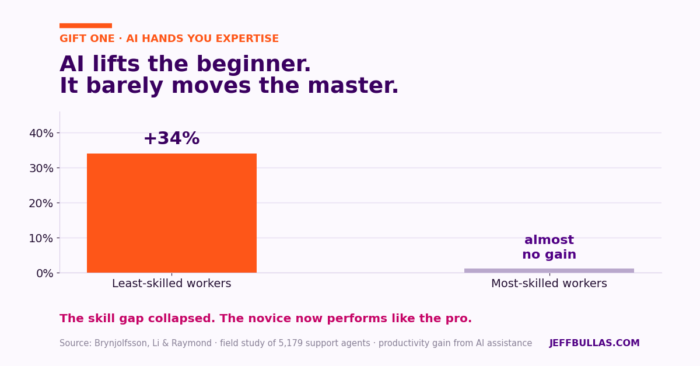
A landmark study conducted by researchers at Stanford and MIT, involving over 5,000 customer support professionals, revealed the profound impact of AI assistants on productivity. While overall productivity saw an average increase of 14%, the most significant gains—a remarkable 34% improvement—were observed among the least skilled workers. Conversely, the most experienced employees showed minimal gains. This data, published by the National Bureau of Economic Research (NBER), highlights AI’s role as a powerful equalizer, democratizing access to high-level performance. The implication is clear: AI acts as a potent mentor, rapidly elevating those at the beginning of their learning curve, while experienced individuals may find their established methods augmented rather than revolutionized. This phenomenon suggests a recalibration of what constitutes "expertise" and a potential flattening of traditional hierarchical skill structures.
2. The Demise of Friction: Accelerated Creation
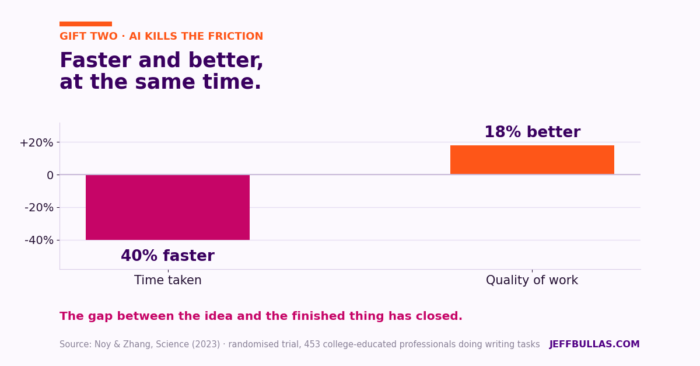
Research published in the journal Science further underscores AI’s transformative power. In a controlled trial with 453 professionals tasked with writing assignments, those utilizing ChatGPT experienced a 40% reduction in time spent and an 18% increase in work quality. This dual improvement—faster and better—effectively collapses the distance between conceptualization and completion. The friction points in creative and productive processes are being systematically dismantled, enabling individuals to bring ideas to fruition with unprecedented speed and efficacy. This accelerated cycle of ideation and execution has significant implications for innovation timelines and the overall output capacity of individuals and organizations.
3. Complexity Collapse: Simplifying the Intricate
Tasks that once demanded extensive teams, substantial budgets, and years of specialized training are now achievable within an afternoon with a well-crafted prompt. AI’s ability to process vast amounts of information and execute complex operations has dramatically simplified intricate workflows. What was once considered a formidable challenge has become an accessible endeavor. This democratization of complex problem-solving has the potential to disrupt established industries and empower individuals to tackle projects previously out of reach. The barrier to entry for sophisticated work has been significantly lowered, fostering a new wave of accessible innovation.
4. The Unnamed Gift: Permission to Embark
Perhaps the most profound, yet often overlooked, gift of AI is the freedom it grants individuals to pursue their own ventures. Traditional obstacles such as lack of capital, insufficient skills, no established team, limited time, or uncertainty about where to begin have been systematically eroded by AI’s capabilities. These barriers, once formidable, have been rendered almost obsolete. The challenge now is not a lack of tools or knowledge, but rather a deficit of personal permission. The internal psychological barrier to self-initiation has become the primary hurdle.
The Internal Gatekeeper: Permission and Action
The ultimate barrier to transformation lies not in external constraints but within one’s own mind. The sentiment that "everything standing in your way is behind your own eyes" becomes paramount. The gate to progress has two essential steps: granting oneself permission and then taking action. Inaction, however well-intentioned, results in the death of promising ideas. This internal gate, the decision to act, is the sole domain that machines cannot unlock for individuals.
The Unmentioned Consequence: A Crowded Room
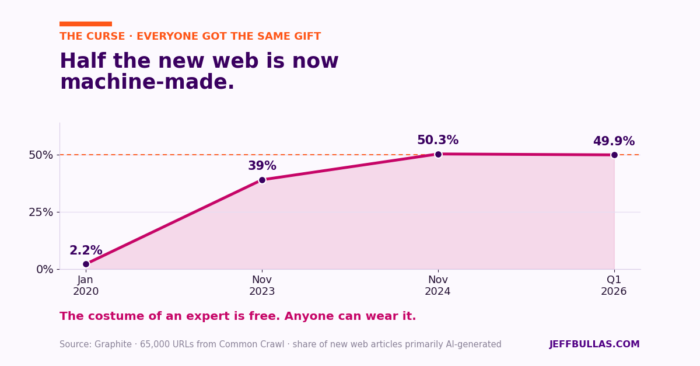
The widespread accessibility of AI presents a critical, often unacknowledged, challenge. The same four gifts were bestowed upon everyone simultaneously, creating an immediate and substantial influx of individuals entering previously exclusive arenas. The ease of creation has led to an exponential increase in content generation. For instance, in January 2020, machine-generated web articles constituted a mere 2% of online content. By late 2024, this figure has surpassed 50%, indicating a dramatic shift in content production. This "arithmetic of ease" means that while the barriers to entry have vanished, the competition has intensified significantly. The costume of expertise, once the preserve of the few, is now readily available to all.
The True Adversary: Not the Machine, but Difficulty Itself
The real "villain" in this narrative is not Artificial Intelligence, but the historical reliance on difficulty as a gatekeeper. For years, the inherent complexity of tasks served as a protective moat, deterring widespread participation. The author’s own experience launching a blog in 2009, initially perceived as simple, was a technical ordeal. This difficulty, while challenging, also served a protective function, limiting competition. AI has effectively drained this moat, not only for established players but also for the millions who now possess the tools to enter formerly protected domains. The trade-off, unadvertised, is that while the tools are democratized, so too is the traffic and competition.
The Price of Passage: Stepping Through the Door
The act of walking through a new door, as experienced by the author on three significant occasions, invariably involves a price. At 17, leaving home for college entailed fear and uncertainty. At 27, departing a deeply ingrained religious upbringing cost more, involving the difficult conversations with loved ones and the fear of ostracization. While this fear of rejection was ultimately unfounded, the necessity of leaving a confining "room" was paramount. At 52, the decision to leave traditional employment and become one’s own boss, embarking on a writing career, demanded years of early mornings, financial uncertainty, and constant anxiety.
This price—the fear, the anxiety, the investment of time and resources without guarantee of success—is rarely highlighted when dreams are promoted. However, the reward for paying this price is profound: the freedom to grow, the liberty to stumble and learn from missteps, and a powerful internal drive that transcends mere discipline. This intrinsic motivation, born from the act of choosing the door, is something AI cannot replicate. It can provide the skills, speed, and finished product, but it cannot bestow the fundamental "why" behind one’s endeavors.
AI’s Limitations: Collapsing the Doing, Not the Deciding
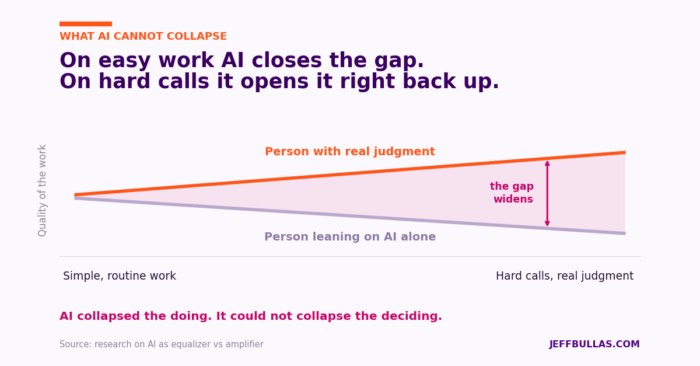
While AI excels at automating and streamlining routine tasks, bridging the gap between beginners and experts in these areas, its efficacy diminishes when faced with nuanced judgment. In complex decision-making scenarios requiring taste, context, and critical evaluation, the gap between novice and expert reopens. AI acts as an amplifier for those who already possess these qualities, rather than an equalizer.
AI has collapsed the doing, but it has not collapsed the deciding.
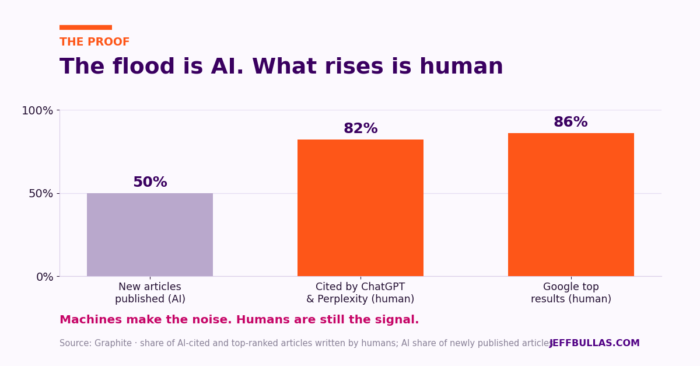
The market’s response reflects this distinction. While approximately half of new online articles are now machine-generated, a significant majority of content ranking highly in search engines (86%) and cited by AI tools (82%) is human-authored. This data suggests that while AI can generate volume, human-created content continues to represent the signal amidst the noise.
The Future of Authority: Building Trust in an AI-Saturated World
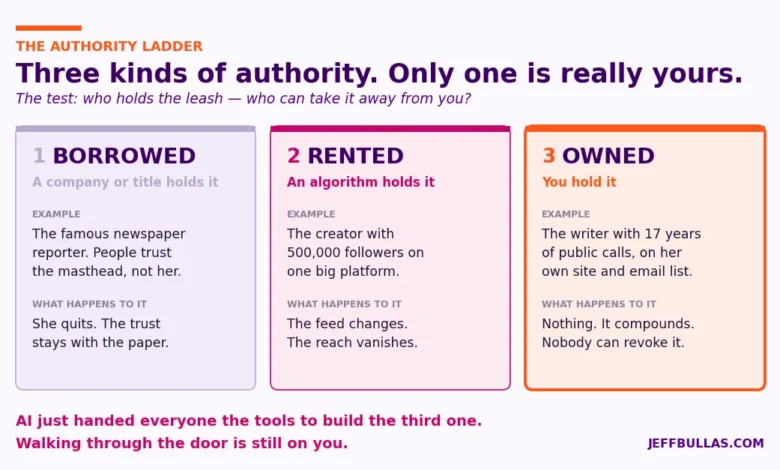
If the ability to simply "produce" is no longer the ultimate prize, what then becomes valuable? The answer lies in the creation of a public record of judgment that people learn to trust. True authority in the modern era is not derived from titles or borrowed credentials but from earned trust. This is particularly relevant as global trust in institutions wanes, with significant percentages of the population expressing concerns about deliberate misinformation from officials, leaders, and journalists. When institutional titles lose their inherent credibility, trust must be rebuilt on a person-to-person basis.
The Pillars of Owned Authority
Owned authority, the only form that cannot be easily replicated, faked, or revoked, is built upon five fundamental pillars:
- Content: Consistently delivering valuable and insightful material.
- Community: Fostering a loyal and engaged audience.
- Curiosity: Maintaining an insatiable desire to learn and explore.
- Credibility: Building a reputation for honesty and integrity.
- Continuity: Demonstrating unwavering commitment and persistence.
The Authority Loop: A Cycle of Growth
Building and maintaining owned authority is an ongoing process, a loop that involves:
- Learning: Continuously acquiring new knowledge and skills.
- Listening: Paying close attention to audience feedback and market trends.
- Leveraging: Applying learned knowledge and feedback effectively.
- Leading: Guiding and influencing the community.
- Longevity: Committing to the long-term vision and consistent effort.
The final step, "Longevity," is often the most neglected, yet it represents the cheapest and most unclaimed path to distinct authority in an era of readily available AI tools.
Beyond the Answer: The Value of Thinking
The author’s journey underscores that the true value lies not in providing instant answers, which AI excels at, but in the process of thinking. Readers connect with the visible struggle of understanding, not merely with polished performance. AI can deliver an answer in moments, but it cannot replicate a lifetime of earned judgment, a quality forged through persistent effort and risk-taking.
The Unassailable Trail
We stand at a precipice. The tools are free, the barriers have fallen, and the initial rooms are now crowded. What remains, and what cannot be copied, faked, or revoked, is the unique trail left by an individual who consistently learned, took risks, and spoke truthfully in public, thereby building an irrefutable foundation of trust. AI has opened the door for everyone. The courageous act of walking through it, and the journey that ensues, remains a deeply personal responsibility. The pertinent question for each individual is no longer what excuses remain, but rather: "What room am I still standing in?"