The SaaSpocalypse: How Anthropic’s AI Agents Triggered a $285 Billion Software Stock Plunge and Unlocked a New Era for Entrepreneurs

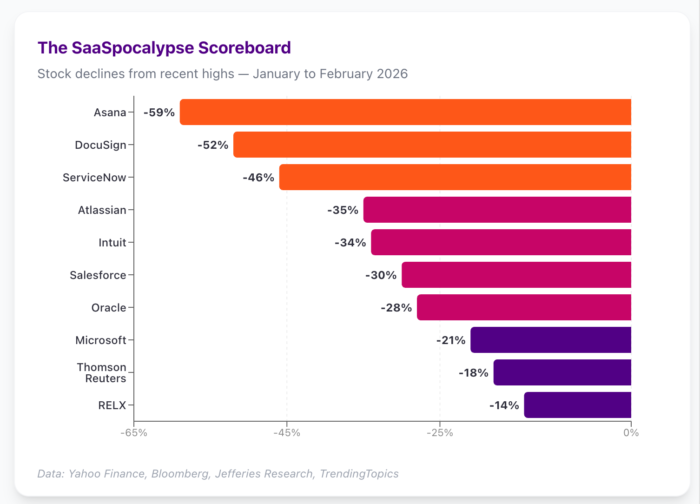
On February 3rd, 2026, global software markets experienced a seismic shock, with an estimated $285 billion in market value vanishing in a single trading session. This unprecedented downturn, swiftly dubbed the "SaaSpocalypse" by Wall Street, saw established software giants endure staggering losses. Atlassian plummeted 35% within a week, while Intuit shed 34%. Salesforce hit a 52-week low, and Oracle’s valuation was nearly halved from its October highs. Asana’s precipitous 59% decline over twelve months left it a staggering 92% below its all-time peak.
The catalyst for this dramatic market correction was a seemingly routine product update from AI company Anthropic. The announcement detailed a new feature for their chatbot, "Claude," named "CoWork," which promised to integrate plugins capable of executing a vast array of core business processes. This development signaled a fundamental shift in how businesses could operate, directly challenging the traditional Software-as-a-Service (SaaS) model that has dominated the tech landscape for two decades.
The Genesis of the "SaaSpocalypse": Claude CoWork and its Plugin Ecosystem
Claude CoWork is designed to empower AI agents to autonomously manage and execute entire business workflows. Anthropic launched the platform with an initial suite of eleven plugins, covering critical business functions such as sales, legal review, financial analysis, and marketing campaigns. These plugins are designed to automate tasks that historically required expensive software licenses and specialized human expertise, drastically compressing the time and resources needed to bring an idea from conception to market. The integration of a WordPress plugin further democratized the process, allowing for the rapid creation of websites directly from an idea.

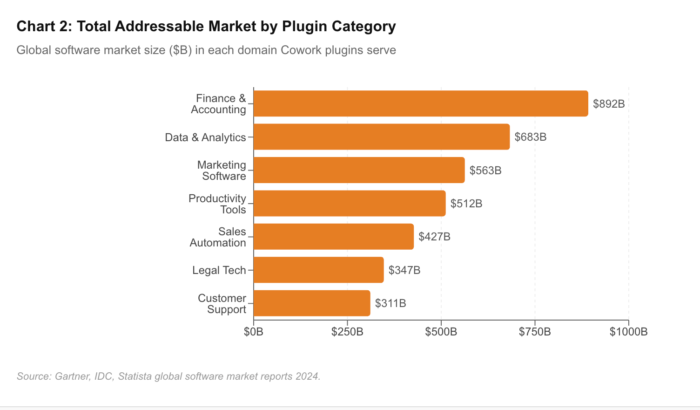
This "plugin economy" for AI agents is poised to be significantly larger than initial market analyses suggest. The eleven foundational plugins launched by Anthropic are not the destination, but rather the starting point for a new wave of innovation. This moment mirrors the early days of platform revolutions, reminiscent of the Apple App Store’s launch, where early builders on an open infrastructure stand to gain substantial opportunities.
The initial eleven plugins reportedly include functionalities for:
- Sales: Automating lead generation, CRM management, and sales outreach.
- Legal Review: Analyzing contracts, identifying risks, and ensuring compliance.
- Financial Analysis: Performing market research, generating financial reports, and forecasting.
- Marketing Campaigns: Developing ad copy, managing social media, and analyzing campaign performance.
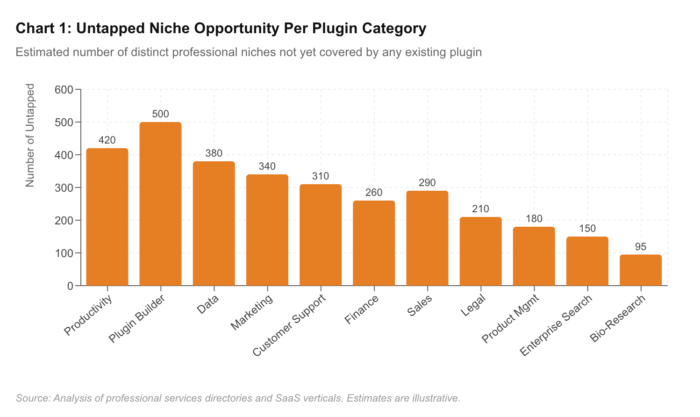
The scope of untapped opportunities is immense. Industries yet to be addressed by Anthropic’s plugins represent fertile ground for new startups and specialized services. Sectors like real estate, professional coaching, course creation, podcast production, e-commerce, and short-term rental management are ripe for AI-driven automation. Crucially, the development of these plugins does not require traditional coding expertise. Plugins are reportedly built using markdown, a plain text format that defines the AI’s operational logic. This accessibility lowers the barrier to entry for entrepreneurs and domain experts to create solutions tailored to specific industry needs.
Historical Parallels: WordPress and the App Store Revolution
The emergence of the Claude CoWork plugin ecosystem draws striking parallels to previous technological inflection points that reshaped industries and created immense wealth.
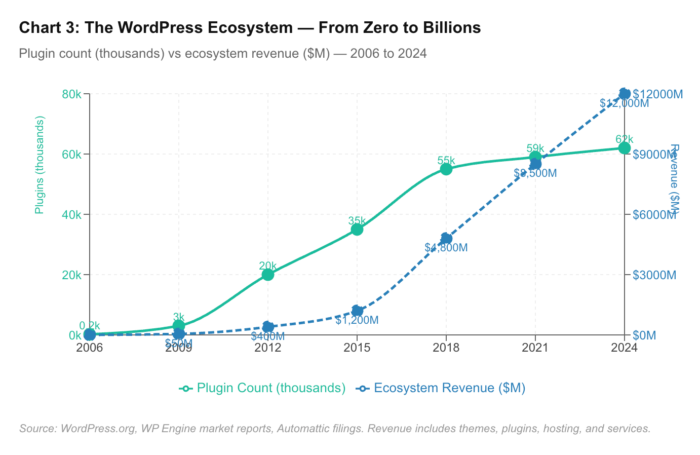
In 2005, WordPress launched as a free, open-source blogging platform. While many saw it as a tool for writers, a more forward-thinking segment recognized its potential as an infrastructure play. This led to the development of a vast ecosystem of themes and plugins, fostering independent wealth creation and ultimately powering over 40% of the world’s websites by 2024. The growth trajectory of the WordPress plugin marketplace, from its nascent stages to a multi-billion dollar industry, serves as a powerful indicator of the potential scale for AI-driven plugin economies.
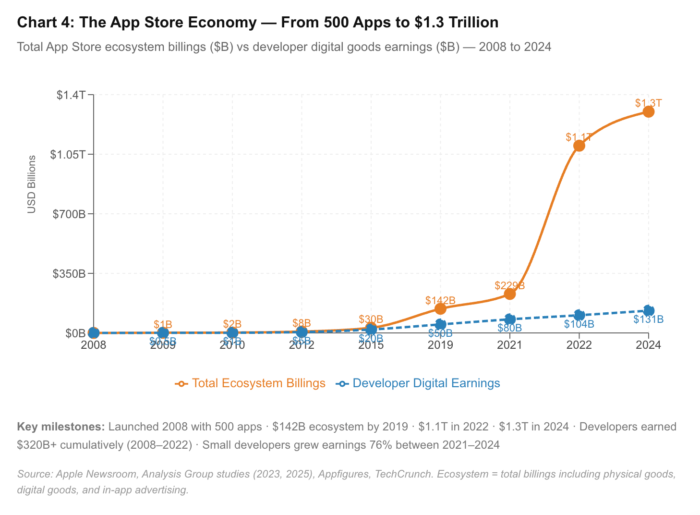
Similarly, the launch of the Apple App Store on July 10, 2008, with an initial 500 applications, marked another transformative moment. While many users focused on games and casual apps, a dedicated group of developers grasped the profound implications of building on a new platform. This foresight led to the creation of innovative applications that reshaped software distribution and consumption, generating significant fortunes for early movers within a decade. The App Store’s evolution, from its initial offerings to a marketplace generating hundreds of billions in developer revenue, underscores the economic power of open platforms and accessible development tools.
The "SaaSpocalypse": Anatomy of a Market Correction
The dramatic stock market reaction on February 3rd, 2026, was not an isolated event but a direct consequence of the perceived disruption posed by Anthropic’s Claude CoWork. The core assumption underpinning the SaaS model for the past twenty years was that software required human operators. Businesses paid on a per-seat basis, with revenue directly tied to the number of employees using a particular software suite. This model fueled the growth of companies like Salesforce, Atlassian, and Intuit, which built their valuations on the premise of widespread enterprise adoption and recurring subscription revenue.
Claude CoWork’s ability to deploy AI agents that can autonomously perform the functions of multiple human users shattered this paradigm. Instead of a team of ten employees using a CRM, a single AI agent could potentially manage the entire sales pipeline. Similarly, an AI could handle the bookkeeping and tax filing tasks previously performed by an accounting department. This shift fundamentally alters the value proposition for software providers. The question for businesses has moved from "How many employees will use this?" to "How many tasks can this AI complete?"
This existential threat to the per-seat revenue model sent shockwaves through the investment community. Analysts from firms like Morgan Stanley began warning of the end of "easy growth" for SaaS companies, as their traditional business models faced obsolescence. The market’s reaction was swift and severe, with investors re-evaluating the future earnings potential of companies whose growth was predicated on a model that AI agents now threatened to dismantle.
The Emerging Landscape: Opportunities in the Wake of Disruption
While the "SaaSpocalypse" inflicted significant pain on public markets, it simultaneously illuminated a vast and unprecedented opportunity for entrepreneurs, digital creators, and aspiring side-hustlers. The cost of execution has plummeted, and the time required to bring an idea to market has been drastically compressed. The value of strategic insight and domain expertise has skyrocketed.
The Great Equalizer: Empowering the Solo Operator
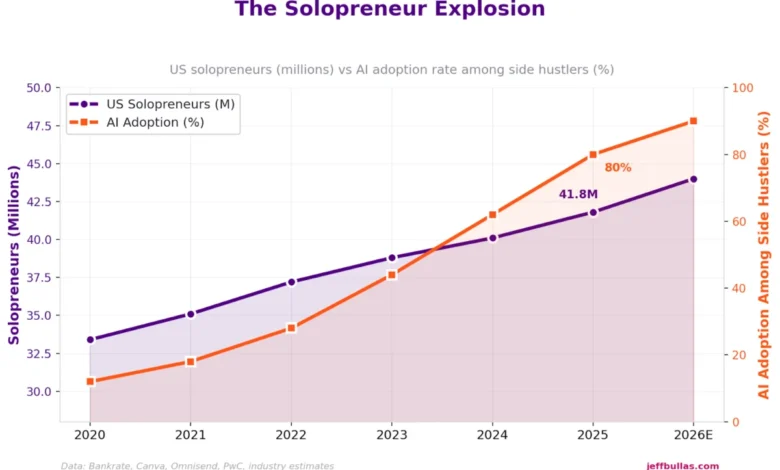
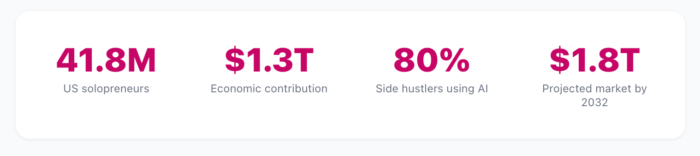
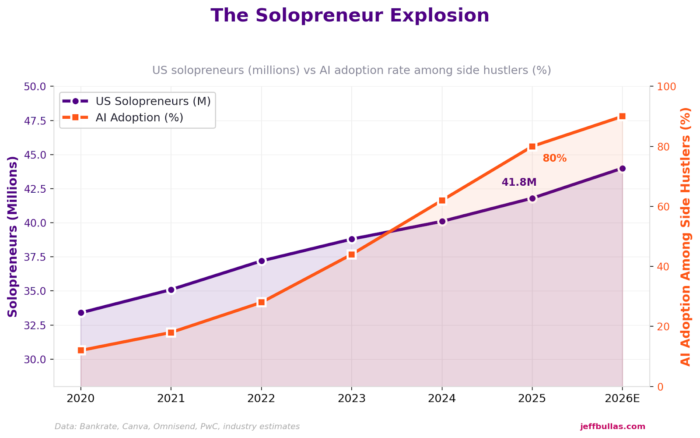
For the first time in history, an individual entrepreneur with a laptop possesses the operational capabilities that once required a well-funded startup with a sizable team. AI agents can now manage marketing campaigns, draft copy, conduct A/B testing, analyze data, research prospects, handle sales outreach, review legal documents, and perform financial analysis. The infrastructure cost of launching a legitimate business, not just a hobby, has been reduced by an order of magnitude. This democratization of operational power is already evident in the freelance market, where AI automation consultants command high hourly rates, and specialized AI consulting services are in demand.
Closing the "Execution Gap": From Idea to Launch
Historically, the biggest hurdle for aspiring entrepreneurs has been execution, not ideation. The inability to afford developers, designers, marketing teams, or operations managers meant that brilliant ideas often remained dormant. Claude CoWork and its burgeoning plugin ecosystem are rapidly closing this gap. AI agents can now scaffold entire projects, from business plan generation and landing page creation to email sequence development and financial modeling. While human judgment and taste remain indispensable, AI can now provide a robust foundation for launching, testing, and iterating at a pace previously unimaginable. Industry experts project that by 2026, AI capabilities will enable solopreneurs to build businesses with revenues in the six and seven figures, a significant increase from previous years.
The Birth of New Industries and Services
The collapse of execution costs invariably leads to the emergence of entirely new business categories. We are already witnessing the rise of AI automation consultants generating substantial monthly incomes by serving small businesses. Local enterprises are investing in AI chatbot implementations to reduce no-shows and automate lead qualification. Practitioners of AI-powered data analysis are reporting significant income streams by packaging these capabilities into client-facing services. The true opportunity lies not in AI itself, but in the translation layer between AI’s capabilities and the specific needs of customers. This requires human empathy, domain knowledge, and contextual understanding – skills that transcend technical proficiency.
Navigating the Risks: Potential Pitfalls in the AI Era
Despite the immense promise, the rapid advancement of AI also presents significant risks that entrepreneurs must navigate carefully.
The Race to the Bottom: Commoditization and Value Erosion
When AI tools become widely accessible, the commoditization of certain tasks becomes inevitable. Skills such as basic content creation, simple design, and routine coding will face intense competition from AI, potentially devaluing human labor focused solely on task execution. The median income for side hustles may stagnate or even decline as the market becomes saturated with AI-generated output.
The Authenticity Crisis: Reclaiming Trust in a Noisy Landscape
The ability of AI to generate vast quantities of content, designs, and code risks creating an information overload. Audiences may become desensitized, leading to an erosion of trust and a diminished signal-to-noise ratio. In this environment, human authenticity, originality, and taste will become crucial differentiators, but these qualities are often more challenging to cultivate and demonstrate than technical skills.
The Dependency Trap: Navigating Platform Risks
Businesses built on AI platforms are inherently reliant on those platforms’ stability and terms of service. Fluctuations in API pricing, feature deprecation, or unexpected model updates can disrupt workflows and impact profitability. Entrepreneurs must be mindful of vendor lock-in and the potential for unforeseen shifts in the AI ecosystem’s economics.
The Displacement Dilemma: Societal Impact of Automation
The efficiency gains offered by AI agents will inevitably lead to job displacement across various sectors. Gartner forecasts a significant increase in agentic AI adoption within enterprise software, potentially eliminating roles in administration, junior analysis, and entry-level positions. This societal challenge, often overlooked in discussions of AI-driven opportunities, requires careful consideration and proactive strategies for workforce adaptation.
Industries Undergoing Transformation
The "SaaSpocalypse" highlighted specific industries particularly vulnerable to AI agent disruption, which simultaneously represent areas of significant opportunity for agile entrepreneurs.
- Legal Services: Companies like Thomson Reuters and RELX experienced notable declines as AI agents demonstrated capabilities in contract review, compliance tracking, and document analysis, challenging the traditional reliance on expensive legal software subscriptions.
- Financial Services and Accounting: Intuit’s substantial drop reflects investor concerns that AI agents can autonomously handle bookkeeping and tax filing, potentially reducing demand for traditional accounting software and services.
- Sales and CRM: Salesforce’s significant market value erosion signals a realization that AI agents can manage entire sales pipelines, undermining the per-seat revenue model that supports a multi-billion dollar industry.
- Project Management and Collaboration: Atlassian’s sharp decline suggests that custom AI solutions, potentially built using tools like Claude Code, could bypass established platforms like Jira and Confluence.
- Marketing and Content Technology: Advertising giants like Publicis, WPP, and Omnicom saw their valuations impacted as AI agents demonstrated the ability to execute end-to-end marketing campaigns, shifting value from tools to strategic insight, which knowledgeable solo operators can now offer.
For entrepreneurs, these disrupted industries represent clear gaps where AI capabilities can be integrated to serve specific customer needs, often without the need for substantial venture capital.
The True Opportunity: Clarity Over Quantity
A common misinterpretation of the current AI revolution is the focus on simply producing more. While AI excels at increasing output, the real bottleneck has shifted from production to clarity. The ability to discern what to build, whom to serve, and why it matters is now the paramount competitive advantage. The individuals who will thrive are not necessarily the most skilled prompt engineers, but those possessing a profound understanding of their unique strengths, their audience’s needs, and the specific problems that warrant solving. They are the ones who can answer the question that no AI can: "What is mine to do?"
In an economy where execution is increasingly frictionless, this question of purpose and focus becomes the most valuable strategic asset.
Strategic Imperatives for Entrepreneurs in the AI Era
For entrepreneurs, creators, and aspiring side-hustlers observing the SaaSpocalypse, a clear strategic path is emerging:
- Prioritize Clarity Over Tools: Before adopting any AI platform, gain absolute clarity on the problem being solved and the target audience. Tools are becoming commoditized; deep audience understanding is not.
- Specialize and Deepen Expertise: Successful AI-powered side hustles are often built by specialists who focus on a specific industry, problem, or customer segment, providing exceptional value within that niche.
- Leverage Existing Experience: Decades of professional experience, pattern recognition, and domain knowledge represent a significant competitive advantage in the AI age. This "moat" is not replicable by AI models.
- Act with Urgency, Build for Longevity: The window for early movers in AI-powered services is open but narrowing. Establishing expertise and client relationships now will create compounding advantages as the market matures.
Conclusion: The Migration of Value
The SaaSpocalypse was not an end to software but a fundamental restructuring of its value chain. Power is shifting from tool creators to tool users, and from platform owners to individuals with the vision and courage to build meaningful solutions. The $285 billion in market value that evaporated on February 3rd, 2026, did not disappear; it migrated. This value is now available to be captured by entrepreneurs who recognize that in an era where AI can build almost anything, the ultimate competitive advantage lies in knowing precisely what is worth building. The question for aspiring builders is whether they will be the ones to seize this transformative opportunity.