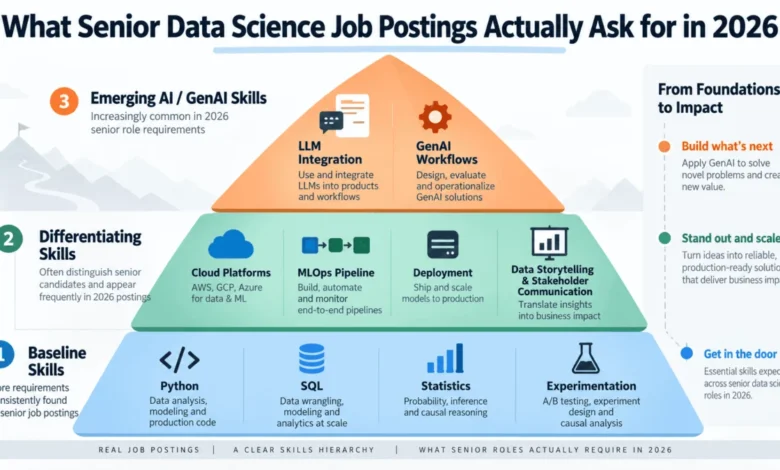
The employment landscape for data science professionals has undergone a profound structural transformation over the past twenty-four months, marked by a decisive shift away from theoretical modeling and toward full-lifecycle production capabilities. Recent analyses of thousands of active U.S. recruitment listings—compiled from major employment platforms including LinkedIn, Indeed, and Glassdoor, alongside comprehensive labour market trackers such as Axial Search—reveal a persistent disconnect between candidate expectations and the rigorous demands of hiring managers. This divergence is particularly pronounced at the senior level, where technical requirements have evolved more rapidly since 2024 than during the preceding five years combined.
Background context indicates that the maturation of automated machine learning tools and the rapid enterprise integration of generative artificial intelligence have permanently altered corporate recruitment strategies. Where organizations previously sought specialists capable of constructing isolated predictive models within localized Jupyter notebooks, contemporary enterprises now demand robust, scalable, production-grade technical depth. Recruitment metrics from early 2026 demonstrate that entry-level opportunities have contracted significantly, leaving mid-level and senior roles to dominate the market as firms prioritize proven deployment experience and demonstrable business acumen.
Core Technical Competencies and Market Baselines
An examination of baseline requirements across tens of thousands of postings underscores that competencies once categorized as advanced have become mandatory prerequisites. Python remains the preeminent programming language, cited in approximately 74 percent of all data science listings. However, expectations surrounding Python have sharpened considerably. Basic data manipulation libraries like pandas are no longer sufficient; senior positions routinely mandate fluency in scikit-learn for machine learning pipelines, PyTorch or TensorFlow for deep learning applications, and FastAPI or Flask for model deployment. Furthermore, integrations involving LangChain and LlamaIndex have rapidly entered the standard technical repertoire.
Structured Query Language (SQL) maintains a critical presence, appearing in roughly 64 percent of all listings and scaling higher within senior cohorts. Basic querying is routinely dismissed in favour of advanced analytical capabilities, including complex window functions (ROW_NUMBER, RANK, LAG, and LEAD), nested subqueries, execution plan optimization, and cloud-native variants such as Google BigQuery SQL, Snowflake SQL, and Amazon Redshift SQL. Similarly, machine learning requirements appear in 69 percent of postings, with a decisive operational pivot toward MLOps, feature engineering, and model interpretability frameworks like SHAP and LIME, particularly within heavily regulated sectors such as finance and healthcare.
Chronological Evolution of Cloud and Generative AI Integration
The acceleration of cloud infrastructure and generative AI adoption forms the backbone of the 2026 hiring cycle. Cloud platform fluency is explicitly demanded in 62 percent of analyzed postings, led by Microsoft Azure at 28.5 percent, Amazon Web Services (AWS) at 19.7 percent, Google Cloud Platform at 14.2 percent, Snowflake at 11.8 percent, and Databricks at 9.3 percent. Senior recruitment filters frequently mandate specific cloud certifications—such as the AWS Certified Machine Learning Specialty or Azure Data Scientist Associate—which routinely correlate with elevated compensation brackets.
Concurrently, generative AI and Large Language Model (LLM) competencies have surged from near-zero visibility in 2023 to explicit inclusion in 31 percent of early 2026 postings. Broad market analyses indicate that AI skills now appear in roughly two-thirds of all data science advertisements, with an overwhelming concentration in mid-level (43 percent) and senior-level (30 percent) positions. Enterprise recruitment data highlights specific demands for Retrieval-Augmented Generation (RAG), multi-agent systems, model fine-tuning, and end-to-end agentic architecture. Major industry players, including financial institutions and consultancy firms, regularly post specialized mandates requiring direct experience in architecting complex AI systems that interface directly with enterprise data pipelines.
Industry Statements and Recruitment Implications
Hiring managers and industry educators emphasize that technical execution and contextual adaptability now outweigh isolated theoretical expertise. Vinod Chugani, an artificial intelligence and data science educator, notes that the modern market heavily rewards practitioners who successfully bridge emerging AI technologies with tangible business outcomes. According to industry observations, foundational statistical knowledge—covering probability theory, Bayesian statistics, hypothesis design, and rigorous A/B testing—serves as a vital differentiator, ensuring that senior professionals can accurately evaluate model reliability amidst widespread automation.
Furthermore, traditional educational credentials continue to occupy a complex tier within recruitment criteria. While approximately 93 percent of data science positions maintain a degree requirement—with master’s degrees demanded in roughly 30 percent of listings and PhD preferences holding steady between 26 and 35 percent depending on the sector—industry consensus increasingly favors demonstrable execution. GitHub repositories containing fully realized, production-ready projects frequently carry more weight during technical screenings than extensive certification lists, provided candidates can successfully communicate complex quantitative insights to non-technical stakeholders.
Broader Industry Distribution and Economic Impact
Geographic and sector distributions reveal that traditional technology monopolies no longer dictate the volume of data science recruitment. Empirical analysis indicates that between 85 and 88 percent of active data science openings originate outside of major tech platforms. Technology and engineering sectors account for 28.2 percent of postings, followed closely by human resources and staffing (19 percent), health and life sciences (13 percent), financial and professional services (10 percent), and manufacturing (8.7 percent).
Healthcare has emerged as a premier growth vertical for advanced analytical talent, while financial services remain a leading sector for total compensation. Regional enterprises, traditional banking institutions, and healthcare systems undergoing digital transformation now generate the vast majority of senior vacancies. This broader economic dispersal provides experienced practitioners with diverse opportunities outside traditional technology hubs, rewarding those who combine rigorous MLOps capabilities with strategic cross-functional communication and targeted business problem-framing.