The global landscape of artificial intelligence education is currently undergoing a radical transformation, shifting away from high-cost, exclusive institutional degrees toward a decentralized, open-source model. As the demand for AI proficiency accelerates across every sector of the economy—from quantitative finance to healthcare—the primary challenge for aspiring engineers is no longer the availability of information, but the navigation of it. In an era where "AI bootcamps" often charge thousands of dollars for introductory concepts, a new standard has emerged: the most rigorous and industry-respected curricula are now being offered for free by the very organizations and individuals pioneering the frontier of the technology.
This shift comes at a critical juncture. According to recent labor market analyses, the "AI talent gap" remains one of the most significant hurdles to global economic productivity. However, hiring managers are increasingly prioritizing demonstrable technical skills and project portfolios over traditional academic credentials. For professionals with a foundational grasp of Python, the path to becoming a proficient AI practitioner is now paved with high-quality, zero-cost resources that bridge the gap between theoretical mathematics and production-level engineering.
The Strategic Shift in AI Pedagogy
The evolution of AI education has moved through three distinct phases. Initially, AI was the exclusive domain of PhD-level researchers focused on symbolic logic and abstract mathematics. The second phase saw the rise of Massive Open Online Courses (MOOCs) which, while accessible, often remained stuck in a "bottom-up" approach that prioritized calculus and linear algebra for months before a student ever wrote a line of code. The current third phase, characterized by "top-down" and "first-principles" learning, emphasizes immediate implementation and the deconstruction of complex frameworks.
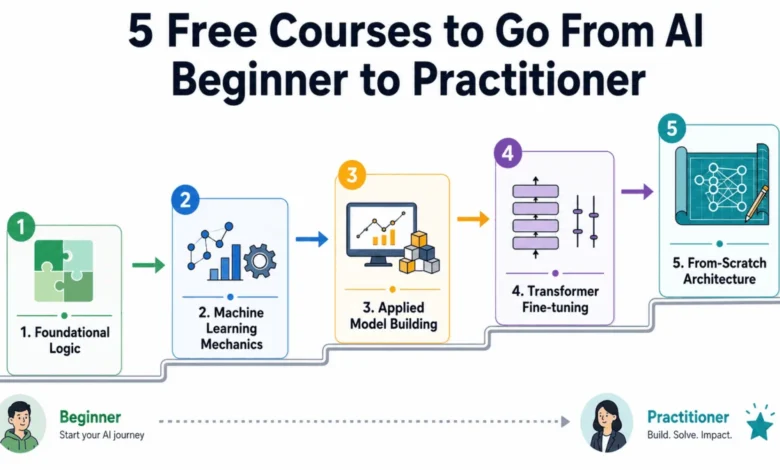
This pedagogical shift is reflected in the curated roadmap of five essential courses. By following this sequence, learners move from the logical foundations of intelligence to the mechanical realities of machine learning, through the practicalities of deep learning and natural language processing, and finally to the granular architecture of large language models (LLMs).
Phase I: Establishing the Logical Framework with Harvard University
The journey toward AI proficiency begins not with neural networks, but with the fundamental logic of computer science and heuristic problem-solving. Harvard University’s CS50: Introduction to Artificial Intelligence with Python has become the gold standard for this foundational layer. Led by Professor David J. Malan and Brian Yu, the course is designed to transition software engineers into the mindset of an AI researcher.
Unlike many introductory courses that rely on "black-box" libraries, CS50 AI forces students to implement the underlying algorithms that powered the first several decades of AI research. This includes graph search algorithms (like A* search), adversarial search (Minimax), and probabilistic inference. By mastering these "classical" techniques, practitioners develop a mental model for how machines navigate uncertainty and make optimal decisions. Industry experts argue that skipping this foundational logic is a primary reason why many self-taught developers struggle during technical interviews at top-tier firms like Google or OpenAI, where first-principles thinking is highly valued.
Phase II: Mastering the Mechanics via Google’s Internal Curriculum
Once the logical foundation is set, the focus must shift to the modern engine of AI: Machine Learning (ML). Google’s Machine Learning Crash Course (MLCC) serves as the definitive bridge between theory and practice. Originally developed as an internal resource to upskill Google’s own engineering teams, the course was eventually open-sourced to provide a common language for the global developer community.
The MLCC is unique in its efficiency. It distills complex concepts like stochastic gradient descent, feature engineering, and regularization into interactive modules. Data from Google indicates that the course has been utilized by hundreds of thousands of developers to gain a functional understanding of TensorFlow, Google’s open-source library for machine learning. The curriculum is heavily weighted toward the practicalities of data: how to handle loss, how to interpret model performance, and how to identify bias in datasets. In a market where data integrity is often the bottleneck for AI projects, the skills gained here are indispensable.
Phase III: The Practitioner’s Leap with fast.ai
The third phase of the roadmap addresses the "implementation gap." Many learners find that even after understanding the math, they cannot build a model that solves a real-world problem. This is where fast.ai’s "Practical Deep Learning for Coders" becomes transformative. Founded by Jeremy Howard and Rachel Thomas, fast.ai operates on a revolutionary "top-down" philosophy: students train a state-of-the-art image classifier in the first lesson and spend the subsequent weeks "peeling back the onion" to understand the mechanics.
Fast.ai has garnered a cult-like following in the Silicon Valley engineering community. The course utilizes the fastai library, which sits on top of PyTorch, the industry’s most popular research framework. By focusing on "best practices" that are often omitted from academic textbooks—such as learning rate finders and data augmentation techniques—fast.ai prepares students to ship models that actually work. This course is frequently cited by practitioners as the moment they transitioned from "learning about AI" to "building with AI."
Phase IV: Navigating the Transformer Revolution with Hugging Face
In the current era of Generative AI, Natural Language Processing (NLP) has become the dominant field of study. The "Transformer" architecture, introduced by Google researchers in 2017, changed everything. To master this, learners must turn to Hugging Face, the organization often described as the "GitHub of AI."
The Hugging Face NLP Course provides a comprehensive guide to the modern AI ecosystem. It teaches practitioners how to use pre-trained models, fine-tune them on specific datasets, and deploy them to the cloud. As the industry moves away from training massive models from scratch—which can cost millions of dollars—the ability to "fine-tune" existing models like BERT, GPT, or Llama has become a highly sought-after skill. The course covers the entire pipeline, from tokenization to model evaluation, ensuring that practitioners can navigate the central hub where almost all modern AI research is shared.
Phase V: Deconstructing the Architecture with Andrej Karpathy
The final stage of the roadmap is arguably the most challenging and rewarding. Andrej Karpathy, a founding member of OpenAI and the former Director of AI at Tesla, created the "Neural Networks: Zero to Hero" series to demystify the "magic" of LLMs.
Karpathy’s approach is surgical. He leads the student through the process of building a library similar to PyTorch from scratch, and then uses that library to build a Generative Pre-trained Transformer (GPT). By removing the abstractions of modern software libraries, Karpathy exposes the "backpropagation" and "attention mechanisms" that allow AI to process language. This level of understanding separates the "tool-users" from the "architects." In a rapidly evolving field, those who understand the underlying architecture are the only ones capable of innovating when existing tools reach their limits.
Chronology and Expected Outcomes
For a dedicated learner, this five-course sequence represents a 300 to 500-hour commitment, typically spread over four to six months.
- Month 1: Focus on CS50 AI (Logic and Search).
- Month 2: Complete Google’s MLCC (Math and Mechanics).
- Month 3: Intensive study with fast.ai (Practical Deep Learning).
- Month 4: Specialized training with Hugging Face (NLP and Transformers).
- Month 5-6: Deep dive with Karpathy (LLM Architecture).
The outcome of this sequence is a portfolio of work that demonstrates a rare combination of theoretical depth and practical agility.
Market Implications and the Future of AI Hiring
The implications of this democratization are profound. As high-quality AI education becomes a "public good," the barrier to entry for the AI industry is no longer financial—it is purely a matter of discipline and cognitive effort. This trend is forcing traditional universities to rethink their value propositions, as many 18-month Master’s programs in Data Science struggle to keep pace with the rapidly updated curricula of open-source platforms like fast.ai or Hugging Face.
Furthermore, this shift is empowering a more diverse global workforce. Developers in emerging economies now have access to the same internal training materials used by engineers at Google and Tesla. This "leveling of the playing field" is expected to spark a wave of AI-driven innovation in regions that were previously excluded from the high-tech economy.
In conclusion, the path to becoming an AI practitioner in 2024 is well-defined and entirely accessible. By moving through the logical, mechanical, practical, and architectural layers of the field via these five premier resources, any programmer with sufficient dedication can reach the vanguard of the most consequential technology of the 21st century. The era of the $50,000 AI degree may not be over, but its necessity has officially vanished.