The Paradox of Experience: Why the Modern Job Market is Failing the Over-50 Workforce

The traditional resume has become a relic of a bygone era, increasingly serving as a barrier rather than a bridge for professionals over the age of 50. In a labor market obsessed with "cultural fit" and "digital natives," seasoned experts are finding their decades of accumulated knowledge labeled as a liability. Yet, an examination of recent employment trends, economic data, and the shifting landscape of corporate hiring reveals a striking irony: while automated gatekeepers continue to reject older workers, the actual market value of deep professional experience has reached an all-time high.
The ordeal of a mid-career professional applying for 700 jobs—only to be met with the standard, sterile rejection of being "overqualified"—is not an isolated incident. It is a systemic failure rooted in a recruitment infrastructure designed for speed and algorithmic efficiency rather than the nuanced assessment of human capability. For a candidate with a track record of driving tens of millions in revenue across diverse industrial cycles, the "overqualified" label functions as a catch-all dismissal. It masks underlying biases that equate age with rigidity, high salary expectations, or an inability to adapt to modern, fast-paced workflows.
The Anatomy of Institutional Ageism
The statistics surrounding age discrimination in the workplace paint a sobering picture of the current environment. According to an AARP survey conducted in early 2026, 64% of workers aged 50 and older reported having witnessed or directly experienced age-based discrimination. Perhaps more telling is that 91% of those affected viewed such bias as a common occurrence in their respective industries.

This phenomenon is corroborated by longitudinal studies from ProPublica and the Urban Institute, which indicate that more than half of American workers over the age of 50 are forced out of their long-term careers well before their planned retirement. Once displaced, these individuals face a grim reality: the duration of their unemployment is typically double that of their younger counterparts. Furthermore, a 133% year-over-year increase in mentions of ageism within corporate reviews on platforms like Glassdoor suggests that the problem is not only pervasive but increasingly visible to the public.
The systemic nature of this issue is further compounded by the rise of automated applicant tracking systems (ATS). These tools are built to filter for specific keywords and dates. When a career spans three decades, the system often cannot synthesize the depth of that experience; it can only process the chronological data, which often results in an automatic disqualification of senior candidates in favor of lower-cost, "high energy" junior hires.
The AI Shift: A Counterintuitive Economic Reality
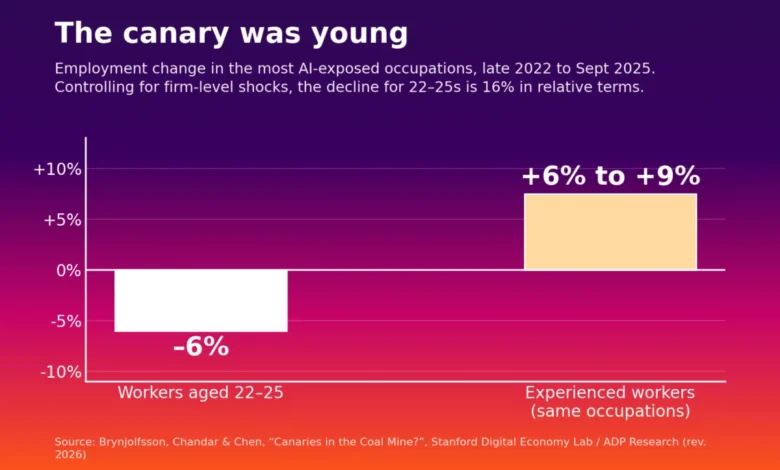
While the prevailing narrative suggests that artificial intelligence is rendering human labor obsolete, recent research from the Stanford Digital Economy Lab provides a critical counterpoint. By analyzing payroll records from ADP, researchers investigated the impact of generative AI on various roles. The findings were counter-intuitive: in occupations most exposed to AI automation, employment for workers aged 22 to 25 fell by approximately 6%—and by as much as 16% when accounting for internal company shocks.
Conversely, in those same AI-exposed fields, employment for workers with extensive experience actually rose by 6% to 9%. This data suggests that as AI handles the rote, entry-level tasks, the premium on human judgment, crisis management, and strategic oversight—skills typically acquired over decades—has increased. The market is quietly repricing experience upward, yet hiring practices have failed to keep pace with this economic shift. The "canaries in the coal mine" are not the seasoned veterans; they are the early-career workers whose foundational tasks are being subsumed by algorithmic outputs.
The Changing Landscape of Entrepreneurship and Consulting
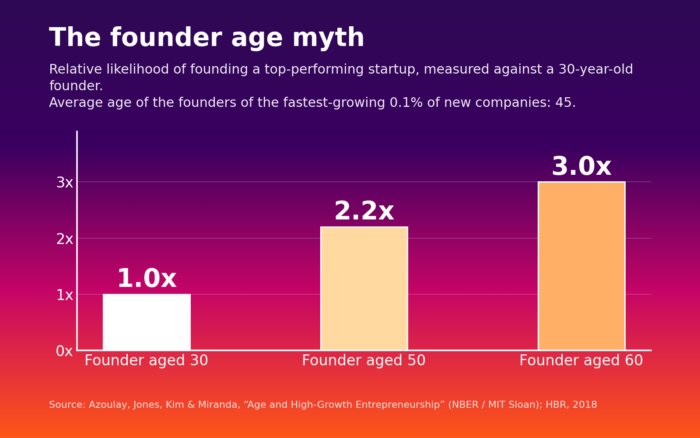
The empirical evidence supporting the efficacy of the older workforce extends beyond traditional employment. Research by Pierre Azoulay of MIT, in collaboration with colleagues at Wharton and the U.S. Census Bureau, examined 2.7 million startup founders. The results demonstrated that the average age of a successful startup founder is 45. Among the top-performing 0.1% of companies, the average age was even higher, at 46.7 years.
A 50-year-old founder is statistically 2.2 times more likely to build a top-performing company than a 30-year-old, and a 60-year-old is three times more likely to do so. This data contradicts the pervasive Silicon Valley trope of the youthful, "move fast and break things" innovator.
Additionally, the rise of the "fractional executive" market—where experienced leaders provide high-level strategy to multiple firms on a project basis—has ballooned into a $5.7 billion sector. The number of fractional leaders doubled between 2022 and 2024, rising from 60,000 to 120,000. This shift highlights that while corporations may be failing to hire senior talent in a traditional full-time capacity, they are increasingly dependent on that same talent to solve complex business problems through independent advisory roles.
The Rise of Human-Centric Content
The proliferation of AI-generated content has created a digital environment saturated with synthetic, low-value information. According to data from the SEO firm Graphite, while over 50% of new web content is now machine-generated, these articles capture a disproportionately small share of search engine rankings. Human-authored content still accounts for 86% of high-ranking results.
This signals a fundamental change in the digital economy: the flood of automated content has not buried human expertise; it has made it more visible and more scarce. Information is no longer a competitive advantage, as AI can generate frameworks and summaries at near-zero cost. What remains scarce is the "lived experience"—the ability to navigate a business from a $4 million valuation to a $50 million valuation, or to manage the fallout of a major client departure.
Strategic Recommendations for the Modern Professional
For professionals over 50, the path forward requires a departure from traditional job-seeking behaviors. The following strategic shifts are increasingly recommended by experts in career management and personal branding:
- Prioritize Publishing Over Applying: A resume is a static document that asks for permission; a body of work is a public record that demonstrates authority. Publishing insights regarding industry problems and solutions allows potential clients or employers to find the expert, rather than the expert waiting to be filtered by an algorithm.
- Focus on Specificity: Rather than summarizing a broad career, successful professionals are increasingly focusing on individual "scars"—specific, high-stakes challenges they have solved. This builds credibility and trust that AI-generated content cannot replicate.
- Targeted Thought Leadership: Research from Edelman and LinkedIn indicates that 73% of B2B decision-makers consider thought leadership a more trustworthy indicator of a company’s capabilities than its own marketing materials. Writing for a specific, defined audience—such as operators two levels below one’s own previous seniority—creates a direct line of value.
- Leverage AI for Scaffolding: Professionals should utilize AI for the structural and administrative aspects of content creation—research, formatting, and drafting headlines—while reserving the "signal" (the unique verdict, tone, and strategic insight) exclusively for themselves.
- Adopt a Long-Term Perspective: Building authority is a gradual process. Consistent, slow-paced publishing builds a cumulative record of expertise that eventually becomes an undeniable asset.
The Broader Implications
The persistent rejection of older, highly qualified workers is not merely an individual grievance; it is a macroeconomic inefficiency. When companies prioritize "culture fit"—a term often used to justify hiring people who look and think like the existing team—they lose out on the diversity of thought that comes from generational experience.
As the labor market continues to grapple with the integration of AI, the value of human judgment—that "tiller" which guides the ship, as Cicero observed two millennia ago—will only grow. The systems that currently filter out these candidates are operating on outdated assumptions. The professionals who thrive in the coming decade will be those who stop waiting for the traditional hiring system to recognize their value and instead build a public, verifiable record of their expertise. The era of the resume as the sole arbiter of professional worth is ending; the era of the practitioner’s public record has begun.
Related posts: