The rapid integration of artificial intelligence into enterprise workflows has created a paradoxical trend in corporate productivity: AI features designed to save users time often inadvertently increase their cognitive load, forcing them to spend more time auditing machine-generated output than they would have spent completing the task manually. This phenomenon, increasingly identified by product teams and human-factors researchers, highlights a critical misalignment between technical capability and user-centered design. To address this, organizations are adopting rigorous, evidence-based audit frameworks to determine exactly where AI earns its place and what specific guardrails are required to ensure that technology serves as a catalyst for efficiency rather than a source of operational friction.
The Anatomy of the Productivity Trap
A illustrative case study currently circulating in the product design community involves a large health insurance provider that attempted to streamline its benefits appeals process. The firm deployed a generative AI tool designed to draft full written determinations for specialists. On paper, the technology performed exactly as specified: it ingested case data and produced coherent, legally compliant text. However, the adoption metrics told a different story. Specialists either abandoned the tool entirely or, if they continued using it, took significantly longer to finalize a case than those who bypassed the AI.
Subsequent evaluation revealed a common pitfall: the mental energy required to carefully review and verify an AI-generated document for subtle errors is often equal to, or greater than, the effort required to draft the document from scratch. For seasoned specialists, the AI was not a productivity enhancer; it was a distraction that forced them to perform a tedious quality-assurance check on work they had already mastered. By shifting the workload from "creation" to "verification," the product team had inadvertently demoted the specialist from an expert decision-maker to a mere proofreader.
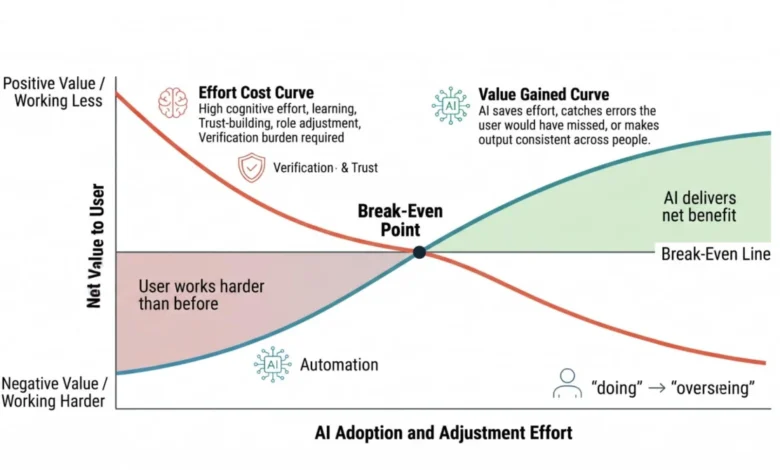
The Break-Even Line: A New Metric for AI Success
Every interface modification imposes a "cognitive tax" on the user, as they must relearn workflows and calibrate their trust in new systems. Research by cognitive scientist Nelson Cowan, whose 2001 studies on working memory suggest that human capacity is limited to roughly four items at once, underscores why these adjustments are so taxing. When an AI feature forces a user to juggle the original task, the verification of AI output, and the navigation of a new interface, the user’s mental bandwidth is quickly exhausted.
Industry experts now define the "break-even line" as the point where the utility provided by an AI feature exceeds the cognitive cost the user incurs to adjust to it. Returns to the user generally fall into three categories: error reduction, speed gains through automation of tedious sub-tasks, or the ability to synthesize vast amounts of data that would be otherwise inaccessible. If an AI feature does not clearly deliver on at least one of these, it remains below the break-even line, leaving the user worse off than they were before the implementation.
Chronology of the Redesign
Following the failure of the initial appeals tool, the insurance firm’s product team engaged in a rapid redesign process. The objective was to pivot the AI’s focus from generation to assistance.
- Phase 1: Initial Deployment. The AI was tasked with writing the entire determination. Result: Increased time-on-task and user frustration.
- Phase 2: Post-Mortem Analysis. Teams interviewed specialists to identify where the "bottleneck" actually existed. They discovered the specialists were already proficient at writing but struggled with the time-consuming search for relevant policy provisions and prior case decisions.
- Phase 3: Rescoping. The team stripped away the generative writing component. Instead, the AI was tasked with surfacing relevant policy data and historical precedents, leaving the actual writing to the specialist.
- Phase 4: Re-deployment. With the AI providing the "research" and the human providing the "synthesis," the search time dropped significantly, and the specialists felt empowered rather than sidelined.
The underlying technology remained identical, but the redistribution of labor turned a failed product into a success.
Human-Factors and Professional Identity
The impact of AI on professional identity cannot be overstated. A 2025 study led by Sophia Ackerhans examined the psychological impact of AI on physicians. The research found that when doctors were asked to merely sign off on AI-assisted decisions, they reported a significant decline in their sense of professional autonomy. Paradoxically, the more the AI explained its reasoning, the more trust increased, but so did the feeling of a threat to the physician’s role.
This research suggests that organizations must be wary of "automation bias," a well-documented psychological phenomenon where individuals defer to automated systems even when those systems are clearly incorrect. As Raja Parasuraman and Dietrich Manzey noted in their 2010 review of human factors in automation, trust in technology often climbs rapidly and subconsciously, leading users to abandon the very scrutiny necessary to catch machine-generated errors.
The Four-Question Audit Framework
To prevent costly development cycles, product teams are increasingly utilizing a four-question audit framework to evaluate features before a single line of code is written:
1. Does this reduce the total effort for the user?
Teams must count the clicks, the thinking, and the inevitable checking that the AI necessitates. If the AI merely shifts the labor—for instance, replacing typing with checking—the net gain is likely zero.

2. Does this outperform the user’s current methodology?
If a user has already developed a "practiced route" to a known answer, AI may add an unnecessary layer of interaction. AI should be reserved for tasks involving genuine ambiguity, high-volume data synthesis, or complex pattern recognition that exceeds human capacity.
3. Can the user actually catch the errors?
Visibility is key. If an error is subtle (e.g., a wrong date or a slightly misquoted policy), the user may not spot it. If an error has high consequences but low visibility, the AI feature must include "provenance" (showing the source of the data) or it should not be deployed.
4. Can the user still perform the task if the AI disappears?
Disuse leads to skill atrophy. Research in radiology, such as the 2023 experiment by Thomas Dratsch, demonstrates that even highly experienced professionals suffer a decline in diagnostic accuracy when they rely too heavily on AI-assisted tools for extended periods. Organizations must build in mechanisms—such as periodic blind reviews—to ensure human expertise remains sharp.
Broader Implications and Industry Response
The broader implications for the software industry are clear: the "pro-innovation bias"—the assumption that any new technology is inherently better—must be replaced by a culture of rigorous, skeptical evaluation. For product managers, this requires a shift in how roadmap reviews are conducted. Instead of asking "Can we build this?", teams must ask "How does this change the user’s daily reality?"
The current consensus among human-computer interaction (HCI) researchers is that the most successful AI integrations are those that operate as "force multipliers" rather than "replacements." In the context of meeting summaries, for example, the AI creates value by capturing action items that might otherwise be forgotten. Because the participants retain the ability to verify these items against the context of the meeting, the risk of error is low. Conversely, in fields like legal, medical, or insurance adjudication, the stakes of an "invisible error" are too high to allow for full automation without robust, built-in provenance.
Future Outlook
As enterprise AI matures, the competitive advantage will likely shift from companies that implement the most AI to those that implement it with the highest level of human-centered precision. The "break-even line" is not a static point; it is a moving target that requires constant monitoring of both system performance and user competency. By formalizing the audit process, organizations can ensure that their digital tools act as a scaffold for human intelligence, rather than a barrier to it. The goal remains constant: technology must facilitate the expert, not replace the expertise that makes the system function in the first place. Through careful scoping and a refusal to sacrifice long-term skill retention for short-term convenience, firms can navigate the current wave of AI integration without compromising the quality or the professional integrity of their workforce.