Microsoft introduces the Copilot harness in Foundry Agent Service to streamline enterprise AI development and deployment.

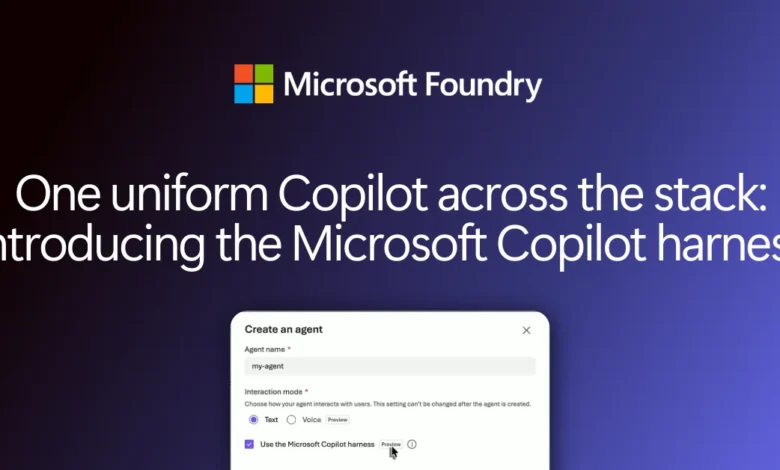
The rapid evolution of generative AI has transitioned from simple chat interfaces to complex, autonomous agents capable of reasoning and executing multi-step tasks. Recognizing that the underlying infrastructure—coordinating model calls, maintaining state, and managing tool execution—often becomes a bottleneck for development teams, Microsoft has officially launched the public preview of the Microsoft Copilot harness within its Foundry Agent Service. This strategic move aims to shift the burden of infrastructure management from developers to a unified, managed foundation, allowing engineering teams to focus on the business logic and domain expertise that define their unique applications.
The Evolution of the Agentic Workflow
In the early days of Large Language Model (LLM) integration, developers primarily focused on prompt engineering. However, as organizations seek to automate complex business processes, the requirements for AI agents have expanded significantly. A modern agent requires more than just a reasoning engine; it necessitates a robust execution environment that can handle file management, persistent memory, and the coordination of external tools.
Historically, development teams have been forced to build custom "harnesses"—the middleware that wraps the model to facilitate these operations. This redundant work consumes valuable engineering hours without necessarily adding unique value to the end product. Microsoft’s new strategy provides a shared, opinionated execution foundation that standardizes these processes across its agent ecosystem. By abstracting the orchestration layer, the Foundry Agent Service allows developers to select a preferred model while benefiting from a fully managed sandbox and execution loop.
Chronology of the Foundry Ecosystem
The release of the Copilot harness is the latest step in a broader roadmap for Microsoft’s AI infrastructure. The company’s focus on the "Foundry" platform signifies a move toward providing a cohesive development experience for AI-native applications.
- Early 2024: Microsoft began consolidating its AI tooling, moving toward a more integrated vision of "Foundry," which acts as a central hub for model selection and orchestration.
- Mid-2024: Introduction of hosted agent capabilities, providing developers with the flexibility to manage their own frameworks and runtimes while relying on Microsoft’s underlying infrastructure.
- Late 2024 (Current): The introduction of the Microsoft Copilot harness into public preview, marking a shift toward managed, high-level abstractions that reduce the overhead of custom agent development.
- December 1, 2026: The scheduled commencement of consumption-based billing for the Copilot harness runtime, following a period of free preview access.
Technical Architecture and Building Blocks
The Copilot harness functions as a managed execution system that operates on declarative definitions. By utilizing the Azure Developer CLI (azd) or the Foundry portal, developers define their agent’s behavior, skills, and tools in a structured format. This approach ensures that the agent can maintain context over long-running workflows—a common failure point in early agentic systems where state would often be lost after a single turn.
The system is built upon four primary building blocks: orchestration of model and tool calls, persistent working context management, file system access, and policy-driven execution. By offloading these tasks to the harness, the agent can reliably handle complex sequences, such as researching a market topic, analyzing data via a code interpreter, and synthesizing an evidence-backed brief, all while adhering to configured security and operational boundaries.
Resilience in Long-Running Workflows
Simultaneous with the public preview of the Copilot harness, Microsoft announced the general availability of "long-running resilience for hosted agents." This is a critical development for enterprise-grade AI. In scenarios where an agent must process large datasets or interact with third-party APIs over the course of several hours, interruptions are inevitable.
The resilience feature allows the system to detect these interruptions and automatically restart the agent’s work from the last known checkpoint. This is not a simple "undo" function; it is a sophisticated state-management system that requires the developer to define checkpoints within their application logic. By saving intermediate results, developers ensure that their agents can resume operations without redundant actions, such as re-uploading files or triggering duplicate API calls to external services.
Industry Perspectives and Practical Implementation
Early adopters of the Microsoft Foundry Agent Service have noted a significant reduction in time-to-market. Chris Evans, CTO of Confluence Technologies, reported that his team was able to deploy a functional agentic solution in less than a week, a feat he attributes to the removal of the need to build the underlying infrastructure from scratch.
Similarly, Fashable CEO Orlando Ribas Fernandes highlights the governance capabilities provided by the new harness. For firms operating in highly regulated or process-heavy industries, the ability to automate complex sourcing and negotiation workflows while maintaining human oversight is paramount. The agent acts as a facilitator, performing the heavy lifting of discovery and data analysis, while the final, commercially binding decisions remain firmly under human control.
Analytical Implications for Developers
The introduction of these tools suggests a shift in the labor market for AI engineers. As infrastructure becomes commoditized, the premium shifts toward those who can design effective "skills" and provide domain-specific knowledge to these agents. The provided example—a research-brief agent—demonstrates how a skill can be packaged, reused, and deployed across different projects, fostering a modular approach to AI development.
This tiered architecture—ranging from standard prompt agents to managed Copilot harnesses and, ultimately, fully hosted agents—allows organizations to match their technical investment to their specific needs. For simple tasks, developers can use minimal infrastructure. For mission-critical, long-running processes, they can leverage the managed reliability of the Copilot harness or the full control of hosted agents.
Economic and Strategic Outlook
The pricing model, set to trigger in December 2026, reflects a clear move toward a utility-based economic structure for AI. By billing based on vCPU-hours and GiB-hours, Microsoft is aligning the costs of agentic workflows with their actual consumption of computational resources. This transparency is vital for large-scale enterprise deployments where cost forecasting and efficiency are critical to project approval.
As the industry matures, the "harness" model is likely to become the standard for agentic AI. By reducing the "plumbing" requirements for developers, Microsoft is lowering the barrier to entry for complex AI, enabling a broader array of organizations to move beyond simple chatbots and into the realm of autonomous, task-oriented agents that drive tangible business value. The success of this strategy will depend on the continued reliability of the sandbox environments and the developer community’s ability to effectively leverage the modular "skills" architecture in diverse industrial applications.